A structured worksheet for producing an honest, non-judgmental view of a parish’s actual communications output over a specific period. Usually reveals that the output is structurally flat across the liturgical year.
Conducted by the parish secretary or a parish pastoral council (PPC) member, in a single focused afternoon, with the last four or eight weeks of parish bulletins, website posts, social media, and emails gathered in one place.
The free church SEO audit does this check for you. Free church SEO audit
THE WORKSHEET
[To be rendered as a four-page PDF, A4, with generous grid space for tallying. DOCX version for digital completion.]
PAGE 1: INTRODUCTION AND GATHERING
Parish Communications Audit
Parish of [parish name]
Conducted by: _______________________________________
Audit period (four or eight weeks recommended):
From: _______________________________________
To: _______________________________________
Date of audit: _______________________________________
What this audit is for
This audit is not a performance review of anyone. It is not a building block for a grand strategy document. It is a way of producing, in one afternoon, an honest picture of what your parish’s communications actually look like over a specific period.
Most parishes that do this for the first time are surprised by the patterns it reveals. The surprise is usually useful.
What you need before you begin
Gather the following for the audit period (usually the last four weeks; eight if you want a richer view):
- Parish bulletins (every issue from the period).
- Website posts and updates (news items, events, announcements).
- Social media posts (Facebook, Instagram, Twitter/X, whichever your parish uses).
- Email communications to parishioners (if you send any beyond the bulletin).
- Notices read aloud at Mass (if you keep a record).
- Any printed materials distributed during the period (flyers, posters, cards).
If some of these do not exist or were not recorded, that is itself a finding. Note the gap and proceed with what you have.
The posture for this audit
Do this afternoon as an observer, not a judge. You are not looking to prove anything. You are looking to see what is actually happening. Surprise and curiosity are more useful than criticism.
If you find patterns you do not like, note them without blame. The people producing parish communications, you included, have been doing the best they could with the frameworks available. The audit is how the framework changes.
Bring tea. Take your time.
PAGE 2: THE TALLY
For each week in your audit period, fill in the grid below. One row per week. If you have a longer audit period, photocopy or print additional tally sheets.
Week 1
Date range: _______________________
Total items communicated this week (across all channels): _______
Liturgical week / season: _______________________________________
Breakdown by content type (tick each item into a category):
| Content type | Count this week | |—|—| | Spiritual (homilies, reflections, saints’ days, Scripture commentary) | | | Pastoral (bereavement, baptism prep, marriage prep, RCIA, prayer requests) | | | Operational (Mass times, confession times, hall bookings, parking, building) | | | Community (SVP, social committee, youth, music, outreach, trips) | | | Financial (collections, appeals, accounts, capital projects) | | | Other (note: _______________________) | |
Any item of particular weight this week: _______________________________________
Notes on tone, rhythm, or register: _______________________________________
Week 2
Date range: _______________________
Total items communicated this week (across all channels): _______
Liturgical week / season: _______________________________________
| Content type | Count this week | |—|—| | Spiritual | | | Pastoral | | | Operational | | | Community | | | Financial | | | Other | |
Any item of particular weight this week: _______________________________________
Notes on tone, rhythm, or register: _______________________________________
Week 3
Date range: _______________________
Total items communicated this week (across all channels): _______
Liturgical week / season: _______________________________________
| Content type | Count this week | |—|—| | Spiritual | | | Pastoral | | | Operational | | | Community | | | Financial | | | Other | |
Any item of particular weight this week: _______________________________________
Notes on tone, rhythm, or register: _______________________________________
Week 4
Date range: _______________________
Total items communicated this week (across all channels): _______
Liturgical week / season: _______________________________________
| Content type | Count this week | |—|—| | Spiritual | | | Pastoral | | | Operational | | | Community | | | Financial | | | Other | |
Any item of particular weight this week: _______________________________________
Notes on tone, rhythm, or register: _______________________________________
[If using an eight-week period, continue with Weeks 5-8 on an additional page, using the same grid.]
PAGE 3: PATTERN ANALYSIS
Now that the tally is complete, step back and look at the patterns.
Volume patterns
What is our typical weekly item count? _______
How much does it vary week to week? _______________________________________
Did volume correspond to liturgical intensity? (For example, was there more in Advent and Lent, less in Ordinary Time?) _______________________________________
Content type patterns
Which of the five content kinds dominated? _______________________________________
Which was under-represented? _______________________________________
Did spiritual content rise in the high liturgical seasons? _______________________________________
Did operational content overwhelm other kinds? _______________________________________
Rhythm patterns
Were there weeks where we communicated more than the reader could reasonably absorb? _______________________________________
Were there weeks where we could have communicated less? _______________________________________
Did our communications reflect what the Church was doing liturgically? _______________________________________
Were there moments of silence that served well? _______________________________________
Were there moments of noise that did not serve? _______________________________________
Tone patterns
Was the overall tone consistent across weeks, or did it vary? _______________________________________
Did sensitive matters receive appropriately careful treatment? _______________________________________
Were there communications we sent that, on reflection, should have been held back? _______________________________________
PAGE 4: REFLECTION AND COMMITMENT
Now the most important page. This is where the audit becomes useful.
The honest question
Were we inhaling or exhaling in our communications during this period? Did our communications match the liturgical breath, or fight it?
_______________________________________
_______________________________________
_______________________________________
One thing to stop
Based on this audit, name one thing we will commit to stop communicating, starting now. Just one. Something that has become habit rather than need. Something that takes up space in the weekly flow without serving readers.
The thing we will stop: _______________________________________
Why: _______________________________________
When we will stop it: _______________________________________
One thing to start or improve
Based on this audit, name one thing we will commit to start communicating better. Again, just one. Clarity and focus matter more than a long list.
The thing we will improve: _______________________________________
How: _______________________________________
When: _______________________________________
The next audit
The audit is most useful when repeated. Most parishes benefit from running this audit once a year, at the end of the liturgical year (late November), to inform planning for the coming year.
Next audit date: _______________________________________
Who will conduct it: _______________________________________
A closing note
If the audit has revealed patterns that are uncomfortable, that is a sign of its usefulness. Almost every parish that does this audit for the first time discovers something about its own rhythm it had not noticed.
The two things to watch for, specifically:
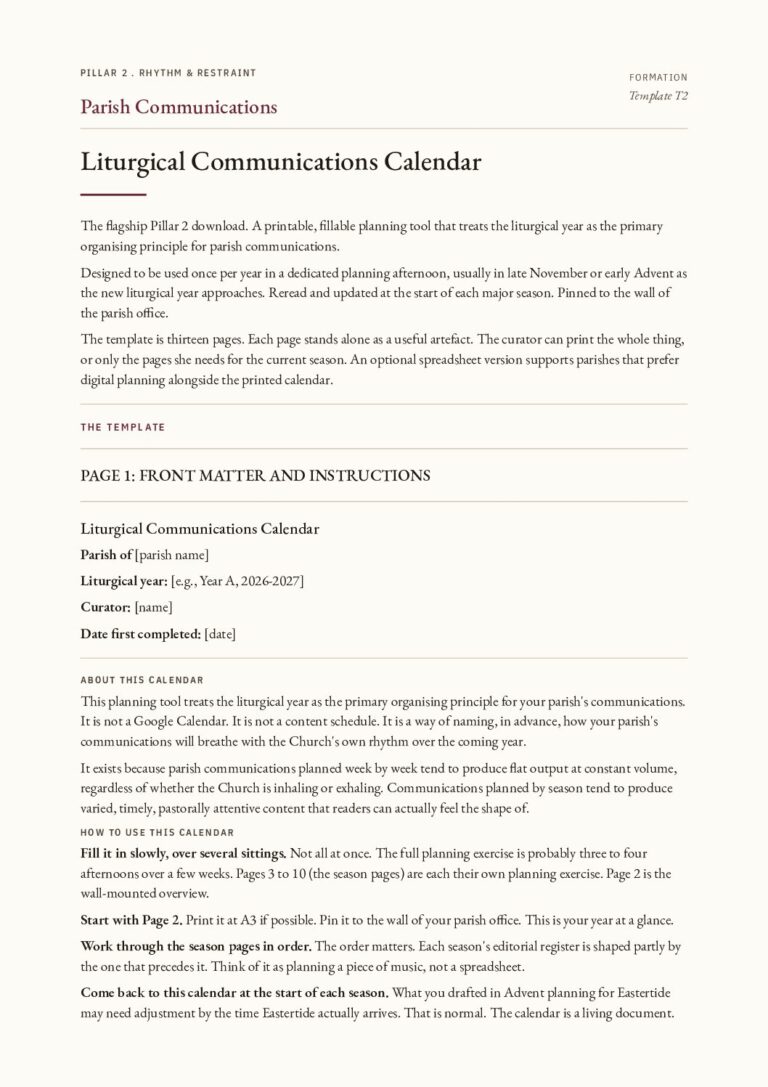
Flat volume across seasons. If you are communicating the same amount in Advent and in mid-Ordinary-Time, your communications are not breathing with the Church. The Liturgical Communications Calendar template (T2) is the planning tool that addresses this.
Dominance of one content type. If operational content is crowding out spiritual or pastoral, the parish’s voice may be functionally clear but pastorally thin. Reweighting takes time. The Editorial Vetting Checklist (T4) and the Liturgical Calendar (T2) together help a curator hold the better balance over a full year.
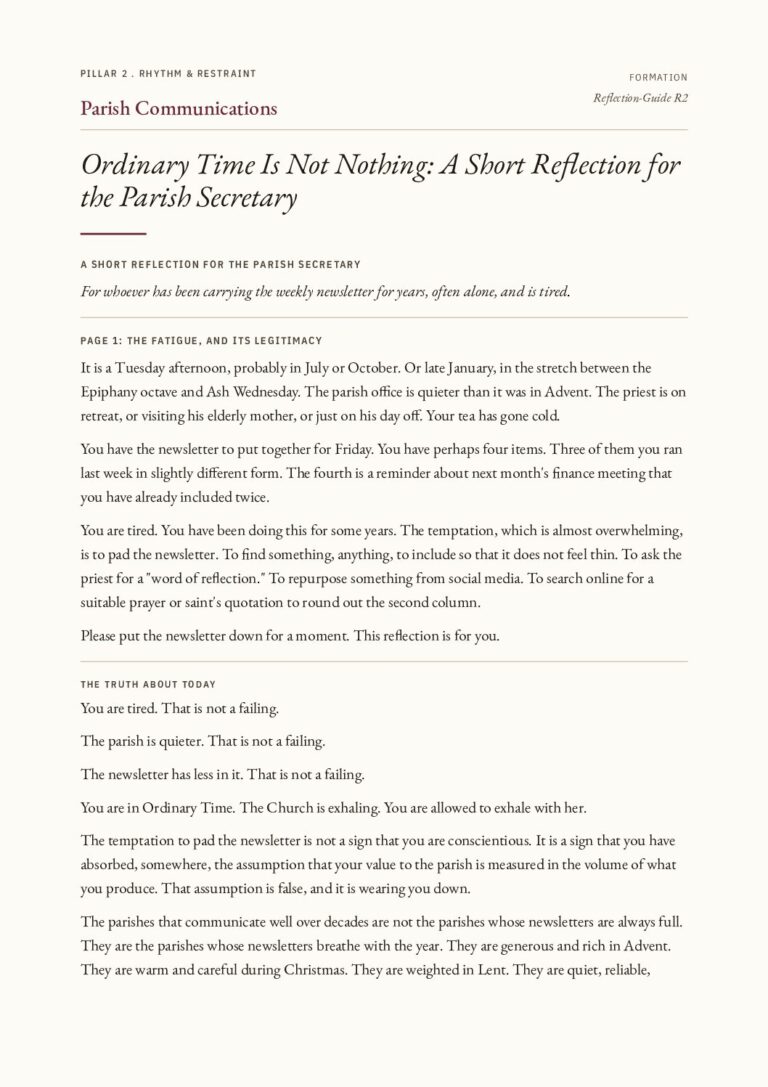
If you are the parish secretary completing this audit, and the findings are heavier than you expected, the reflection guide Ordinary Time Is Not Nothing (R2) was written for exactly this moment. Ten minutes with it, slowly, may help.
Based on the True Light Digital Formation framework. For the cornerstone essay on which this audit is based, see truelight.digital/formation/rhythm-and-restraint/.
True Light Digital publishes this worksheet as part of its free Formation library. If your parish would value support in building a wider communications system, please contact us at sean@truelight.digital. If not, we hope this worksheet serves you well on its own. That is the goal.
Download
Free, no email needed. Adapt it for your parish and hand it to the next volunteer.