A short cover note
This pack contains four documents. Together, they are enough to start a parish communications system from something like zero.
They are free. They are adaptable. They are the artifacts parishes actually need in their first season of doing this work deliberately, rather than articles about the work.
If your parish website is where this goes wrong, we build ones the office can actually run. Catholic parish websites
What is in the pack
T1. The Communications Champion role description. A one-page template to commission a named person into the curator function. Completed together, usually over tea, by the priest and the person being commissioned. When signed, it is the parish’s agreement that this work is real, supported, and not simply one more thing on a tired volunteer’s list.
T2. The Liturgical Communications Calendar. A thirteen-page working calendar organized by liturgical season rather than by calendar quarter. Advent is planned as Advent. Ordinary Time has its own pages. Holy Week has the page it deserves. The calendar is the instrument that turns weekly scrambling into seasonal rhythm.
T3. The Change Proposal Template. A two-page proposal form for any significant parish communications change. Structured so that the parish honors what already works before proposing what might change, names the pace explicitly (three liturgical seasons, not eight weeks), and invites rather than announces.
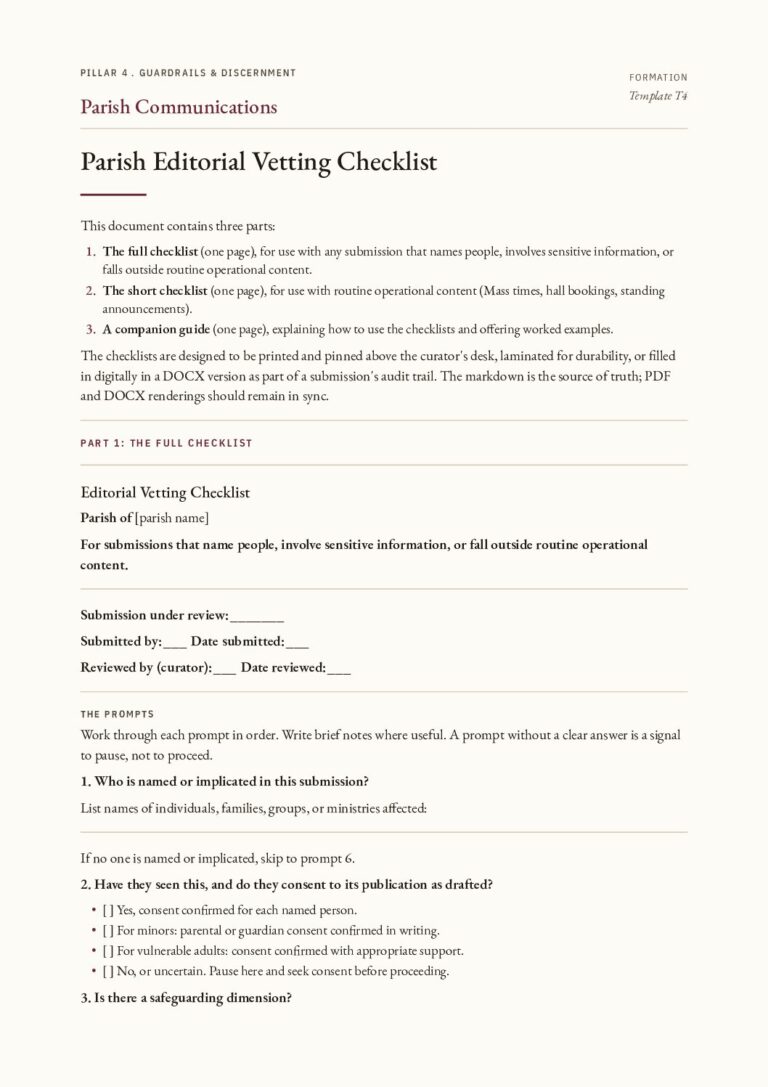
T4. The Editorial Vetting Checklist. A two-page checklist to run against any piece of content before publication. Safe Environment. Consent. Pastoral weight. Register. The pause before speech, made tractable as a list the parish secretary can actually use on a Wednesday afternoon.
How to use the pack
Not all at once.
The temptation, with four documents in hand, is to adopt all of them in a two weeks. Please do not. The pack is designed to be worked through across a liturgical year, in the following rough order.
Season one. T1 first. The commissioning conversation is the foundation. Everything else presumes a named person who is supported to do the work. Do not skip this step because it feels administrative; it is the part that makes the rest real.
Season two. T4 next. Once there is a named curator, she needs a checklist to work against. The Editorial Vetting Checklist is the smallest artifact that will most change the quality of what the parish publishes, immediately.
Season three. T2 and T3 together. The Liturgical Calendar is a seasonal planning instrument that works best once there is a curator in post and a vetting rhythm in place. The Change Proposal template is used when a larger change is being considered; it may not be needed in your first year, but it is worth having ready.
A note on what this is not
This pack is not a parish communications strategy. A strategy is a larger thing, shaped by the particular parish, its community, its gifts, and its priest’s own sense of mission. No document can supply that.
This pack is the operational scaffolding that makes a strategy livable once it exists. The scaffolding matters because good strategies without scaffolding collapse into the week-to-week. The scaffolding is, quietly, most of what parishes actually need.
If, having worked through the pack, you find that you want help thinking about the strategy itself, that is the kind of work True Light Digital does with individual parishes. It is also the kind of work that many parishes can do well on their own, given the scaffolding. The pack is free either way.
These four documents are drawn from the Formation framework. The full framework, including four cornerstone essays and further supporting resources, is free at truelight.digital/formation.