The honoring-before-proposing exercise. A structured worksheet that forces the discipline of understanding what is currently good, and naming it specifically, before any change is proposed.
Conducted by the priest, parish pastoral council (PPC) chair, or agency. Used before a change proposal is drafted. Often the work takes two to four weeks, because it requires real conversations rather than desk analysis.
If your parish website is where this goes wrong, we build ones the office can actually run. Catholic parish websites
THE WORKSHEET
[To be rendered as a five-page PDF, A4, designed for extended use across multiple conversations. DOCX version for digital completion. Clear sections that can be worked on non-linearly.]
PAGE 1: INTRODUCTION AND POSTURE
What Already Works: An Audit Before Change
Parish of [parish name]
Area being considered for change: _______________________________________
Auditor: _______________________________________
Dates of audit: From _______________ to _______________
What this audit is for
This audit is done before a change is proposed. Its purpose is not to build a case for the change. Its purpose is to understand, honestly, what is currently happening in the area being considered, and what is currently working.
Many audits conducted in this posture conclude that the proposed change is not needed, or needs to be much smaller than originally thought. That is a success outcome. The audit has done its job.
If you skip this audit and move directly to proposing a change, you will almost certainly propose badly. The change will feel top-down, will fail to honor the people currently doing the work, and will meet resistance that the proposal will not be able to answer.
Take the time.
The posture
You approach these conversations as a student, not a consultant.
- You are not looking for pain points.
- You are not trying to elicit dissatisfaction.
- You are not building evidence for a case.
You are trying to learn. The questions you ask will shape what you hear. Questions framed as “what is not working?” produce a list of complaints. Questions framed as “tell me how this works” produce understanding.
How to use this worksheet
Page 2 contains the interview guide. You will use it multiple times, one full page per person interviewed.
Pages 3 and 4 support the reflection after the interviews are complete.
Page 5 produces the output that feeds into the Change Proposal template (T3).
Allow two to four weeks between starting the audit and completing Page 5. The work cannot be rushed. Interviews need space between them. Insight needs time to settle.
PAGE 2: THE INTERVIEW GUIDE
Use one full page per person interviewed. Photocopy or print additional pages as needed.
Interview
Person being interviewed: _______________________________________
Their role or function: _______________________________________
Length of time in this work: _______________________________________
Date of interview: _______________________________________
Opening the conversation
Before the questions, set the conversation up honestly.
Example opening: “Thank you for agreeing to talk. We are thinking about whether there might be a better way to do [area of parish life], and before I propose anything, I want to understand how it actually works now, and what is good about how you have been doing it. This is not an evaluation. I am trying to learn.”
Let them respond. Their first words often reveal how they have understood being approached.
The questions
Use these as a starting point. Follow the conversation where it goes, and come back to any questions you have not asked by the end.
How long have you been doing this work? What did you inherit from whoever came before?
Notes: _______________________________________
_______________________________________
Walk me through a typical week. What do you do on Monday? On Tuesday? On Sunday after Mass?
(The texture of the actual work, not an abstract description. Listen for what they mention and what they do not.)
Notes: _______________________________________
_______________________________________
_______________________________________
What do you find yourself doing that is not in any job description?
(The invisible work. Often the most important.)
Notes: _______________________________________
_______________________________________
What do you wish more people understood about this work?
Notes: _______________________________________
_______________________________________
What works really well that you would not want to change? Be specific.
(This is the core question. If the interviewee cannot name specifics, prompt gently until she can.)
Notes: _______________________________________
_______________________________________
_______________________________________
What currently frustrates you? (Open, without leading.)
Notes: _______________________________________
_______________________________________
If you could change one thing, what would it be? (Their priority, not yours.)
Notes: _______________________________________
Who else should I talk to before I understand this properly?
Names and suggested topics: _______________________________________
_______________________________________
After the interview
Close warmly. Thank her specifically. Do not promise anything at this stage; you are still learning. If she asks what happens next, say honestly: “I am talking with several people, and then I will draft something for the parish to consider. I would like to come back to you with the draft before it goes wider. Would that be all right?”
Most people will say yes. That follow-up is what turns the audit into an invitation to shape the proposal rather than a data-gathering exercise.
PAGE 3: CROSS-CONVERSATION OBSERVATIONS
After at least three or four interviews, you will start to see patterns. This page is for recording them while they are fresh.
Patterns across interviews
What has come up repeatedly as working well?
_______________________________________
_______________________________________
_______________________________________
What has come up repeatedly as frustrating?
_______________________________________
_______________________________________
What have multiple people pointed to that you did not expect?
_______________________________________
_______________________________________
What have people specifically asked you to protect, if change happens?
_______________________________________
_______________________________________
Silences you noticed
Was there anything people seemed reluctant to talk about, or talked around?
_______________________________________
_______________________________________
Were there people who said less than you expected, or who declined to engage?
_______________________________________
_______________________________________
(Silences are data. They may indicate burnout, disagreement, distrust, or simply that the matter is not a priority for the person. Each possibility means something different.)
Surprises
What did you learn that you had not expected to learn?
_______________________________________
_______________________________________
What assumption did you hold going in that the interviews have changed?
_______________________________________
_______________________________________
PAGE 4: THE THREE-SPECIFICS REFLECTION
This page is central. After all interviews are done, and after you have noted the cross-conversation patterns on Page 3, name three specific things the current system does well. Not generic. Specific. Named. Attributable.
If you cannot fill in three specifics, the audit is not complete. Return to Page 2 and do another interview or two, asking the “what works really well” question more carefully.
Specific 1
What the specific thing is:
_______________________________________
Who is responsible for it working:
_______________________________________
Why it matters pastorally or operationally:
_______________________________________
How we would protect this if the proposed change happens:
_______________________________________
Specific 2
What the specific thing is:
_______________________________________
Who is responsible for it working:
_______________________________________
Why it matters pastorally or operationally:
_______________________________________
How we would protect this if the proposed change happens:
_______________________________________
Specific 3
What the specific thing is:
_______________________________________
Who is responsible for it working:
_______________________________________
Why it matters pastorally or operationally:
_______________________________________
How we would protect this if the proposed change happens:
_______________________________________
Note: if, having completed this page, you find yourself thinking that the proposed change is less urgent than you originally thought, that is not a problem. It is a gift. Adjust the proposal. Or set it aside for six months. Or abandon it entirely. The audit has served you.
PAGE 5: THE CARRY-FORWARD PLAN
If, after completing this audit, a change is still being proposed, this page becomes the input to Section 4 of the Change Proposal Template (T3): “How this honors what already works.”
What we will carry forward from the current system
Practices, tools, relationships, knowledge, or approaches that will be preserved as part of any change:
_______________________________________
_______________________________________
_______________________________________
Who currently carrying this work will have a named role in whatever comes next
For each person named in your interviews as carrying significant work:
Name: _______________________________________ Current role: _______________________________________ Proposed role in the new approach: _______________________________________
Name: _______________________________________ Current role: _______________________________________ Proposed role in the new approach: _______________________________________
Name: _______________________________________ Current role: _______________________________________ Proposed role in the new approach: _______________________________________
What is at risk of being lost that we commit to protect
Things worth preserving that might quietly disappear if the change is handled carelessly:
_______________________________________
_______________________________________
_______________________________________
What institutional knowledge needs to be documented before any change begins
Tacit knowledge held by specific people that, if lost, would be hard or impossible to recover. Who will document it? When?
_______________________________________
_______________________________________
_______________________________________
Your commitment
I have completed this audit honestly, and the proposal I now draft will honor what I have learned.
Signed: _______________________________________ Date: _______________
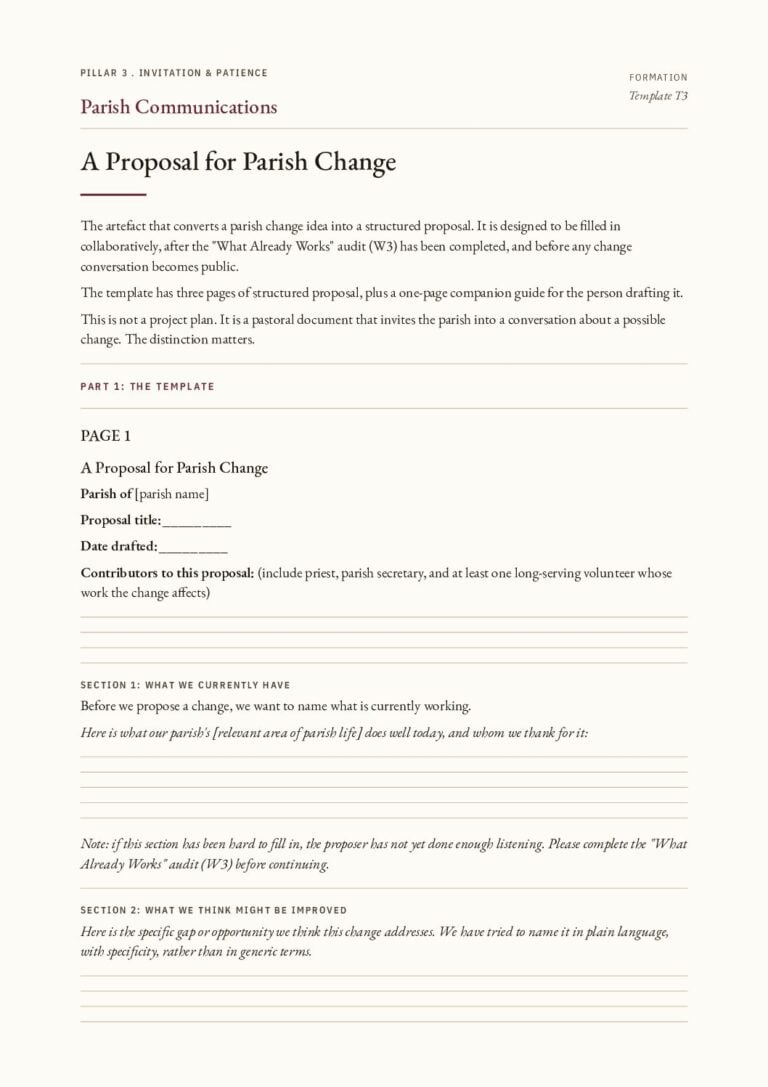
This audit feeds directly into the Change Proposal Template (T3). Bring the outputs of Pages 4 and 5 to that template when you are ready to draft the proposal.
If the audit has led you to conclude that the change is not needed, or not needed now, that is also a legitimate outcome. Document what you learned, share the conclusion with the priest, and consider whether to revisit in six months.
Based on the True Light Digital Formation framework. For the cornerstone essay on which this audit is based, see truelight.digital/formation/invitation-and-patience/.
True Light Digital publishes this worksheet as part of its free Formation library. If your parish would value support in building a wider communications system, please contact us at sean@truelight.digital. If not, we hope this worksheet serves you well on its own. That is the goal.
Download
Free, no email needed. Adapt it for your parish and hand it to the next volunteer.