This document contains two parts:
- The template itself (one page), designed to be printed and completed by hand, or filled in digitally in a DOCX version.
- A companion note (one page) explaining how to use the template, written for the priest.
The template is intentionally short. It is not a job description in the corporate sense. It is a pastoral agreement between a priest and a person being commissioned to a specific ministry within the parish, written down so that what is agreed is clear to both and to whoever comes after.
If your parish website is where this goes wrong, we build ones the office can actually run. Catholic parish websites
PART 1: THE TEMPLATE
[To be rendered as a single-page PDF, A4, professionally typeset. Fillable fields indicated in brackets. Parish crest or logo placeholder at top left. True Light Digital attribution at the bottom in small type.]
Parish Communications Champion: Commissioned Role
Parish of [parish name]
Date of commissioning: [date]
Priest: [Fr. Name]
Champion being commissioned: [Name]
Section 1: The function
A Communications Champion helps the parish share the good news of what God is doing through its life and ministries. This is not a clerical role. It is part of the baptismal apostolate of every Christian, made specific in this parish at this time.
This particular Champion is being commissioned as:
- [ ] Originator: bringing news and updates from [specific ministry: ________________] into the parish’s communications.
- [ ] Curator: stewarding the parish’s editorial voice, receiving and shaping submissions from originators, and protecting the coherence of what the parish publishes.
- [ ] Producer: supporting the curator by posting, formatting, scheduling, and publishing content, under the curator’s editorial direction.
- [ ] Combination (rare but legitimate): the specific combination is named here: ________________
Section 2: The specific remit
This Champion is responsible for:
_________________________________________________________________
_________________________________________________________________
_________________________________________________________________
This Champion is explicitly not responsible for:
_________________________________________________________________
_________________________________________________________________
Section 3: Working relationships
This Champion works closely with, and is supported by:
- The parish priest: first point of support; final authority on matters of editorial judgment where escalation is needed.
- The parish secretary (if separate from the Champion): ________________
- The parish safe environment officer: ________________
- Other Champions in the parish: ________________
Section 4: Time commitment
This is an honest estimate, not a contract. Actual hours will vary with liturgical season.
- Typical weekly commitment: approximately ______ hours.
- Heavier seasons: Advent, Holy Week, and the run-up to major parish events.
- Lighter seasons: Ordinary Time, especially during summer and late autumn.
- Holiday cover arrangements: ________________
The Champion has explicit permission to step back during personal or family difficulty, without needing to justify the reason.
Section 5: Protection from scope creep
Requests to the Champion for additional work beyond this remit (“can you just…”) should be routed through the parish priest or parish secretary, not piled directly onto the Champion. The priest signs this section to give the Champion explicit air cover in declining or deferring such requests.
Section 6: Review and succession
- First review: [date approximately six months from commissioning]
- Annual review thereafter: on or near the anniversary of commissioning.
- Documentation: the Champion and the priest will document the work as it is carried, so that a successor can pick it up without starting from zero.
Section 7: Commissioning
This Champion is commissioned to this ministry in the parish, with thanks for the gift she/he brings, and in confidence that the Holy Spirit will accompany the work.
Signed:
___________________________ (Priest) Date: _______________
___________________________ (Champion) Date: _______________
Based on the True Light Digital Formation framework. For accompanying guidance, see the Pillar 1 cornerstone essay at truelight.digital/formation/communications-champion/.
PART 2: COMPANION NOTE FOR THE PRIEST
[To be rendered as a separate one-page PDF, A4, pairing with the template.]
How to Use This Template: A Short Companion Note for the Priest
This note is for you, Father. The Role Description template on the other page is designed to be filled in together with the person you are commissioning. This note explains the posture for doing that well.
Before you sit down together
Read the Pillar 1 cornerstone essay if you have not already: The Parish Communications Champion. It gives the theological and structural grounding for this role.
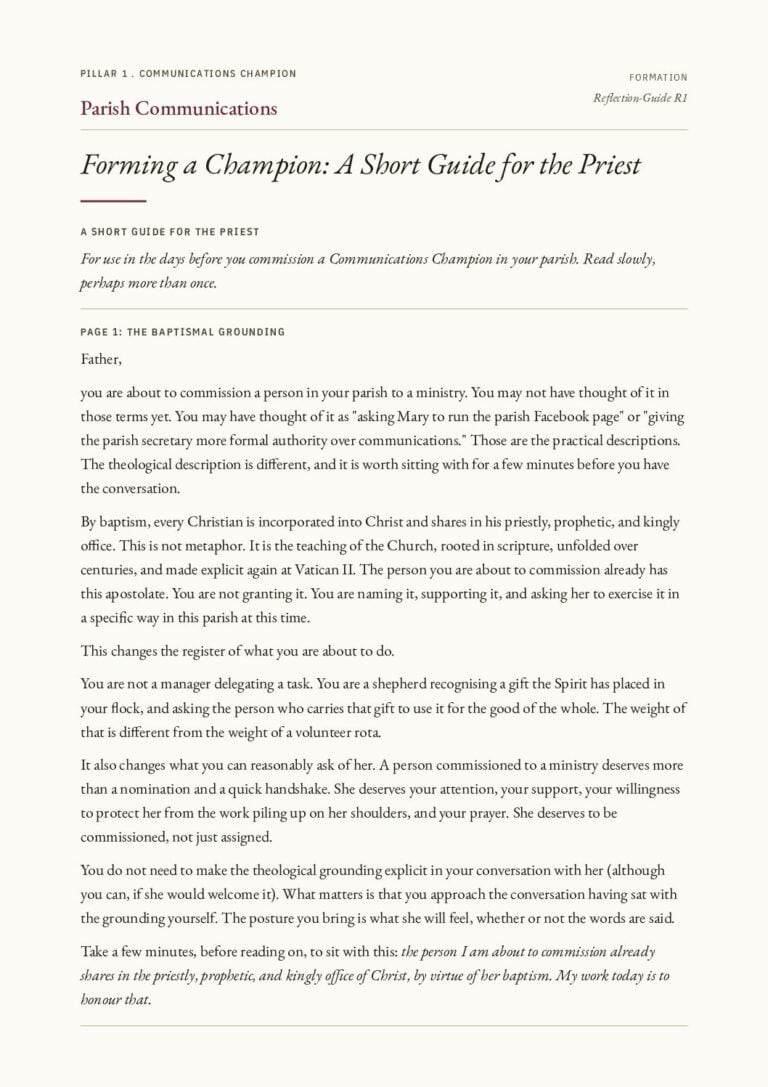
If you have time for one more short reading, the Reflection Guide Forming a Champion (R1) is written specifically for this moment. Fifteen minutes, read slowly, in the day or two before the conversation.
Make sure the conversation is unhurried. Thirty to forty-five minutes. Not between other appointments. A cup of tea, not a boardroom.
The first and most important move
Before you fill in any fields, thank her (or him) for being willing to consider this role. Name, specifically, what you have noticed about her that led you to ask. Do not generalise. “I have seen how you handle the SVP collection notices” is worth a hundred times more than “I think you would be great at communications.”
If she is already carrying this work informally, as many parish secretaries are, name that. The conversation may be an emotional one. She may not have been explicitly thanked for this work before.
Filling in the template together
Work through the template in the order it is printed. The order is deliberate.
Section 1 (the function): this is where you together decide which flavour of Champion she is being commissioned as. Most new commissionings are for a single flavour. Originators are the most common. A curator is rarer and weightier. A producer is usually identified after the curator is in place.
If she is being commissioned as curator, name that specifically. This is the role that carries the most authority and the most risk of burnout. It deserves the most careful conversation.
Sections 2 and 3 (remit and relationships): these are the heart of the template. Take time. Write in her words, not yours. If she says “I don’t want to be responsible for the Facebook page during Holy Week,” write that down in Section 2 as a boundary. Her boundaries are not obstacles to the role; they are the role being made sustainable.
Section 4 (time): be honest with her about what you think it will take, and listen more than you speak about what she can offer. A Champion who agrees to more hours than she has is a Champion who will burn out. Prefer the smaller commitment, and adjust upward at review if she wants.
Section 5 (protection from scope creep): this section is you, the priest, making a specific commitment. It is not boilerplate. When you sign this section, you are personally taking responsibility for intercepting “can you just…” requests on her behalf. Mean it.
Section 6 (review and succession): put the six-month review date in your calendar now, while you are in the room. If you do not, it will slip. The review is not a performance evaluation; it is a pastoral check-in that keeps the role honest over time.
Section 7 (the commissioning): sign it together, in her presence. Pray with her if she is comfortable with that. A short commissioning prayer is offered in the Reflection Guide Forming a Champion, or you may use your own.
After the commissioning
Some priests mark the commissioning publicly at a Mass, within the prayers of the faithful or in a short named moment. Others mark it privately with just the Champion and the parish secretary. Either is fine. What matters is that the role is real, named, and supported.
In the first month after commissioning, check in with her briefly twice, just to ask how she is finding it. Not long meetings. A few minutes after Mass, or a phone call on a Tuesday evening. This is where many commissioned roles begin to drift: the priest’s attention moves elsewhere and the Champion is left quietly wondering whether she was really backed. Early, light, repeated check-in prevents that drift.
Put the first formal review date in your calendar now, and keep it.
If you are replacing an informal role with a formal one
Many parishes already have someone doing this work without a title. Your conversation is then a different kind of conversation. You are not creating a new role; you are recognizing what has been carried, probably for years, and giving it the support and authority it has lacked.
This conversation is often more emotional than a brand-new commissioning. She may be moved to be seen. She may also be wary, having been disappointed before. Go slowly. Honor what she has been carrying. Do not promise more than you can deliver. The conversation itself is part of the commissioning.
What happens next
Once the Champion is commissioned, the next practical steps depend on her flavour:
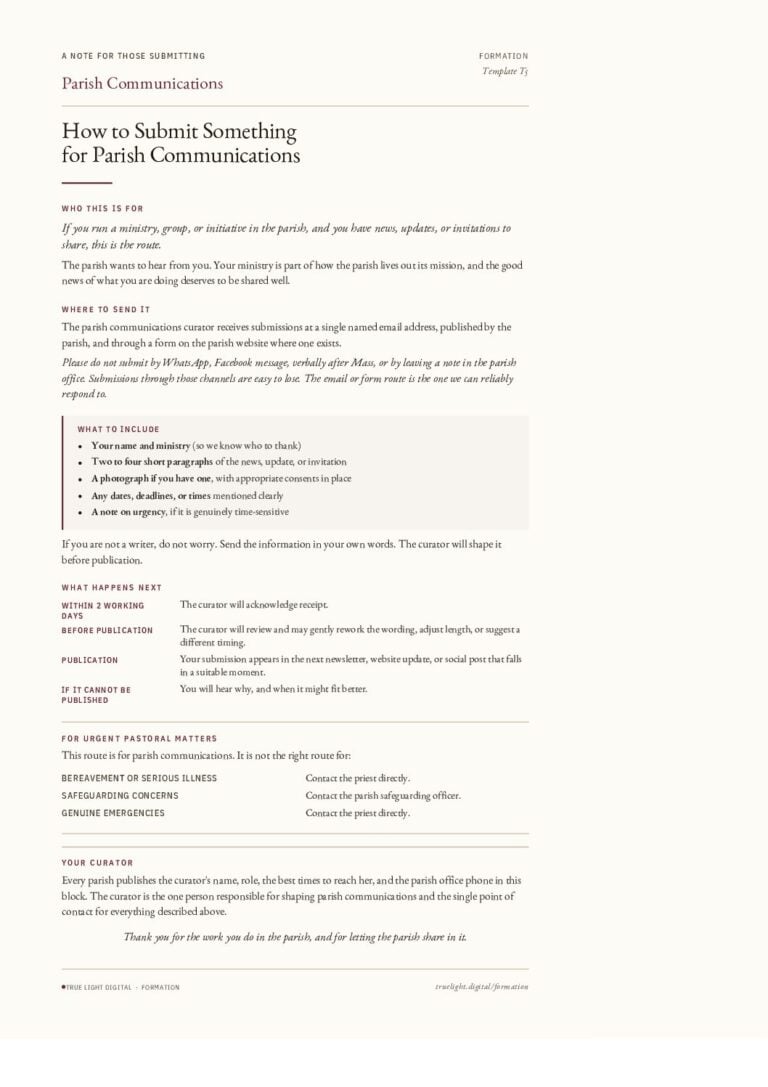
- If she is a curator: she will want to draft a Submission Route One-Pager (template T5) within the first two weeks, and adopt the Editorial Vetting Checklist (template T4) as part of her workflow.
- If she is an originator: she needs to know the submission route and the curator’s contact details, and then she simply needs to be invited to submit when she has something to share.
- If she is a producer: she needs training on the parish’s publishing tools from the curator, and a clear agreement on what she posts independently versus what she escalates.
All of these resources are available free at truelight.digital/formation.
One last thing
This is a ministry. The Church has always known that the Spirit works through the people who show up with their gifts. The Champion you are commissioning is one such person. Your job, from here, is to support her, check in with her, protect her, and trust the Spirit.
The work is in good hands when it is in her hands and yours together.
True Light Digital publishes this template and companion note as part of its free Formation library. If your parish would value support in building a wider communications system, please contact us at sean@truelight.digital. If not, we hope this template serves you well on its own. That is the goal.
Download
Free, no email needed. Adapt it for your parish and hand it to the next volunteer.