This document contains three parts:
- The full checklist (one page), for use with any submission that names people, involves sensitive information, or falls outside routine operational content.
- The short checklist (one page), for use with routine operational content (Mass times, hall bookings, standing announcements).
- A companion guide (one page), explaining how to use the checklists and offering worked examples.
The checklists are designed to be printed and pinned above the curator’s desk, laminated for durability, or filled in digitally in a DOCX version as part of a submission’s audit trail. The markdown is the source of truth; PDF and DOCX renderings should remain in sync.
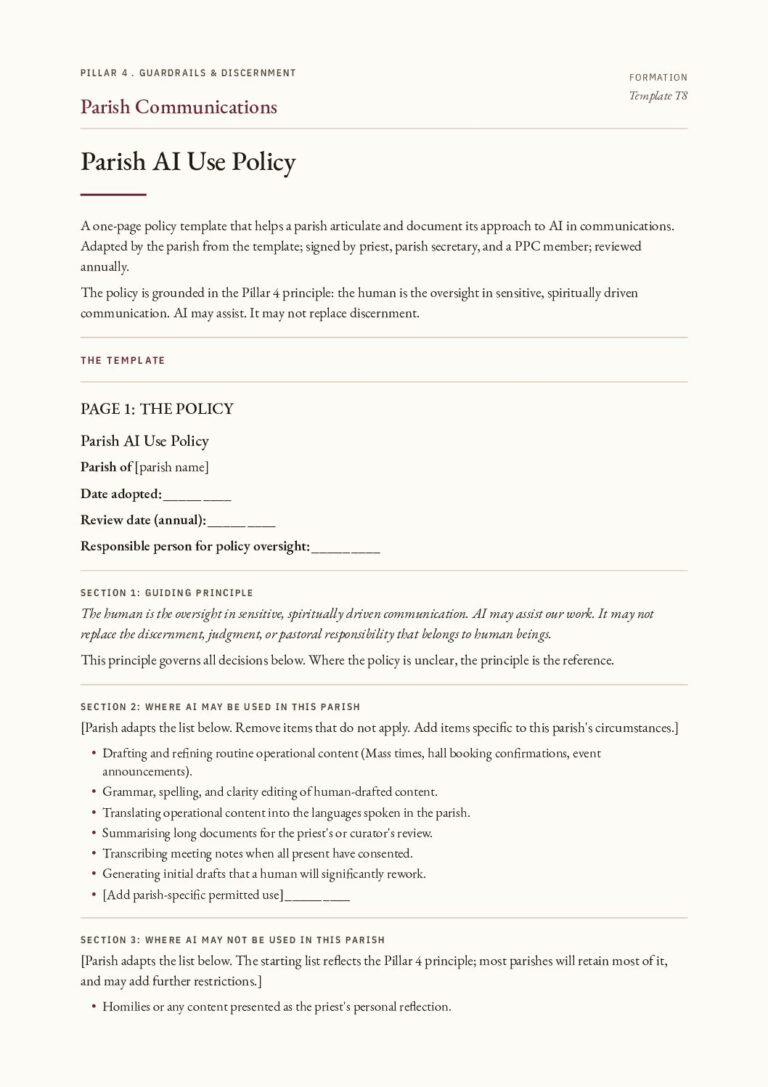
There's a free policy template for this in the library. Parish AI use policy
PART 1: THE FULL CHECKLIST
[To be rendered as a single-page PDF, A4, professionally typeset. Clear typography. Enough white space that a curator can actually work through the prompts rather than feeling crowded. Parish name and crest placeholder at top. True Light Digital attribution at bottom in small type.]
Editorial Vetting Checklist
Parish of [parish name]
For submissions that name people, involve sensitive information, or fall outside routine operational content.
Submission under review: _________________________________________________
Submitted by: _____________________ Date submitted: _____________________
Reviewed by (curator): _____________________ Date reviewed: _____________________
The prompts
Work through each prompt in order. Write brief notes where useful. A prompt without a clear answer is a signal to pause, not to proceed.
1. Who is named or implicated in this submission?
List names of individuals, families, groups, or ministries affected:
_____________________________________________________________
If no one is named or implicated, skip to prompt 6.
2. Have they seen this, and do they consent to its publication as drafted?
- [ ] Yes, consent confirmed for each named person.
- [ ] For minors: parental or guardian consent confirmed in writing.
- [ ] For vulnerable adults: consent confirmed with appropriate support.
- [ ] No, or uncertain. Pause here and seek consent before proceeding.
3. Is there a safe environment dimension?
Does this involve children, vulnerable adults, historical safe environment matters, or anything the parish safe environment officer should see before publication?
- [ ] No, proceed to prompt 4.
- [ ] Yes. Stop. Contact the safe environment officer before going further.
4. Is there a data protection dimension?
Does this include personal details (names, addresses, health information, family circumstances, financial information) that require consent or careful handling?
- [ ] No, proceed to prompt 5.
- [ ] Yes. Confirm consent, note retention implications, and proceed carefully.
5. Is there a copyright, liturgical text, or image rights dimension?
Does this include lyrics, images, quotations, liturgical texts, or other material that requires license, attribution, or permission?
- [ ] No, proceed to prompt 6.
- [ ] Yes. Verify rights or license before publication.
6. Is the timing right for the liturgical season?
Does this fit the current season’s register, or would it land better at another time?
- [ ] Timing is right.
- [ ] Hold until: ___________________________________
7. Is silence the better option here?
For sensitive matters, ask explicitly: would not communicating this serve the people involved better than communicating it?
- [ ] No, publication is appropriate.
- [ ] Uncertain. Refer to When Silence Serves reflection guide and discuss with priest.
- [ ] Yes, silence is the right answer this time.
The decision
- [ ] Publish as submitted.
- [ ] Rework, then publish. Notes: ________________________________
- [ ] Hold until [date or trigger]: __________________________________
- [ ] Refuse with pastoral conversation to follow with submitter.
- [ ] Escalate to priest or safe environment officer.
Curator’s signature: _____________________ Date: _____________________
Based on the True Light Digital Formation framework. See the Pillar 4 cornerstone essay at truelight.digital/formation/guardrails-and-discernment/ for the full reasoning behind this checklist.
PART 2: THE SHORT CHECKLIST
[To be rendered as a separate one-page PDF, A4. Designed to be pinned alongside the full checklist. Smaller format possible if needed; this version can be a half-page if that serves the curator better.]
Editorial Vetting Checklist (Short Form)
Parish of [parish name]
For routine operational content: Mass times, hall bookings, standing announcements, minor updates. Use the full checklist for anything involving named individuals, sensitive topics, or unusual situations.
Submission under review: _________________________________________________
1. Is anyone named who has not seen this?
- [ ] No, or all named persons have been consulted.
- [ ] Yes. Stop. Switch to the full checklist.
2. Is the timing right?
- [ ] Yes.
- [ ] No, better held until: _______________________
3. Am I happy to publish this?
- [ ] Yes, publish.
- [ ] No, switch to the full checklist or discuss with priest.
Curator’s initials and date: _____________________
PART 3: COMPANION GUIDE FOR THE CURATOR
[To be rendered as a separate one-page PDF, A4, pairing with the checklists.]
How to Use These Checklists
This guide is for you, the curator, whether that is the parish secretary, a commissioned volunteer, or whoever holds the editorial function in your parish. It explains the thinking behind the checklists and offers worked examples.
The principle
Most of what good parish communications looks like is things that did not happen, because somebody paused.
The checklists exist to build that pause into your workflow as a structural feature, not a personal virtue. On a Wednesday afternoon when you are tired and a submission has arrived that feels mostly fine, the checklist is what slows you down enough to notice the detail that would have caused harm. That is its only job. Everything else follows.
When to use which checklist
Use the short checklist for:
- Mass time updates.
- Hall booking confirmations.
- Standing announcements (e.g. “Confessions continue at the usual times”).
- Minor reminders about routine events.
- Anything where no individual is named in a sensitive context.
Use the full checklist for:
- Any submission that names a family, a child, a vulnerable adult, or an individual in a sensitive circumstance.
- Prayer requests that include specific personal details.
- Bereavement notices.
- Communications about illness, family crisis, or personal difficulty.
- Photographs of children or identifiable groups.
- Content that quotes or adapts copyrighted material (hymns, liturgical texts, third-party writing).
- Anything you feel uncertain about.
When in doubt, use the full checklist. The time cost is small. The cost of skipping the full checklist when it was needed is much larger.
Worked examples
Example 1: A prayer request from a parishioner.
A parishioner emails asking for prayers for her adult daughter, who is going through a difficult divorce. She names the daughter and mentions the husband by name.
Full checklist applies. Prompt 1: yes, three people are named. Prompt 2: consent from the mother is implied, but the daughter has not been consulted, and the husband definitely has not. Prompt 3: no safe environment dimension. Prompt 4: yes, sensitive family information. Prompt 7: silence is probably the right answer for this level of specificity.
The decision: rework, with a short pastoral conversation with the submitter. The public prayer request can read “Please pray this week for those in our parish facing family difficulties,” with the specific prayers happening through the parish’s private prayer ministry. The submitter is thanked and the approach is explained gently.
Example 2: A photograph of children at First Holy Communion.
The First Holy Communion catechist sends a group photograph with thirty smiling children for the parish Facebook page.
Full checklist applies because children are named or identifiable. Prompt 1: yes, children are identifiable. Prompt 2: annual standing consent forms should be on file; each face in the photograph needs to be covered by those consents. Prompt 3: yes, safe environment dimension is present. Prompt 4: yes, data protection dimension is present.
The decision depends on your diocesan safe environment officer’s guidance. In most dioceses, a group photograph with standing consent forms is acceptable; individual close-ups of named children are usually not. When in doubt, the safe environment officer is the specific answer.
Example 3: A notice about the Wednesday morning Mass time moving to 10am.
The priest asks you to put a notice in the bulletin that Wednesday Mass is moving from 9:30am to 10am.
Short checklist applies. No one is named. Timing is fine (the week before the change takes effect). You are happy to publish. Initial and date. Done.
Example 4: A submission celebrating the parish’s longest-serving volunteer on her ninetieth birthday.
A parish pastoral council (PPC) member sends warm words thanking Mrs. Mary O’Connor on her ninetieth birthday, naming her late husband, her children, and her decades of service.
Full checklist applies. Prompt 1: several people named. Prompt 2: Mary herself needs to see this and consent; has she? Her children, named in the submission, should also be aware. Her late husband is named, which raises a pastoral question about tone. Prompt 3: vulnerable adult dimension (her age alone does not make her vulnerable, but specific consent still matters). Prompt 7: silence is not the right answer; Mary deserves to be honored, but she deserves to be consulted first.
The decision: hold for a few days. Speak with Mary directly. If she is happy to be honored publicly, publish as drafted. If she would prefer a quieter acknowledgement, honor that. Her preference is the final word.
A note on the seventh prompt
Prompt 7 (Is silence the better option here?) is the one that most rewards slow reading. It is also the one curators most often skip when they are busy.
When a submission has arrived about a painful situation (a family tragedy, a controversy, a parishioner’s public anger, a difficult diocesan matter), the instinct of modern communications practice is to respond. Sometimes this is right. Often it is wrong. The seventh prompt asks you to consider, honestly, whether not communicating might serve the people involved better than communicating.
The Reflection Guide When Silence Serves (R4) is written for exactly this moment. If the seventh prompt produces uncertainty, take ten minutes to read it before deciding. The guide is free at truelight.digital/formation/guardrails-and-discernment/.
A note on escalation
Escalating a submission to the priest is not a failure. It is a legitimate fifth option in the decision box. Some submissions are not yours to decide alone. When you escalate:
- Explain briefly why you are escalating, not just that you are.
- Suggest what you think the right answer is, while remaining open to the priest’s judgment.
- Note the decision on the checklist once it is made.
The priest who has commissioned you has committed to supporting your editorial authority. Part of that support is receiving escalations thoughtfully and returning decisions promptly.
A note on refusing
Refusing a submission (“Refuse with pastoral conversation to follow”) is the hardest of the five decisions. It is also the one that, done well, builds long-term trust.
When you refuse:
- Speak to the submitter directly, ideally in person or by phone. Not by email.
- Thank them for their contribution, specifically and genuinely.
- Explain what could not be published and why, in plain terms.
- Offer, if possible, an alternative (a reworked version, a different venue, a different timing).
- Do not blame “policy” or the priest. The decision is yours, held in communion with the parish, and you own it.
A submitter who has been refused with dignity will keep submitting. A submitter who has been refused by form letter will not.
The long view
The checklists are tools. The real work is the discernment that happens while you are using them. Over time, as you get used to the prompts, you will find yourself running through them mentally on routine submissions without even reaching for the printed page. That is not a failure of the checklist; it is the tool having done its job. The discipline of the pause becomes part of you.
And on the harder weeks, when the tiredness is setting in or the submissions are stacking up, the printed checklist is there on the wall, waiting. It does not judge you. It just invites you to slow down for a moment, ask the questions, and make the decision you can sign your name to.
That is all the checklist is. That is why it is enough.
True Light Digital publishes these checklists as part of its free Formation library. If your parish would value support in building a wider communications system, please contact us at sean@truelight.digital. If not, we hope these checklists serve you well on their own. That is the goal.
Download
Free, no email needed. Adapt it for your parish and hand it to the next volunteer.