A Short Guide for Those Proposing Change
For agency leads, diocesan staff, priests, parish pastoral council (PPC) chairs, and consultants entering parish work. Read before proposing any change.
[To be rendered as a five-page PDF, A4 portrait. Pastoral typography. Pale warm background. Generous white space. Designed to be read slowly, possibly more than once. True Light Digital attribution in footer.]
If your parish website is where this goes wrong, we build ones the office can actually run. Catholic parish websites
PAGE 1: THE DIFFERENCE THIS GUIDE IS NAMING
You are reading this because you are thinking about proposing a change in a parish. A new website. A restructured newsletter. A different way of running the communications ministry. A migration to new software. A reorganisation of how the ministries feed information into parish life.
Whatever the change is, you have some expertise you are bringing to it. You may have run similar projects in other contexts. You may have been trained in change management, project management, or communications strategy. You may simply have a clear sense of what would make the parish’s work better.
Some of what you know will serve you well. Some of it will not. This guide is about the second kind.
Two postures, side by side
Buy-in. Transactional. Assumes a decision has been made that needs to be sold. Measures success by the percentage of stakeholders who verbally agree. Works on a timeline. Produces compliance. Becomes brittle when people leave.
Invitation. Relational. Assumes a possibility has been identified that needs to be offered. Measures success by the quality of engagement. Works at the pace of the people. Produces ownership. Becomes stronger when people leave because what they carried has been genuinely shared.
A direct question: which posture has shaped your training?
Most readers will recognize the first. It is the dominant posture of professional change management, of digital transformation consulting, of the content that dominates management literature. It works, in many corporate contexts. It works, to some degree, in organizations where compliance is possible because paycheques depend on it.
It does not work in parishes.
The rest of this guide is about unlearning it, and about what to do instead.
PAGE 2: THE THEOLOGY OF THE SPIRIT’S PACE
Before we get to the practical unlearning, a short theological note, because the theology is where the unlearning actually has to start.
The Catholic Church has never been in a hurry about anything that matters.
Councils take decades to be called, years to deliberate, and decades more to be received. The Second Vatican Council concluded in 1965. The Church is still, sixty years later, receiving and implementing its teaching. This is not dysfunction. It is the Church’s normal pace.
Canonisations take centuries. The Church waits. Evidence accumulates. Witnesses are heard. Cases are set aside and returned to. A person declared Blessed in 2012 may be canonised in 2080, or not at all. The Church is patient because she knows the Holy Spirit is patient.
Doctrine develops over generations. The dogma of the Immaculate Conception was defined in 1854, but the Church had been teaching and praying around it for more than a thousand years before the definition. The definition did not create the doctrine. It recognized what had been slowly, patiently, prayerfully understood.
A parish change of six months, compared with this pace, is hardly a pace at all. And yet most of the projects proposed to parishes operate on a calendar-quarter logic that would be unrecognisable to the Church’s own way of working.
The Ignatian principle
In the Ignatian tradition of discernment, truth takes time to emerge in a person who is considering a decision. The movements of consolation and desolation must be observed over days or weeks, not minutes. A hasty decision is, almost by definition, an undiscerned decision.
A parish that is invited into a change needs time to discern. Not by filling in feedback forms. By sitting with the proposal. By letting it settle. By noticing how they feel about it a week later, a month later, three months later.
If your timeline does not accommodate this, your timeline is fighting the parish’s capacity to engage well.
PAGE 3: WHY THE CORPORATE PLAYBOOK FAILS
The following failure modes are common in parish change projects. You may recognize some of them. If you do, that recognition is the beginning of the unlearning.
The kickoff meeting with the slide deck.
Treats volunteers as an audience to be persuaded. Volunteers are not an audience. They are the parish.
What to do instead: no kickoff meeting. A series of one-to-one conversations. You bring questions, not slides.
Stakeholder alignment.
Treats people as variables in a persuasion equation, to be moved from misalignment to alignment. People are not variables. They are the parish.
What to do instead: consultation, not alignment. You are asking people what they think, genuinely, not trying to move them to a predetermined position.
Change resistance.
“Change resistance” is a consultant’s label for the reality that the parish is telling you something you have not yet heard. Resistance is data.
What to do instead: treat resistance as useful information about what the proposal is missing. Ask what specifically is worrying people. Address the specific worry, not the general objection.
Adoption metrics.
Measure compliance, not ownership. A parish that scores well on adoption metrics and badly on actual use is a parish that has learned to perform the change without incorporating it.
What to do instead: pay attention to real use, not measured use. Are the originators actually submitting? Is the curator actually using the new tool? Is the work easier than it was? These are the real metrics, and they are not countable.
Milestones that do not align with the liturgical year.
A project plan with milestones in weeks 3, 8, and 14 is fighting the parish’s actual rhythm. The parish does not live in weeks. It lives in seasons.
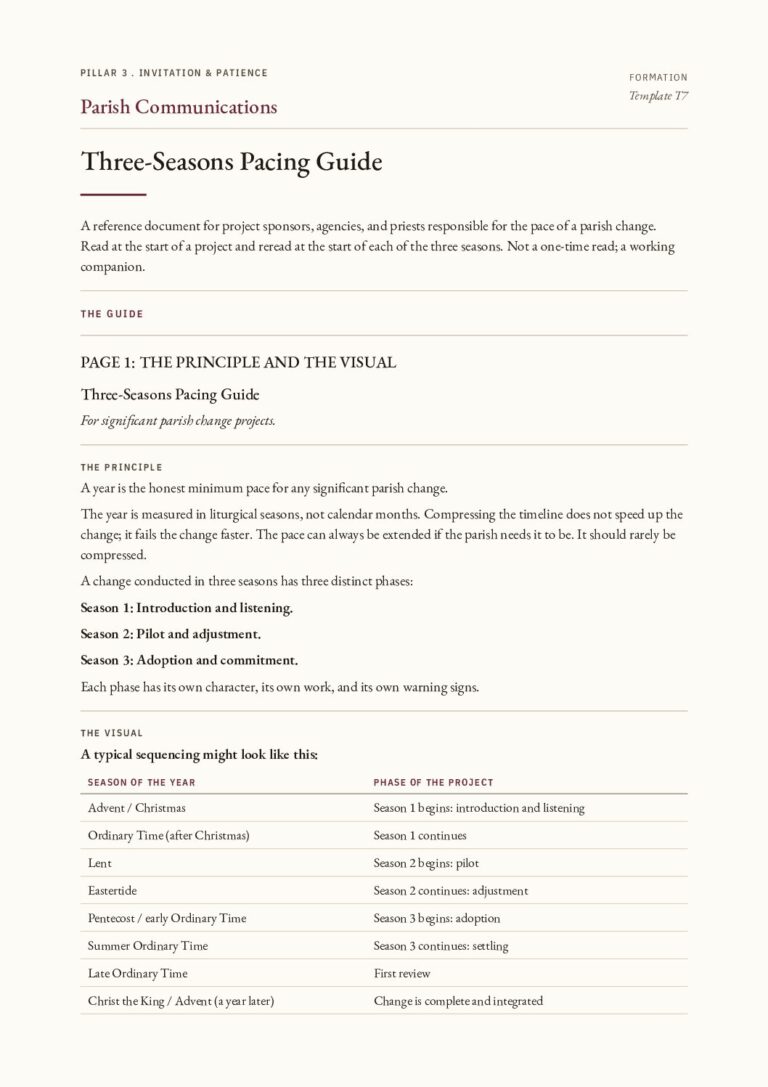
What to do instead: milestones in liturgical seasons. The pilot begins in Lent. The full adoption happens after Pentecost. See the Three-Seasons Pacing Guide (T7) for the fuller framework.
The imposed deadline.
A deadline imposed from outside the parish is almost always a deadline the parish will resent, whether or not it meets it.
What to do instead: propose a timeline; ask the parish if it works; adjust if not. Deadlines that come from budgets, agency cashflows, or the consultant’s travel schedule are not the parish’s deadlines, and the parish knows this.
Each of these failure modes is something you are likely doing, or have done, or have been trained to do. The guide names them without apology, because the damage they do is real. The priest who has been through a failed transformation remembers the failure, not the framework. The volunteer who felt managed rather than invited becomes the one who will not engage with the next change, however well-proposed.
PAGE 4: WHAT INVITATION LOOKS LIKE IN PRACTICE
Concrete reframings, one at a time.
Instead of: “We need to align stakeholders on the new website vision by end of Q1.”
Try: “We want to spend Advent having conversations with everyone whose work the website affects. We will bring a proposal to the PPC at the start of Lent. The decision is theirs to shape.”
Instead of: “What is your objection to the proposed change?”
Try: “What are you worried would be lost if this changed? What is working now that we need to protect?”
Instead of: “We need to drive adoption.”
Try: “We are offering this tool. Let us see who finds it useful and why, and let us adjust based on what we learn.”
Instead of: “The agency will deliver the project on schedule.”
Try: “The agency will propose a pace, and we will adjust if the parish needs us to.”
Instead of: “Let’s get buy-in from the priest.”
Try: “Let’s make sure Father understands what we are proposing, and listen to whatever he says back, including his hesitations.”
Instead of: “The parish secretary needs to be trained on the new system.”
Try: “The parish secretary needs to be consulted on the design of the new system, and then supported in learning how it works once we have built what she actually needs.”
Each reframing is a change of posture, not just language. The language matters because it trains the posture. A consultant who says “drive adoption” for three weeks will find herself acting like a consultant who drives adoption. A consultant who has taught herself to say “help the change take root” for three weeks will find herself acting differently, even without meaning to.
The words shape the work. Choose them with care.
PAGE 5: THE DISCIPLINE OF HEARING NO
The deepest section of this guide. A parish sometimes says no. The no may come as silence, as polite deferral, as the return of old patterns after a visible rollout, as the disappearance of the champion, as the PPC’s courteous request to revisit in a year.
All of these are legitimate answers. All of them should be honored, even when they are inconvenient for the agency, the priest, or the budget cycle.
Specific discipline
When you hear no, do not push. The push is almost always what makes the no harden. A no that is met with acceptance is sometimes revisited later. A no that is met with pressure is usually final.
Do not ask “what would need to change for you to say yes?” That is a persuasion question. It signals that you have not accepted the no; you are still trying to convert it.
Ask instead: “What have I not understood?” That is a learning question. It signals that you are genuinely open to the possibility that the parish’s judgment is better than yours, which it often is.
Sometimes the answer is “nothing, we just do not want this.” That is also legitimate. Some changes are not right for some parishes, and the parish does not need to justify that conclusion to you.
What you do after the no
Thank the parish for its engagement. Do not apologize for having proposed; the proposal was offered in good faith. Do not extract a commitment to revisit; if the parish wants to revisit, it will.
Revise or shelve the proposal. Consider whether the original problem has been addressed some other way, or whether it was not actually a problem.
Return to the matter in a year if it still seems relevant. Or do not.
The closing truth
Invitation is a way of loving the parish even when you are proposing something. If your proposal cannot survive being declined, your proposal is not actually an invitation. It is a persuasion attempt in the costume of an invitation, and the parish will feel the difference.
The invitation you extend is complete when it is made. The parish’s answer is not your achievement; it is the parish’s discernment. Your job is to extend the invitation well, to listen well, and to accept the answer with grace.
This is what distinguishes a practitioner who is trusted by Catholic parishes over a career from a consultant who burns through client relationships in three-year cycles. Trust is built on the capacity to hear no. It is the deepest credential in this work.
If you can learn this, you can genuinely serve parishes. If you cannot, there is more money to be made elsewhere, and True Light Digital would quietly prefer you did not take on parish work at all.
This guide is part of the Pillar 3 reflection library within the True Light Digital Formation framework. For the cornerstone essay on which it is based, see truelight.digital/formation/invitation-and-patience/.
Other reflection guides in this family may also serve you, depending on the moment:
- Forming a Champion: A Short Guide for the Priest (R1)
- Ordinary Time Is Not Nothing (R2)
- When Silence Serves (R4)
True Light Digital publishes these reflections as part of its free Formation library. If your parish would value support in building a wider communications system, please contact us at sean@truelight.digital. If not, we hope this guide serves you well on its own. That is the goal.
Download
Free, no email needed. Adapt it for your parish and hand it to the next volunteer.