The artifact that converts a parish change idea into a structured proposal. It is designed to be filled in collaboratively, after the “What Already Works” audit (W3) has been completed, and before any change conversation becomes public.
The template has three pages of structured proposal, plus a one-page companion guide for the person drafting it.
This is not a project plan. It is a pastoral document that invites the parish into a conversation about a possible change. The distinction matters.
If your parish website is where this goes wrong, we build ones the office can actually run. Catholic parish websites
PART 1: THE TEMPLATE
[To be rendered as a three-page PDF, A4, professionally typeset. Warm, non-corporate visual register. Parish name and crest placeholder. True Light Digital attribution in footer.]
PAGE 1
A Proposal for Parish Change
Parish of [parish name]
Proposal title: _______________________________________
Date drafted: _______________________________________
Contributors to this proposal: (include priest, parish secretary, and at least one long-serving volunteer whose work the change affects)
_______________________________________
_______________________________________
_______________________________________
Section 1: What we currently have
Before we propose a change, we want to name what is currently working.
Here is what our parish’s [relevant area of parish life] does well today, and whom we thank for it:
_______________________________________
_______________________________________
_______________________________________
_______________________________________
_______________________________________
Note: if this section has been hard to fill in, the proposer has not yet done enough listening. Please complete the “What Already Works” audit (W3) before continuing.
Section 2: What we think might be improved
Here is the specific gap or opportunity we think this change addresses. We have tried to name it in plain language, with specificity, rather than in generic terms.
_______________________________________
_______________________________________
_______________________________________
_______________________________________
What the problem looks like in practice, on a typical week or in a specific recent example:
_______________________________________
_______________________________________
_______________________________________
PAGE 2
Section 3: What we are proposing
The actual change, described in plain language. Short enough that a parishioner reading it would understand what is being suggested without jargon.
_______________________________________
_______________________________________
_______________________________________
_______________________________________
_______________________________________
What will be different, in practical terms, if this change happens:
_______________________________________
_______________________________________
_______________________________________
Section 4: How this honors what already works
Here is how the proposed change carries forward what is currently good, and protects the people currently doing the work.
What we will carry forward from the current approach:
_______________________________________
_______________________________________
_______________________________________
How the people currently doing the work will be involved in the change:
_______________________________________
_______________________________________
Institutional knowledge that will be documented before anything changes:
_______________________________________
_______________________________________
Note: if this section feels thin, the proposal itself may be thin. Return to the audit (W3) and deepen your honoring work before continuing.
Section 5: Proposed pace
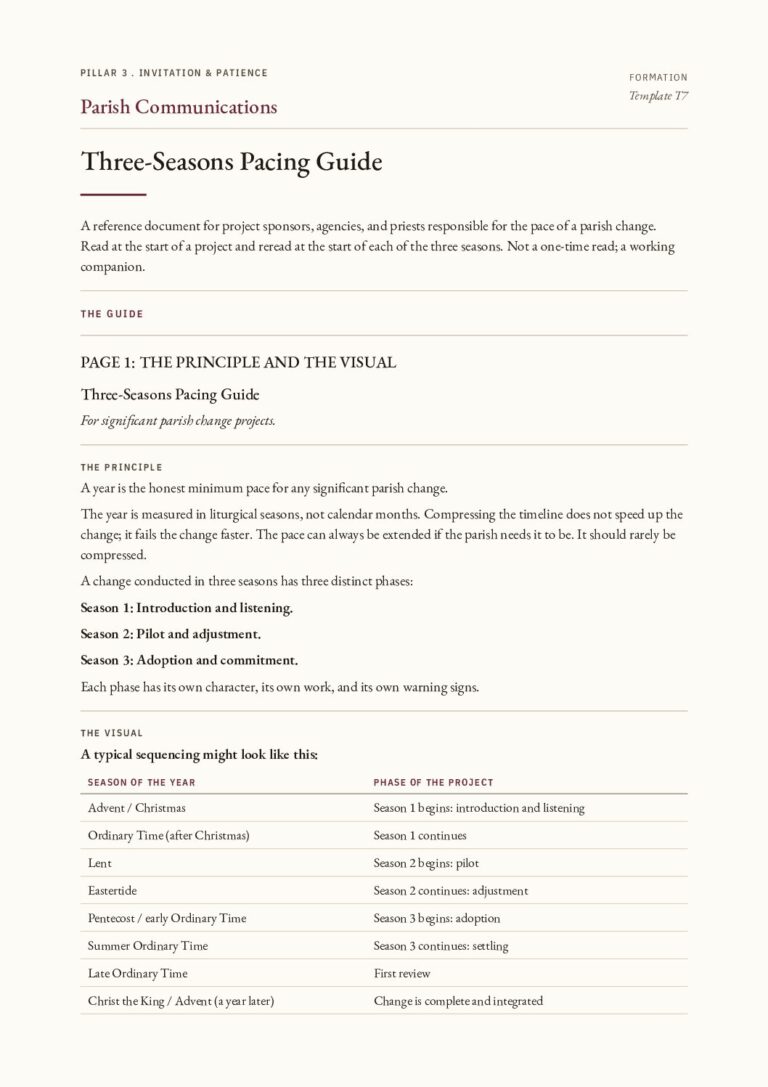
The True Light Formation framework recommends that significant parish change should span at least three liturgical seasons. See the Three-Seasons Pacing Guide (T7) for the reasoning.
Season 1 (introduction and listening):
- Begins in which liturgical season: _______________________________
- What will happen in this season: _______________________________
- Who will be consulted: _______________________________
Season 2 (pilot and adjustment):
- Begins in which liturgical season: _______________________________
- What will happen in this season: _______________________________
- Who will participate in the pilot: _______________________________
Season 3 (adoption and commitment):
- Begins in which liturgical season: _______________________________
- What will happen in this season: _______________________________
- How success will be recognized: _______________________________
Willingness to slow or pause:
We commit to slowing the pace, or pausing entirely, if the parish indicates at any point that it is not ready. The signs we will watch for include: key people becoming quiet, the pilot not being used, the pastoral load of the parish rising, and direct feedback that the change is not welcome.
Signed: _______________________________ Date: _______________
PAGE 3
Section 6: Who will be consulted
Beyond those who have drafted this proposal, these are the people and groups whose input we need at each stage.
In season 1:
- _______________________________________
- _______________________________________
- _______________________________________
- _______________________________________
In season 2:
- _______________________________________
- _______________________________________
- _______________________________________
In season 3:
- _______________________________________
- _______________________________________
- _______________________________________
Section 7: What success looks like
What will be true twelve months from now if this goes well. Written in human terms, not metric terms.
_______________________________________
_______________________________________
_______________________________________
_______________________________________
Section 8: What failure looks like, and what we will do about it
Honest acknowledgement that some parish changes do not succeed. These are the signals that would tell us this is not working.
Signals we will watch for:
_______________________________________
_______________________________________
_______________________________________
What we commit to do if those signals appear:
- Pause the timeline.
- Return to the parish for a fresh conversation.
- Consider slowing, restructuring, or stopping.
- Treat the slowing or stopping as a legitimate outcome, not a failure.
Section 9: Invitation to respond
We offer this proposal for the parish’s consideration. We welcome questions, concerns, additions, and alternatives.
Please respond to: _______________________________________
By: _______________________________________
Your silence will not be taken as agreement. We would prefer to hear from you, even briefly, even to say you have no view.
Signatures
Priest: _______________________________________ Date: _______________
Parish Pastoral Council (PPC) Chair (if applicable): _______________________________________ Date: _______________
Lead proposer: _______________________________________ Date: _______________
Based on the True Light Digital Formation framework. For the cornerstone essay on which this proposal is based, see truelight.digital/formation/invitation-and-patience/.
PART 2: COMPANION GUIDE FOR THE PROPOSER
[To be rendered as a separate one-page PDF, A4, pairing with the template.]
How to Use This Template: A Short Companion Guide
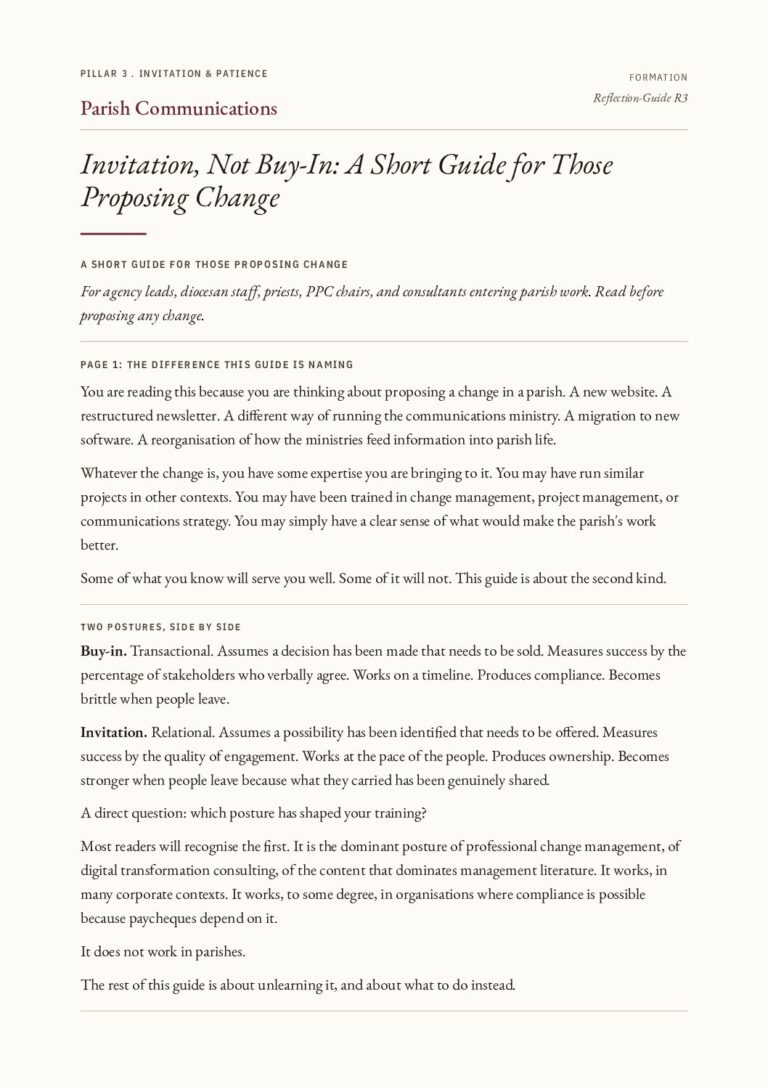
This note is for you, the person drafting the proposal. It explains the posture for filling in the template well, and flags the common mistakes that undermine proposals even when the change itself is right.
Before you begin
You cannot fill in this template well without first completing the “What Already Works” audit (W3). The audit is what makes Section 1 and Section 4 possible. If you try to skip the audit, those sections will be thin, and thin honoring produces change proposals that the parish will not engage with.
Budget at least two to four weeks for the audit conversations before you sit down with this template. This is not delay; it is the work.
If you have not yet read the Pillar 3 cornerstone (Invitation & Patience) or the reflection guide Invitation, Not Buy-In (R3), do so before drafting. The posture they establish is what makes this template land pastorally rather than corporately.
The collaborative drafting
This template is designed to be filled in by at least three people together: the priest, the parish secretary, and at least one long-serving volunteer whose work the change affects.
If you are the agency or consultant leading the work, you are a facilitator, not the proposer. The parish proposes. You support.
If you are a priest new to the parish, resist the urge to fill in the template alone and bring it to the PPC. The template loses its weight if the parish has not shaped the proposal from the beginning.
Common mistakes
Thin Section 1. If your “what we currently have” section is generic (“our parish communicates in various ways”), the rest of the proposal will read as not-yet-listened-to. Specificity is the work. Name people. Name practices. Name what is good, concretely.
Over-specified Section 3. If your “what we are proposing” section is a detailed technical specification, you have jumped ahead. Section 3 should be a plain-language description of the change, not a build brief. The technical detail comes later, after the parish has engaged with the principle.
Unrealistic Section 5. If your three-season timeline begins and ends in under six months, you are not following the pacing principle; you are performing it. Most parish changes benefit from a full liturgical year or more. Err on the side of more time.
Empty Section 8. If you cannot name honest signals of failure, you have not thought seriously about risk. Every parish change can go wrong. Naming how it could go wrong in this proposal is an act of trust with the parish, not a weakness.
The register of the proposal
The whole template should read as an invitation, not an announcement. Check your language before you sign. If you have written “we will” more than “we propose” or “we hope to” or “we would like to,” you have drifted from invitation to declaration. Adjust.
Check also for corporate vocabulary: “stakeholders,” “alignment,” “rollout,” “drive adoption,” “transformation.” Every one of these is a tell. Replace with parish-appropriate language: “people affected,” “agreement,” “introduction,” “help the change take root,” “development” or simply the specific thing being described.
After drafting
Before the proposal is shared with the wider parish, sit with it for two or three days. Reread. Notice anything that feels like you are selling the change rather than offering it. Adjust.
Then bring it to the PPC first, not as a decision to approve, but as a conversation to shape. The PPC’s role is to help you refine the proposal before it goes wider. A proposal that has been genuinely refined by the PPC will land differently in the wider parish than one that has been rubber-stamped.
After the PPC, share it with the people named in Section 6 as those to be consulted in Season 1. Give them time to respond. Read their responses carefully. Adjust the proposal if their input deserves adjustment. This may take weeks. That is correct.
Only when the proposal has been through this refining process is it ready for the wider parish conversation.
If the parish declines the proposal
Sometimes a parish, having considered a proposal carefully, decides the change is not right, or not right now. This is a legitimate outcome. It is not a failure of the proposal or of the proposer. It is the parish exercising its proper discernment.
If this happens, thank the parish for its engagement. Revise or shelve the proposal. Consider whether the original problem has been addressed some other way, or whether it was not actually a problem. Return to the matter in a year if it still seems relevant.
A proposer who cannot accept no has not been operating in the posture of invitation. The capacity to hear no well is part of the commitment you made when you chose this template.
True Light Digital publishes this template as part of its free Formation library. If your parish would value support in building a wider communications system, please contact us at sean@truelight.digital. If not, we hope this template serves you well on its own. That is the goal.
Download
Free, no email needed. Adapt it for your parish and hand it to the next volunteer.