A specific interface document between parish safe environment and parish communications. Not a safe environment policy: the parish safe environment officer has that, following diocesan and bishops’ conference guidance. This template closes the gap between safe environment and communications that exists in most parishes. In the UK the same discipline is called safeguarding.
Drafted collaboratively by the parish safe environment officer and the parish communications curator. Reviewed annually. Updated whenever diocesan or bishops’ conference safe environment guidance changes.
Important note: This template is a starting point. It must be adapted to the specific safe environment requirements of the USCCB and diocese in which the parish is located. Before adopting this template, the parish should check its specific obligations with the safe environment officer and, where appropriate, the diocesan safe environment lead.
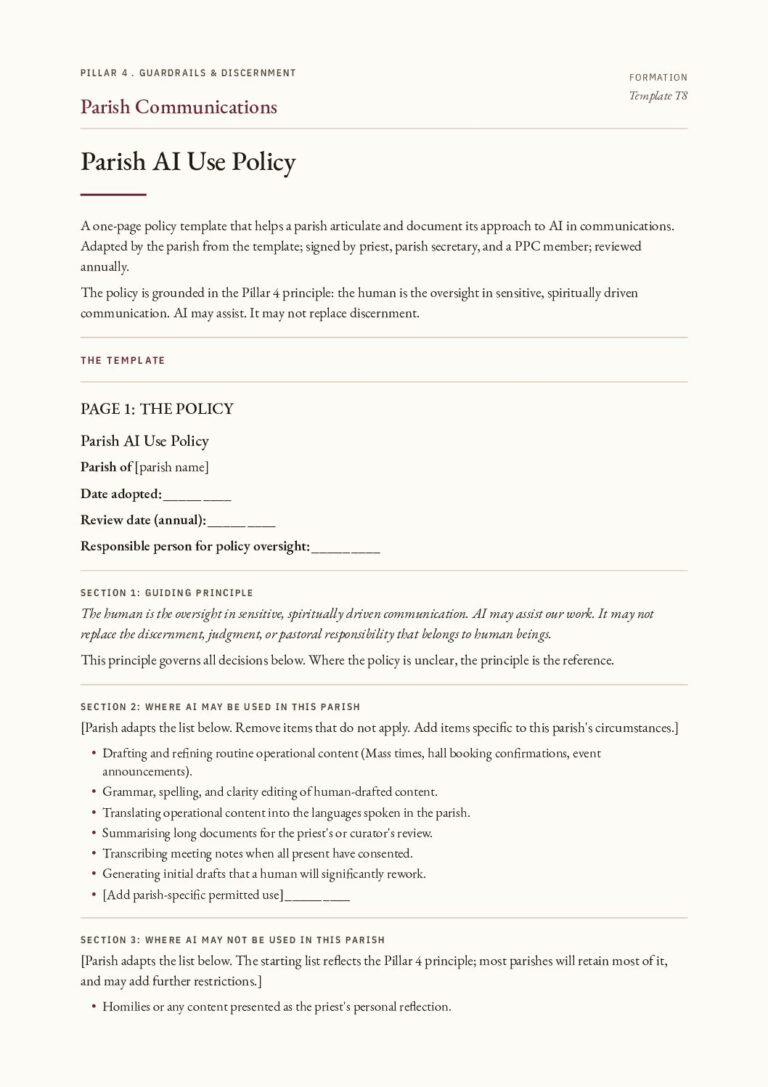
There's a free policy template for this in the library. Parish AI use policy
THE TEMPLATE
[To be rendered as a three-page PDF, A4. Page 1 and Page 2 are the protocol itself. Page 3 is worked examples. DOCX version supports adaptation.]
PAGE 1: THE PROTOCOL (PART 1)
Safe Environment Communications Protocol
Parish of [parish name]
Date adopted: _______________________________________
Review date (annual minimum, sooner if guidance changes): _______________________________________
Parish Safe Environment Officer: _______________________________________
Parish Communications Curator: _______________________________________
Section 1: Scope
This protocol governs the interface between parish communications and parish safe environment. It does not replace the parish safe environment policy, which follows diocesan and bishops’ conference guidance.
It names the specific communications decisions that require safe environment consultation, and establishes a clear working relationship between the safe environment officer and the communications curator.
Section 2: Content always requiring safe environment sign-off before publication
The following categories of content are not published, in any channel, without the safe environment officer’s review and approval:
- Any image of a named minor (under 18), whether in the parish bulletin, website, social media, printed materials, or shared with the diocese.
- Any image of a vulnerable adult, where capacity or sensitivity is a factor.
- Named references to children in sensitive contexts (illness, family crisis, safe-environment-adjacent situations, difficult family circumstances).
- Named references to vulnerable adults in sensitive contexts.
- Historical content being re-surfaced or re-published that involves any of the above.
- Any communication referring to a safe environment matter, whether ongoing or historical, whether within the parish or in the wider Church.
- Any content relating to the parish’s response to a safe environment concern, incident, or investigation.
If in doubt, the communications curator defaults to consultation, not publication.
Section 3: Content requiring safe environment awareness but not formal sign-off
The following categories require the curator’s awareness of safe environment principles but do not require sign-off on each instance:
- General group photos where children are present (congregational photos, parish events) with appropriate standing consent in place.
- Announcements about children’s sacramental preparation (First Holy Communion, Confirmation) naming groups rather than individuals.
- General pastoral communications that touch on safe environment themes (Child Protection Sunday, safe environment training announcements, diocesan awareness campaigns).
For these categories, the curator proceeds using the standing consents and general practice agreed with the safe environment officer). Specific questions are raised as needed.
Section 4: Image consent procedures
For minors:
- Annual consent forms are collected from parents or guardians at the start of the school year or sacramental preparation program.
- The consent form specifies the specific uses permitted (parish website, parish social media, parish bulletin, diocesan communications, external media).
- Specific consent is required, beyond the annual form, for specific high-profile uses (website banner, social media featured content, printed materials distributed beyond the parish).
- Children have the right to decline being photographed, regardless of parental consent in place.
- Parents or guardians may withdraw consent at any time, and the parish removes the relevant images promptly.
For vulnerable adults:
- Consent is sought directly from the person when capacity allows.
- Where capacity is in question, consent is sought through the appropriate advocate, family member, or legal representative.
- Specific rather than general consent is sought for each use.
- The right of withdrawal is respected at any time.
Record-keeping:
- Consent forms are kept securely by the parish, in line with data protection requirements.
- Retention period: as specified by diocesan data protection guidance.
- Access to the consent forms is limited to named staff (parish secretary, safe environment officer, priest).
PAGE 2: THE PROTOCOL (PART 2)
Section 5: Historical content review
The parish’s website, social media, and archives accumulate content over years. Content that was appropriate at the time of publication may not be appropriate to leave publicly accessible now.
Review cadence:
- An annual review of content published more than two years ago, for content involving minors or vulnerable adults.
- A responsive review whenever a concern is raised, by a parent, a safe environment referral, or the safe environment officer).
Who conducts the review:
- The communications curator, in consultation with the safe environment officer).
- Content identified for removal is removed promptly.
- Where removal is contested (for example, the content was consented to at the time and is treasured by a family), the safe environment officer’s judgment prevails.
Section 6: The mandatory reporting obligation
If in the course of communications work any person becomes aware of information suggesting a safe environment concern, the obligation is to report through the proper channels immediately.
No exceptions. No weighing of goods. No discretion. The safe environment officer is the named first point of contact, followed by diocesan safe environment protocols.
This obligation applies to:
- The parish secretary.
- The communications curator.
- Any volunteer or staff member handling submissions.
- Any agency or contractor working on parish communications.
The obligation is paramount. It overrides confidentiality expectations within the communications workflow. It does not override the seal of confession, which belongs to a different category entirely.
Section 7: The working relationship
The safe environment officer and the communications curator work as colleagues, not as opposing functions. The protocol functions because the relationship works.
Agreed working pattern:
- The safe environment officer and communications curator meet at least quarterly for a short check-in (30 minutes or so is usually enough).
- The curator raises any uncertain cases directly with the safe environment officer, as soon as the uncertainty arises.
- The safe environment officer flags any communications implications of her own work to the curator (for example, a new diocesan campaign, a change in consent procedures, an upcoming training event).
- Where the two disagree on a communications matter, the priest is the final arbiter on the communications question.
- Where the two disagree on a safe environment question, the safe environment officer’s authority is not negotiable; her judgment prevails.
Section 8: Signatures
This protocol is adopted jointly. Changes to the protocol require the agreement of both named signatories and the priest.
Safe Environment officer: _______________________________________ Date: _______________
Communications curator: _______________________________________ Date: _______________
Priest: _______________________________________ Date: _______________
PAGE 3: WORKED EXAMPLES
This page supports the curator and safe environment officer in applying the protocol to common real-world situations.
A parent sends a lovely First Holy Communion photo and asks if it can go on the parish website.
Standing consent forms should cover this. The curator checks that the specific child in the photo has appropriate consent on file, and that the intended use (parish website) is within the scope of that consent. If yes, the photo can be published without further sign-off.
If the child does not have current consent on file, the photo is not published until consent is obtained.
A family in crisis asks for prayers through the weekly prayer list, mentioning their son’s difficulty by name and details.
The request is received and the family is thanked pastorally. The public prayer list reads: “Please pray this week for a family in our parish facing a difficult situation.” The specific prayers happen through the parish’s private prayer ministry. The family is informed how the prayer request will be communicated publicly; if they want more or less, they are consulted.
The safe environment officer is not typically consulted for this situation, as no safe environment concern is present. The principle applied is general pastoral discretion.
A bereaved family asks if they can share the story of their late child in the parish bulletin as a memorial.
The safe environment officer and the priest are both consulted before anything is drafted. The family’s wishes are honored, but the parish takes responsibility for how the story is told. A draft is prepared, shown to the family, adjusted as they wish, and reviewed by the safe environment officer before publication.
If the story involves any safe-environment-adjacent detail (for example, the nature of the death, circumstances in the family), the safe environment officer’s judgment on what can be safely communicated prevails.
A parishioner forwards an article about an abuse case in another diocese and asks if the parish should share it on Facebook.
Not without significant discernment. The priest and safe environment officer are consulted before anything is posted. Often the answer is that the parish does not share, because the matter is not the parish’s to comment on publicly. If the parish does respond, the response is carefully worded, approved by the safe environment officer, and typically a single measured statement rather than ongoing commentary.
A youth minister submits a blog-style reflection about the confirmation retreat, naming several teenagers who had moving experiences during the weekend.
The curator does not publish until each named teenager (and their parents, if minors) has seen the reflection and consented to its publication. Consent is specific: what will be said, where it will be posted, how identifiable the teenager will be.
If any teenager or parent declines consent, that teenager is not named, and the reflection is reworked to honor the decision.
A historical photograph from a parish event ten years ago is discovered on the parish website, showing children who are now adults.
The photograph is reviewed in the annual historical content review. The question is not only “was this appropriate then?” but “is it appropriate to leave publicly accessible now?” Given that the children photographed are now adults, their consent to continued publication would need to be obtained, or the photograph removed.
The safe environment officer makes the final call in consultation with the curator and the priest.
Based on the True Light Digital Formation framework. For the cornerstone essay on which this protocol is based, see truelight.digital/formation/guardrails-and-discernment/.
This template should be adapted to the specific safe environment framework of the USCCB in which your parish is located. It does not replace diocesan safe environment guidance; it complements it by naming the communications interface specifically.
True Light Digital publishes this template as part of its free Formation library. If your parish would value support in building a wider communications system, please contact us at sean@truelight.digital. If not, we hope this template serves you well on its own. That is the goal.
Download
Free, no email needed. Adapt it for your parish and hand it to the next volunteer.