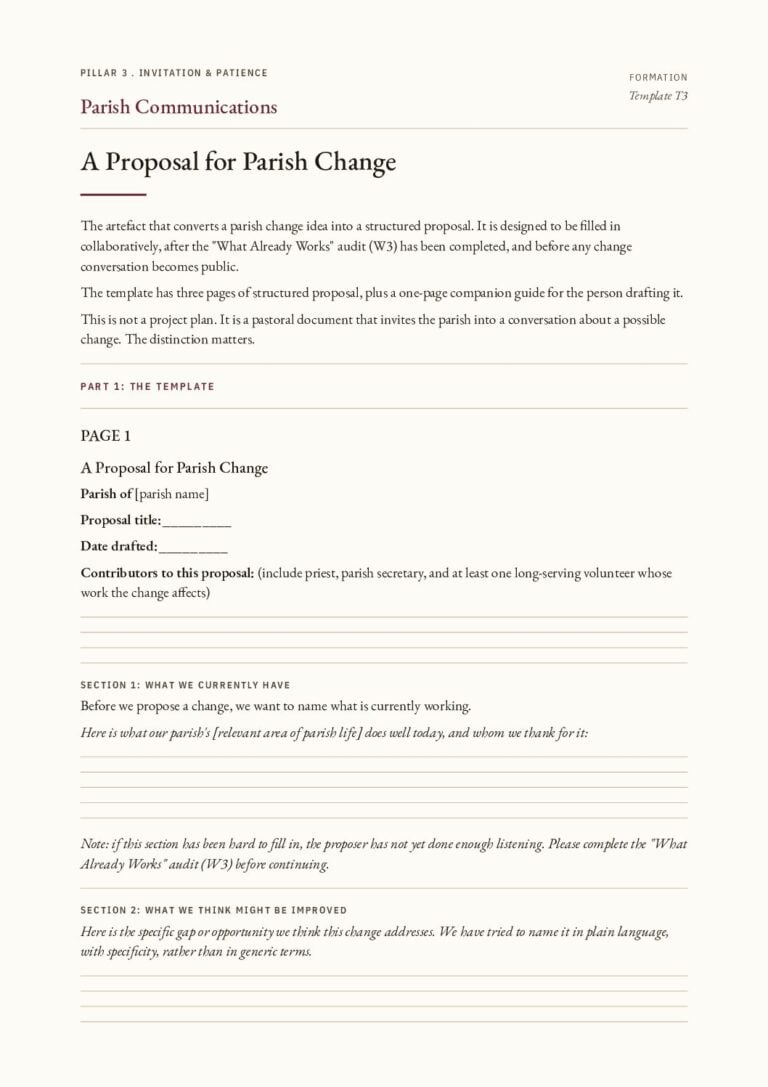
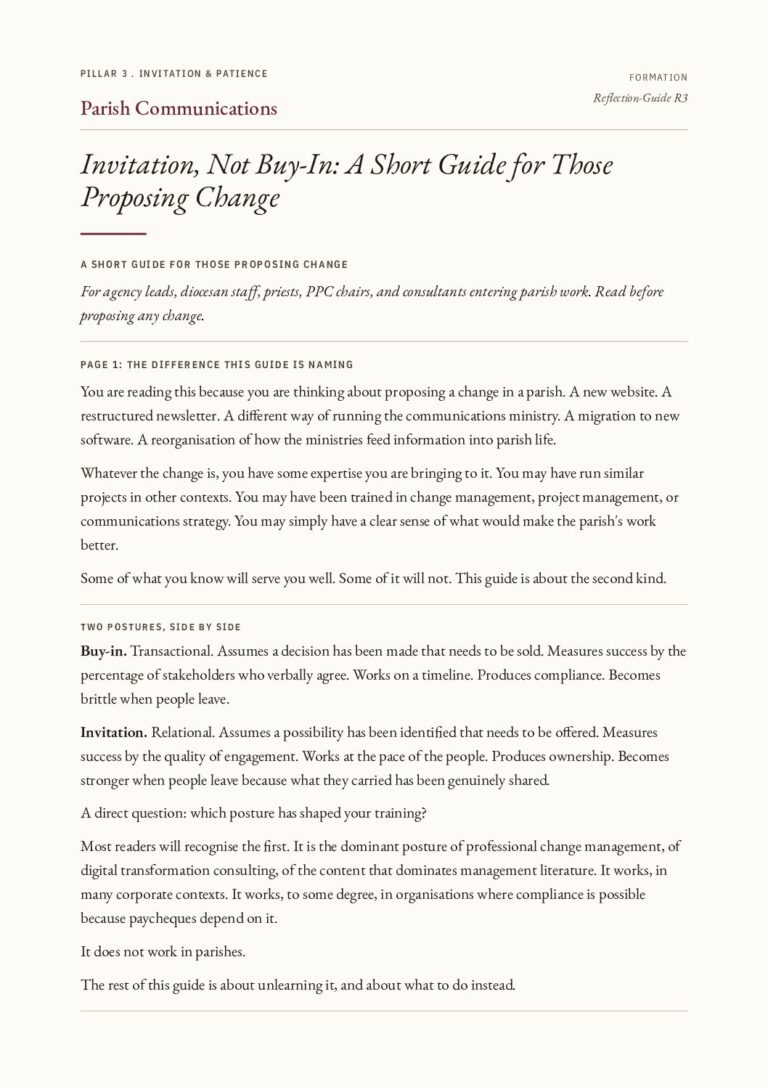
A reference document for project sponsors, agencies, and priests responsible for the pace of a parish change. Read at the start of a project and reread at the start of each of the three seasons. Not a one-time read; a working companion.
THE GUIDE
[To be rendered as a four-page PDF, A4. Visual timeline on Page 1. Each subsequent page gives guidance for one of the three seasons. Designed to be printed and held for reference throughout a change project.]
If your parish website is where this goes wrong, we build ones the office can actually run. Catholic parish websites
PAGE 1: THE PRINCIPLE AND THE VISUAL
Three-Seasons Pacing Guide
For significant parish change projects.
The principle
A year is the honest minimum pace for any significant parish change.
The year is measured in liturgical seasons, not calendar months. Compressing the timeline does not speed up the change; it fails the change faster. The pace can always be extended if the parish needs it to be. It should rarely be compressed.
A change conducted in three seasons has three distinct phases:
Season 1: Introduction and listening.
Season 2: Pilot and adjustment.
Season 3: Adoption and commitment.
Each phase has its own character, its own work, and its own warning signs.
The visual
[To be rendered as a horizontal timeline graphic spanning the liturgical year, with the three seasons marked as distinct zones, indicative of progression and pace rather than fixed calendar dates.]
A typical sequencing might look like this:
| Season of the Year | Phase of the project | |—|—| | Advent / Christmas | Season 1 begins: introduction and listening | | Ordinary Time (after Christmas) | Season 1 continues | | Lent | Season 2 begins: pilot | | Eastertide | Season 2 continues: adjustment | | Pentecost / early Ordinary Time | Season 3 begins: adoption | | Summer Ordinary Time | Season 3 continues: settling | | Late Ordinary Time | First review | | Christ the King / Advent (a year later) | Change is complete and integrated |
The specific liturgical seasons can vary. What matters is that three distinct phases span meaningful parish time, not calendar quarters.
The Holy Spirit’s pace
One reminder to carry through all three seasons: the Holy Spirit is not on our timeline. We work at the pace of persons.
Every time the timeline feels slow, every time there is pressure to compress, every time someone asks why this cannot happen faster, return to that sentence. Parish change done at parish pace is the only kind that lasts.
PAGE 2: SEASON 1: INTRODUCTION AND LISTENING
What should be happening:
- The “What Already Works” audit (W3) is completed before this season begins, or in its first weeks.
- The change is introduced to a small circle first: priest, parish secretary, key affected volunteers. Not to the wider parish.
- The change proposal template (T3) is drafted collaboratively, with the people whose work the change affects.
- The proposal is then shared with the parish pastoral council (PPC) and wider parish for response.
- Specific time is allowed for people to sit with the idea before being asked to commit.
What should not be happening:
- Nothing is built yet. No software is purchased. No contracts are signed.
- No decisions are finalised.
- The agency or consultant, if involved, is in a listening mode, not a building mode.
The key question of this season:
Is this actually the right change for this parish, at this time?
Most of the listening in Season 1 is about answering this question honestly. Sometimes the answer is no. That is a legitimate outcome, and stopping at the end of Season 1 is not a failure; it is Season 1 having served the parish.
Warning signs in Season 1
Key people are not responding to invitations to discuss.
The priest’s messages go unanswered. The parish secretary is not proactive. A long-serving volunteer cancels a scheduled conversation.
What to do: pause. Do not push. Ask gently what is happening. The answer is almost always telling you something the proposal missed.
The proposal is being met with polite non-engagement.
People say “that sounds good” without questions, suggestions, or concerns. That is not agreement. That is disengagement dressed up in politeness.
What to do: ask specifically what they would change, what they worry about, what feels missing. Genuine engagement includes real feedback.
The parish secretary has become quieter since the proposal was shared.
She contributed early and has since stopped. Her silence usually means the proposal has landed wrong for her, and she is not sure how to say so.
What to do: speak with her directly, privately, warmly. Her view is one of the most valuable in the parish and the proposal probably needs her shaping.
What to do when warning signs appear
Pause. Listen more. Consider whether the proposal itself, not just the timeline, needs revising. Sometimes warning signs in Season 1 are asking for a smaller change than you originally proposed. Sometimes they are asking for no change at all. Both are legitimate.
Season 1 should end with a proposal that the PPC and key affected people have genuinely shaped, and with a shared sense that the parish is ready to move into Season 2. If you do not have that at the end of Season 1, do not proceed to Season 2. Extend Season 1, revise the proposal, or set it aside.
PAGE 3: SEASON 2: PILOT AND ADJUSTMENT
What should be happening:
- A pilot begins. Small. Specific. Reversible.
- The pilot involves a chosen group of originators (often the most sympathetic, confident, and patient).
- Regular, short check-ins (once every two weeks) happen with pilot participants.
- Adjustments are made in response to real use, not imagined use.
- The pilot is running alongside existing arrangements, not replacing them yet.
What should not be happening:
- No full parish rollout.
- No training sessions for people who are not in the pilot.
- No declarations that “the new system is now live.”
- No pressure on pilot participants to perform enthusiasm they do not feel.
The key question of this season:
Is this change actually serving the people it was meant to serve, in practice?
The pilot is not a soft launch. It is a listening exercise with working software. What matters is not whether the pilot produces the expected outputs; what matters is whether real users find the change makes their work better. If the answer is no, the change needs further adjustment before Season 3, or possibly a return to Season 1.
Warning signs in Season 2
Pilot participants are not using what was built.
Logins are not happening. Submissions are not arriving. The new workflow is being politely ignored.
What to do: this is not a training problem. It is a fit problem. The pilot is telling you that what was built is not what the parish actually needs. Revise. Do not push.
The pilot is producing lots of feedback that is really about something the audit missed.
Users keep bringing up things the proposal did not address. The feedback feels like it is about a different problem.
What to do: pause and return to the audit. There is tacit knowledge that did not surface in Season 1 conversations. Listen now.
Enthusiasm from the priest or agency is not matched by engagement from actual users.
The priest is positive in meetings, but the parish secretary is quiet. The agency’s team is proud of the pilot, but the pilot participants are non-committal.
What to do: weight the users’ response more heavily than the leaders’ enthusiasm. The leaders’ enthusiasm can be misleading because they are too close to the project. The users’ response is what Season 3 will depend on.
What to do when warning signs appear
Pause the pilot. Do not extend it in the hope that things will improve. Return to the audit, have the honest conversations again, revise what was built, and restart the pilot when the revisions are in place. A pilot that is running while known problems exist is producing false data, not real learning.
Season 2 should end with the pilot demonstrating genuine, not manufactured, fit with the parish’s actual work. If it does not, Season 3 will fail.
PAGE 4: SEASON 3: ADOPTION AND COMMITMENT
What should be happening:
- Full rollout to the parish, following a pilot that has genuinely succeeded.
- Training, documentation, and commissioning of the named people who will carry the work forward.
- Clear handover from the project phase to the ongoing operation. The agency or consultant steps back. The parish owns the work.
- Review commitments agreed: first review at six months post-adoption, annual review thereafter.
- Explicit end of the project phase. Named celebration if appropriate.
What should not be happening:
- Rushing the rollout because the deadline has arrived.
- Adding features or changes that were not in the pilot.
- Continuing the project indefinitely without a named end.
- The agency or consultant remaining embedded beyond the agreed handover.
The key question of this season:
Can this change sustain itself in the parish without the project team continuing to carry it?
If the answer is yes, the rollout completes and the change becomes ordinary parish life. If the answer is no, Season 3 needs to extend or restart, not push through.
Warning signs in Season 3
The rollout is happening because the deadline has arrived, not because the parish is ready.
Milestones on a project plan are being met while the reality on the ground is not ready. This is the most dangerous moment in the whole project because it looks like success.
What to do: delay the full rollout. Extend the pilot. Schedule more preparation. Yes, this is uncomfortable for the budget and the timeline. It is also what distinguishes a change that lasts from a change that collapses in six months.
Training sessions are thinly attended.
The parishioners who need to learn the new tool are not showing up. This is not an attendance problem. It is a signal that the parish is not yet committed to the change in the way Season 3 requires.
What to do: pause the training. Return to the pilot participants and ask what they have heard from others. Reconfigure the rollout based on what they say.
The people commissioned to carry the work forward are visibly anxious about it.
The new curator is nervous. The commissioned originators are quiet. The handover is happening mechanically rather than confidently.
What to do: slow down the handover. Offer more support in the first months. Do not treat the commissioning moment as the end of the work; treat it as the beginning of a new phase of accompaniment.
What to do when warning signs appear
Delay, extend, support. Do not push. The project that finishes on time but fails to sustain itself is a more expensive failure than the project that takes an extra three months and becomes ordinary parish life.
Season 3 should end with the change integrated into the parish’s ordinary work, owned by named people, supported by clear documentation, and running without the project team’s daily attention. The first six-month review is scheduled. The agency, if involved, has stepped back.
After Season 3
The project is done. The change is now part of the parish’s life. You, as the person who led the project, have two last responsibilities:
The six-month review. Return for the named review. Celebrate what is working. Honestly address what is not. Make adjustments.
The long goodbye. The parish does not need you anymore. That is the goal. Do not over-extend your presence. The people you commissioned should carry the work forward; your continued closeness can become a kind of dependence. Trust them. Let go gracefully.
The closing principle
A parish change done in three seasons is a parish change that holds. A change rushed into eight weeks is a change the parish will spend the following two years quietly undoing. The honest calculation is that patience is cheaper.
Through all three seasons, one reminder: the Holy Spirit is not on our timeline. We work at the pace of persons.
Based on the True Light Digital Formation framework. For the cornerstone essay on which this pacing guide is based, see truelight.digital/formation/invitation-and-patience/.
True Light Digital publishes this guide as part of its free Formation library. If your parish would value support in building a wider communications system, please contact us at sean@truelight.digital. If not, we hope this guide serves you well on its own. That is the goal.
Download
Free, no email needed. Adapt it for your parish and hand it to the next volunteer.