A Reflection Guide for Difficult Decisions
For the priest, parish secretary, or curator facing a communications decision they are not sure about.
[To be rendered as a six-page PDF, A4 portrait, with typography that invites slow reading. Pale, warm background. Generous white space. A small image or woodcut at the head of each page would be appropriate but not essential. True Light Digital attribution in footer. Formatted so the reader can print and take the pages away from the screen.]
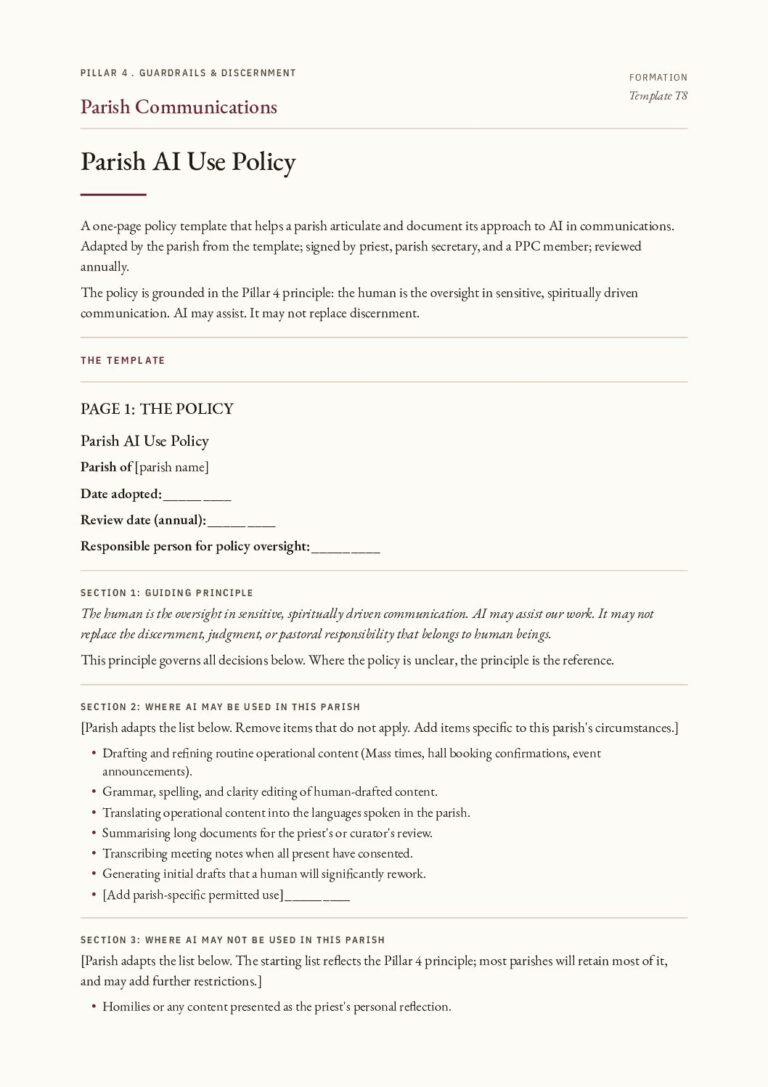
There's a free policy template for this in the library. Parish AI use policy
PAGE 1: THE INVITATION
You are reading this because you are facing a decision you are not sure about.
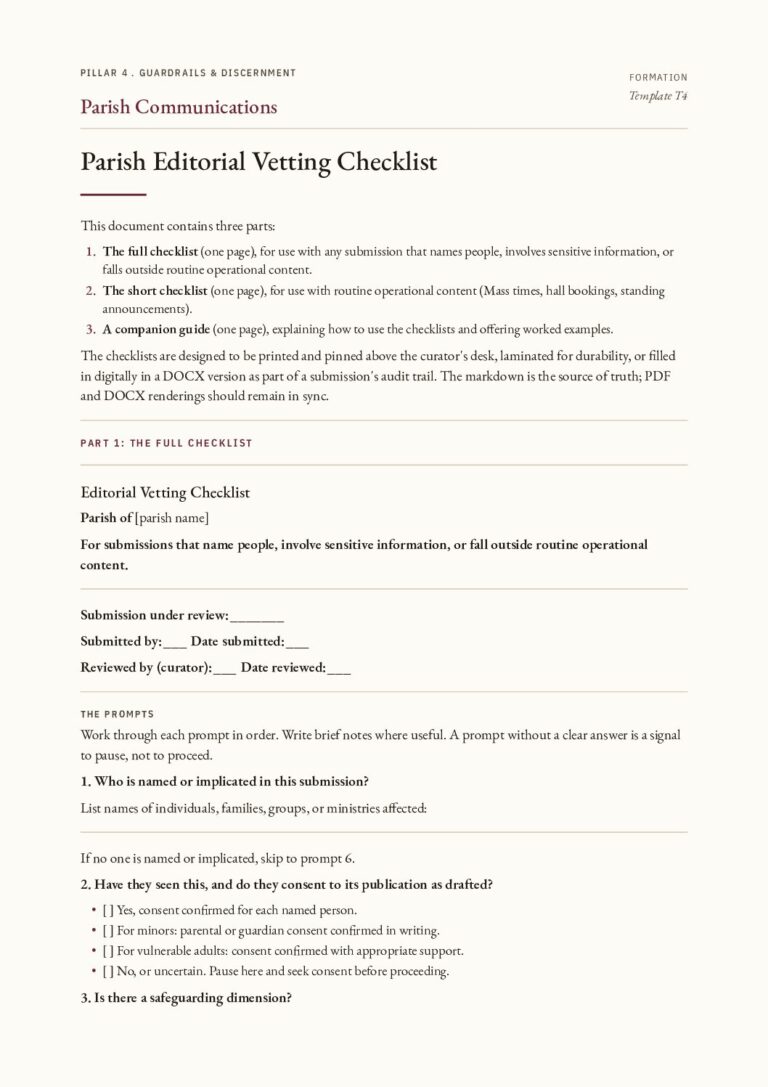
Something has arrived. A submission. A question. A situation. And you do not know whether to communicate about it, or how, or when. You have probably already read the Editorial Vetting Checklist. The Checklist has asked you the question “Is silence the better option here?” and you have paused, because you are not sure.
This guide is for that pause.
Before reading on, take three slow breaths. Put down the screen if you can. Sit somewhere quiet, with a cup of tea if you have one, away from the parish office if possible. This is not a decision to rush, and this guide is not designed to be skimmed between other tasks. It is written in the register of spiritual direction, not consultancy. It asks for a different quality of attention than your usual reading.
You do not need to read the whole thing in one sitting. You may find that one page is enough for now, and that you come back to another page later.
If you are praying person, and you are inclined to, it may help to begin with a short prayer for clarity. If you are not, the stillness alone will do the work.
Then read on.
PAGE 2: THE THREE CASES WHERE SILENCE SERVES
There are, broadly, three kinds of situation in which silence is not absence but positive pastoral choice. The decision you are facing is likely one of these, or a combination.
Tragedy
Something serious and painful has happened. A death. A family crisis. A diagnosis. A loss that the parish is aware of.
The instinct of modern communications practice is to respond with content. A statement. A reflection. A social media post. Sometimes this is right. Often it is wrong.
The family whose child has died does not need the parish’s Instagram post about grief. They need a priest at the house. They need the parish secretary to hold the funeral arrangements carefully. They need specific, human presence. The public communication, if it ever comes, comes slowly, with the family’s consent, and only if it serves them.
Silence, in tragedy, is not absence. It is presence held close rather than broadcast. It is love that does not need to be seen.
Controversy
Something contentious has arisen. An anonymous complaint. A disgruntled former volunteer’s public post. A parishioner’s public issue with a decision of the priest. A controversy splashing onto the parish from the diocese or the wider Church.
The instinct is to respond, to clarify, to get ahead of the story. Sometimes this is right. Often it escalates what would have died on its own.
A parish that rebuts publicly has agreed to meet the complainant on the complainant’s terms, which are the terms of public contest. The parish’s own terms are different: pastoral care, relational repair where possible, and the Church’s long confidence that most disputes subside when they are not fed.
Silence, in controversy, gives the situation the weight it actually deserves, which is usually less weight than it has claimed.
Fatigue
The parish is tired. The readers are tired. The liturgical season is exhaling. You yourself are tired.
The right communications move is less, not more. A week without a newsletter in Ordinary Time is not a failure. It is sometimes a gift to everyone involved.
Silence, in fatigue, is rest for both the parish and its readers. It is trust that the rhythm of the year will bring the next deep breath when it is time.
If the decision you are facing is one of these three, the rest of this guide can help you sit with it. If it is something else, the prompts on the next page may still help you find your way.
PAGE 3: STRUCTURED PROMPTS
Work through these prompts slowly. Write your answers down if that helps. Not to file anything; just to think on paper.
The prompts are not designed to produce an answer. They are designed to produce the kind of attention from which an answer can emerge.
1. Who is affected by this communication, by name?
List the people, families, or groups who would be directly affected if you publish.
2. What would publishing do for each of them?
Take each person named above. Ask, honestly, what publishing would actually do for them. Would it comfort? Would it expose? Would it help? Would it hurt? Would it honor? Would it embarrass?
Do not generalise. Each person is specific.
3. What would not publishing do for each of them?
Now ask the same question in reverse. If you stay silent, what happens to each of these people? What is lost by silence? What is protected?
4. Whose attention is this communication serving?
The reader’s, who would benefit from knowing? The parish’s own need to be seen responding? The submitter’s need to say something? Your own instinct to act?
Be honest. Sometimes the attention being served is not the attention that most needs serving.
5. If this happened in a parish you do not know, watching from outside, what would you want them to do?
Sometimes the clearest judgment comes from imagining yourself as an outsider. If you read on Facebook that a different parish had published this submission, what would your honest reaction be?
6. Is there a pastoral action that would be more appropriate than a communication?
A phone call to the family. A visit from the priest. A private word with the submitter. A personal letter. Real presence is almost always more pastorally useful than broadcast, when there is real pain involved.
7. If you published, and it went wrong, what is the worst outcome? If you did not publish, and it went wrong, what is the worst outcome?
This is the most uncomfortable prompt. Both paths carry risk. Naming the worst case honestly on both sides helps you see what you are actually choosing between.
8. What does the priest think? Have you asked him, specifically, about this decision?
If you have not, pause and do so. Not by email if it can be avoided. A short conversation. His discernment may be different from yours, and that is useful information.
Sit with your answers. You may find that one of them clarifies the whole question. You may find that they raise questions you had not thought to ask. You may find that you need to come back to this tomorrow, after the decision has rested.
All of these are signs of discernment working.
PAGE 4: THE THEOLOGY OF SACRED SPEECH
The Catholic tradition knows something about speech that most modern communications training does not.
The seal of confession
The seal of confession is the absolute marker. What is said in the sacrament of penance belongs to God alone. Nothing, no state power, no pastoral urgency, no clever argument, can break that seal.
The existence of this absolute limit teaches the Church something about speech more generally: that some things are protected by not being said, and that the Church has always known this. The seal is the extreme case. It is not the whole of what the tradition teaches about silence, but it is the foundation.
Not every parish communication is a confession. But the principle extends. Some things are protected by not being said. Some pastoral realities are better held than broadcast. Some truths are better served by silence than by words, at least for now, at least in this venue.
Custodia linguae
There is a tradition in Christian spirituality called custodia linguae, “guardianship of the tongue.” It is ancient. The Rule of Saint Benedict has a chapter on it. The desert fathers and mothers practiced it. Saint James, in his letter, writes that the tongue is a fire, a world of iniquity, and that the person who can control it is perfect, and able to control the whole body.
Custodia linguae is not a rule against speech. It is a discipline of speech. A practice of tending one’s words as carefully as a gardener tends plants. Speaking when speech serves. Staying silent when silence serves. Knowing the difference.
You, as a parish communicator, are a practitioner of this ancient discipline, whether or not you have used the word for it. The decision you are sitting with is an instance of custodia linguae. You are in the tradition.
Christ’s own silence
In the Gospels, Christ is silent at specific moments. Before his accusers. Before Pilate, at the critical moment. Before Herod, who wanted entertainment. The silences are not accidental. They are not passive. They are deliberate, and they teach.
Silence is sometimes God’s own language. When Christ was silent before his accusers, he was not agreeing with them; he was refusing to meet their terms. When he was silent before Herod, he was refusing to be made into a spectacle. His silences served his mission as clearly as his speech did.
The parish that learns to use silence well is participating, in a small and local way, in something Christ himself practiced.
PAGE 5: A PRAYER FOR DISCERNMENT
For use if you are of a mind to pray. Optional. You may pray it slowly, twice if that helps, or adapt the words to your own.
Lord,
you have given us words as a gift, and I am grateful for them.
You have also given us silence, and you have taught us, through your Son’s silence before his accusers, that silence is sometimes your own language. I did not always know this.
I am facing a decision about whether to speak or to stay silent. I do not trust my own instincts fully. I am tired, or anxious, or being pushed, or all three. The pressure to act is real. The ease of acting is sometimes what makes acting the wrong choice.
Grant me the grace of hesitance.
Slow my hand. Give me the patience to sit with this decision longer than I want to. Let me hear, in the quiet, what I have not yet heard.
If I should speak, give me the words, and the courage to use them well. If I should stay silent, give me the courage for that too, and the faith to trust that my silence is serving those I cannot see.
Grant me, in particular, the wisdom to know whose attention I am serving. If it is not truly the reader’s, or the family’s, or the parish’s, let me recognize that and choose again.
Help me not to be moved by the pressure to appear responsive. Help me to be moved by what actually serves.
And if my decision turns out to have been imperfect, let me be at peace with that too, knowing that I made it in a posture of care, which is itself a form of love.
Through Christ our Lord, who spoke when he should, and was silent when he should, and whose silence was as eloquent as his speech.
Amen.
Or, if a shorter form helps:
Lord, slow my hand. Let me hear what I have not yet heard. Whether I speak or am silent, let it serve. Through Christ our Lord. Amen.
PAGE 6: AFTER THE DECISION
Whatever you decide, do three things.
Write down what you decided and why
Two sentences. Not a report. Not a defense. Just a record.
“I decided to hold the submission until after the funeral, because the family had not consented to the detail being published. I spoke with the priest before deciding.”
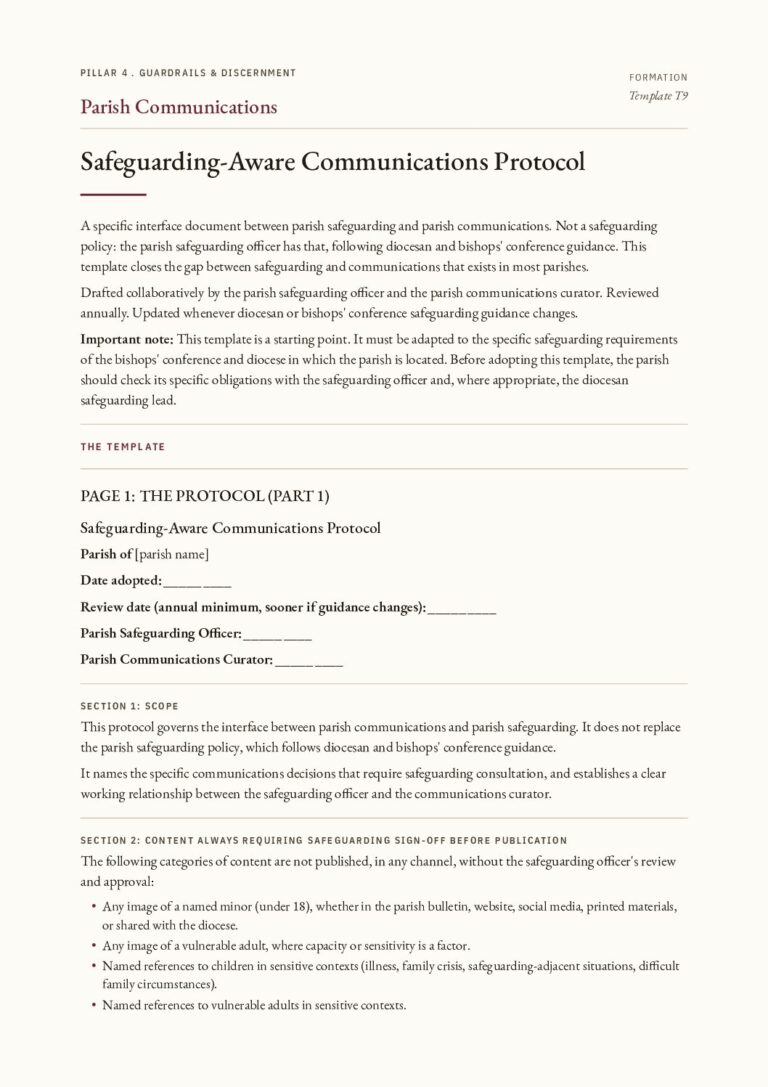
“I decided to publish the announcement without changes, after consulting the safe environment officer, because the consent forms were complete and the context was appropriate.”
“I decided not to respond publicly to the complaint on Facebook, because I judged that responding would give it weight it did not deserve. The priest has reached out privately.”
Keep these notes. Not defensively. As a way of honoring the discernment that happened, so you remember what you learned, and so anyone who comes after you has some idea of how this parish thought about hard cases.
This is institutional memory at its simplest and most valuable. The curator who comes after you, in five years or ten, will be grateful.
Mark the follow-up
If you held back, mark the date you will revisit. Sometimes silence is for now, not forever. The family may be ready in a month. The season may pass. The right moment may come.
If you published, mark the date you will check in on those most affected. Your decision is not complete when the publication happens; it is complete when you know whether what you did served the people you were trying to serve. A phone call, a brief visit, a quiet word after Mass. Did this land as you hoped?
This is how good communications work becomes better over time. Not by hoping. By checking.
Know that you did something quietly important
The decision you made, even if it turns out to have been imperfect, was made in a posture of care. That posture is itself a form of love.
Most of what good parish communications looks like is things that did not happen, because somebody paused. You paused. You thought. You asked the right questions. You may not have landed the decision perfectly, but you landed it thoughtfully, which is the most that any of us can do.
The parish you serve is blessed by someone who takes this work this seriously.
Thank you.
This guide is part of the Pillar 4 reflection library within the True Light Digital Formation framework. For the cornerstone essay on which it is based, see truelight.digital/formation/guardrails-and-discernment/.
Other reflection guides in this family may also serve you, depending on the decision:
- Forming a Champion: A Short Guide for the Priest (R1)
- Ordinary Time Is Not Nothing (R2)
- Invitation, Not Buy-In (R3)
True Light Digital publishes these reflections as part of its free Formation library. If your parish would value support in building a wider communications system, please contact us at sean@truelight.digital. If not, we hope this guide serves you well on its own. That is the goal.
Download
Free, no email needed. Adapt it for your parish and hand it to the next volunteer.