How a parish learns to breathe with the Church, and why most parish communications are quietly gasping.
Salve Regina
Salve, Regina, Mater misericordiae, vita, dulcedo, et spes nostra, salve.
The free church SEO audit does this check for you. Free church SEO audit
Hail, Holy Queen, Mother of Mercy, our life, our sweetness, and our hope. A prayer the Church has breathed for a thousand years, at the end of Compline, at the close of the Rosary, at the edge of sleep. You say it because somebody who came before you said it, and somebody who comes after will say it when you are gone. The words are not yours. The breath is yours.
This essay is about that kind of breath. The kind a parish takes together, over the course of a year, whether it means to or not.
Because communications is not broadcast. It is not output. It is not transmission. It is breath. And the parishes whose communications actually land, in the hearts of the people they are meant for, are parishes that have learned how to breathe with the Church.
Most parishes haven’t. Most parishes are quietly gasping, producing the same volume of the same kind of content every week of the year, regardless of whether the Church is inhaling or exhaling. Fourteen items in the second week of Advent. Fourteen items in the octave of Easter. Fourteen items in Ordinary Time when the Church is resting and the people need rest with her.
The reader opens the newsletter. Scans. Closes. Nothing has landed. The parish has spoken and nothing has been heard. Not because the reader is indifferent. Because the parish has forgotten how to breathe.
The diagnosis
Here is the honest assessment of most parish communications I have seen in England, and from conversations with people in Ireland, Scotland, the United States, and beyond.
The parish is not communicating too little. Quite often it is communicating too much. The problem is not volume. The problem is that the volume is flat. Everything is delivered at the same weight, at the same cadence, at the same tone, regardless of what the Church is doing in that moment of the year.
A parish producing a weekly bulletin with fourteen items is not, by that act, serving its people. It is, more often, exhausting its parish secretary, overwhelming its readers, and producing the impression that the Sunday Eucharist and the Wednesday hall booking are matters of roughly equivalent importance. Neither of which is true.
This isn’t a technology problem. This isn’t a staffing problem. It isn’t even really a content problem, not at the level most people think about content. It is a rhythm problem. The parish has forgotten that communication has seasons, that some content is meant to rise and some is meant to fall, that some weeks of the year call for depth and others call for quiet. A parish that communicates at constant volume all year is a parish that has replaced rhythm with routine, and routine is not the same thing.
The good news is that the fix is not another CMS. The fix is learning, or remembering, how the Church has always breathed, and then letting the parish’s communications breathe with her.
What breath actually looks like
Here is the image I want you to hold in your head for the rest of this essay.
The Church, over the course of a year, breathes. Deeply, slowly, with rhythm that has been shaped over two thousand years.
She takes her first inhalation at Advent. Four weeks of drawing in, of waiting, of preparation, of the quiet expansion of the lungs. Christmas is the held breath, the moment at the top of the inhalation, the fullness before release. Then she begins to exhale, gently, into Ordinary Time after Christmas. The breath goes out. The people who came for the inhalation drift away, and the Church does not chase them. She trusts the rhythm.
Then Lent, a deeper inhalation, forty days of drawing in. Holy Week is the held breath at its fullest. The Triduum is the longest, quietest held breath in the Christian year: the silence of Holy Saturday, the waiting at the tomb, the held breath of the universe before the resurrection. Easter is not an exhalation; Easter is the breath releasing with such force that it carries the Church through an entire octave and beyond, through Eastertide, to Pentecost, where the Spirit is given and the exhale begins to settle.
Then the long exhale of Ordinary Time. Weeks and weeks of it. The Church is resting. The people come less. The Church does not gasp to bring them back. She knows Advent is coming. She trusts the rhythm.
A parish’s communications, whether the parish realizes it or not, are either breathing with this rhythm or fighting it. And most parishes are fighting it, not out of ill will, but because nobody has given them language for the alternative.
The four properties of parish communication that breathes
If you accept the image of breath, then good parish communication has four properties, and I want to walk through each one before we get to the practical section.
It has depth and shallowness. Some content matters more than others, and the parish’s communications say so. The Sunday Eucharist is not the same weight as the Wednesday hall booking, and a parish bulletin that presents them as equal bullet points is lying, gently, about the reality of parish life. Hierarchy, in its proper sense, is not about org charts. It is about rightly-proportioned attention. About telling the truth about what matters.
It has rhythm across the year. The liturgical seasons drive the pulse. Advent and Lent are inhalations. Christmas and Easter are the held breaths. Eastertide is the release. Ordinary Time is the long settling exhale, and it is not a failure of content; it is a legitimate part of the rhythm.
It has flow between levels. What originates at the diocese comes down. What originates at the parish stays there, or flows up to the deanery if it deserves to. What originates in a ministry group belongs to that ministry first, and appears elsewhere only if it serves the wider community. Content is not pushed everywhere by default. It moves through the levels the way breath moves through lungs: each bronchus to the place it belongs.
It has restraint. It knows when to stop. It exhales properly. It does not chase the people who drift out with the breath; it trusts the rhythm to bring them back at the next inhalation. Restraint is not cold. Restraint is pastoral. A parish that cannot stop talking is a parish that does not trust its own readers.
The rest of this essay walks through each of these four properties in turn, and ends with three things you can do this week.
Depth and shallowness: hierarchy, properly understood
The English word hierarchy has been badly damaged by corporate usage. It makes people think of org charts, of middle managers, of pyramidal power structures, of things that good people are supposed to flatten. That is not what the word means.
Hieros and archē. Sacred, and origin or rule. Hierarchy is sacred order. It is the reality that some things are not equal, and that naming the inequality is a form of love, not a form of domination.
A parent who loves three children loves each one specifically, not identically. The child who is sick tonight gets different attention from the child who is healthy, and that is not unfairness; that is the hierarchy of need expressing itself in the love of a parent. A parish that loves its people will communicate with them specifically, not identically. It will say, in the shape of its bulletin and the tone of its website and the length of its announcements, that some things matter more.
This is what a hierarchy of attention looks like in practice.
It means the Sunday Eucharist gets pride of place, every week, without apology. Not as one item among fourteen, but as the fact that organizes the week.
It means the bishop’s pastoral letter gets its own weight. Not a paragraph in the newsletter; a piece of its own, treated with the care it deserves. When the bishop speaks, the parish communicates that the bishop has spoken.
It means the sacramental calendar, First Holy Communions and Confirmations and the Triduum liturgies, rises above the operational calendar, however important the operational calendar is.
It means the bereavement notice is treated with different weight than the cake sale, not because the cake sale doesn’t matter, but because a family who has just lost someone deserves to find their loved one named with care rather than as item nine.
It means, in practice, that when the parish secretary sits down to curate the week’s communications, she is not filling slots. She is making judgments. She is saying, this matters more than that, and the shape of what I produce will reflect it. A parish that refuses to make those judgments is a parish that has outsourced its hierarchy of attention to the reader, who will make her own judgments, usually by closing the newsletter.
Love differentiates. Communications that loves its readers differentiates, too.
Rhythm across the year: the liturgical calendar as editorial spine
This is the longest section of the essay, because it is the one most parishes have thought least about.
Catholics do not live in calendar time. They live in liturgical time. A Catholic who has been catechized at any depth knows that September is not just September; it is late Ordinary Time, drifting toward the Solemnity of Christ the King, which is the hinge of the year. She knows that February is not just February; it is Lent or the run-up to it, depending on the calendar. She knows that the fifty days of Easter are not just “after Easter Sunday”; they are a season in their own right, with their own character, their own readings, their own posture of joy.
A parish whose communications ignore this is a parish whose communications feel, to a Catholic reader, weirdly secular inside a sacred context. The parish bulletin might as well be the local council newsletter, for all the difference the liturgical year makes to its rhythm.
But a parish whose communications breathe with the liturgical year gives its people a gift that almost nothing else in their week gives them: a sense that time itself has shape, that the year has meaning, that the weeks are not undifferentiated units but seasons with depth and purpose.
Here is what the breath of the year looks like, in rough editorial terms.
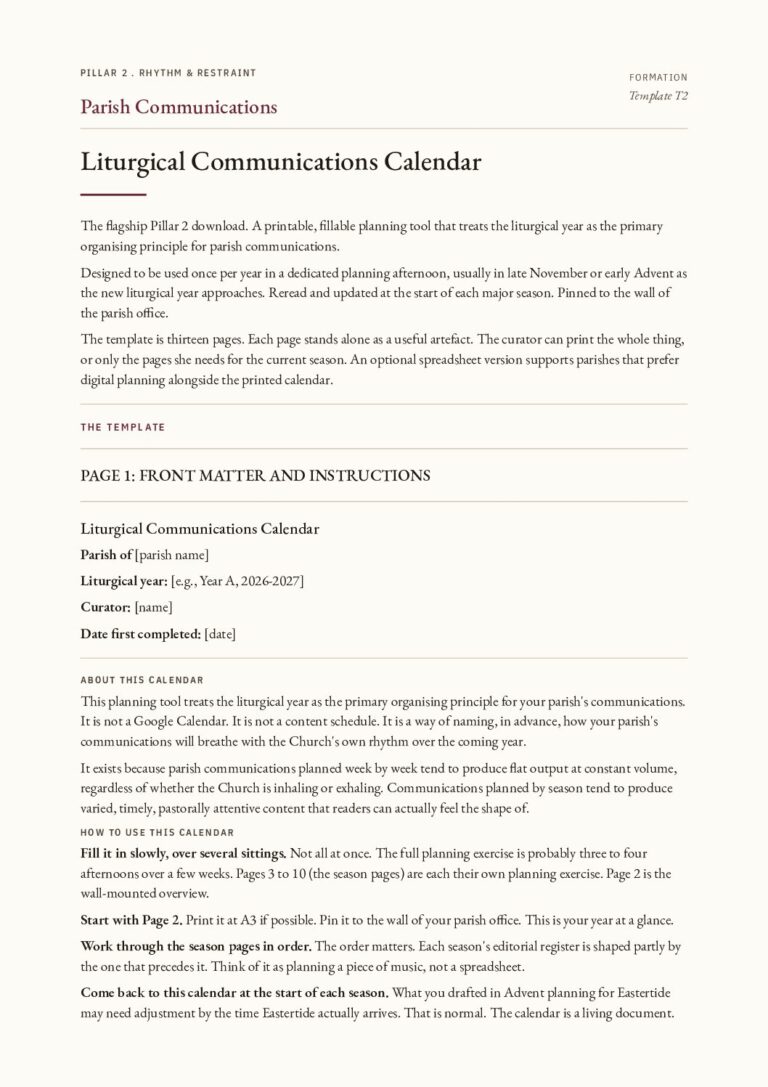
Advent is an inhalation. Four weeks of drawing in, of preparation, of waiting. The parish’s communications should slow, deepen, and narrow. This is not the season for fourteen items. This is the season for fewer, richer pieces. A reflection on waiting. A practical guide to the parish’s Advent observance. The Advent wreath lighting schedule, treated with weight. The penance service, given its own communication rather than crammed into a list. Less volume, more depth. The inhalation is gentle.
Christmas is the held breath. The Octave of Christmas is eight days of fullness. Parishes often exhaust themselves with production in the run-up and then fall silent between Christmas Day and New Year, which is almost exactly the wrong way round. The held breath is where the parish should be present, not absent. Short, warm communications through the Octave. The Feast of the Holy Family. The Epiphany. The Baptism of the Lord. Each with its own gentle presence.
Ordinary Time after Christmas begins the exhalation. Shorter in most years. The parish’s communications return to a normal cadence, but without the depth of Advent. This is legitimate. Ordinary Time is not a failure of content; it is a different register.
Lent is a deeper inhalation. Forty days. Longer than Advent, and the breath is drawn deeper. The parish’s communications should take on weight. Stations of the Cross. Fridays of Lent. The discipline of fasting and almsgiving. RCIA rising toward its fullness at the Easter Vigil. A weekly reflection, perhaps, or a curated series on the Gospel readings. The content becomes more explicitly spiritual, because the season is.
Holy Week is the held breath at its fullest. The parish’s communications should be minimal and precise. Mass times for the Triduum, with care. An invitation to the Easter Vigil. The parish’s invitation to return to confession if it has been a while. Very little else. This is the holiest week of the year; the parish bulletin is not the place to add volume. It is the place to protect the silence.
Easter is the breath releasing. The Octave. Eastertide, all fifty days of it. This is a season Protestants often mark for a week and move on. Catholics hold it for seven weeks, and the parish’s communications should too. Joy, confidence, invitation. The Easter sequence. The Gospels of the Resurrection appearances. The slow rise toward Pentecost.
Pentecost is the settling of the breath. The Spirit given, the Church commissioned, the exhale beginning in earnest.
Ordinary Time after Pentecost is the longest stretch of the year. Twenty to thirty weeks of it, depending on the calendar. This is where most parishes hyperventilate. They fill the weeks with the same volume as the rest of the year, and end up exhausting themselves and their readers by the time Advent returns. The discipline of Ordinary Time is to communicate well, but less. To trust that the year has a rhythm, and that the next deep inhalation is coming, and that the parish does not need to manufacture intensity in the weeks between.
The late weeks, drifting toward Christ the King and the new liturgical year, begin to deepen again. The Gospels turn toward the end times. The liturgy begins, gently, to prepare for Advent. The parish’s communications can begin to deepen with it.
Then the cycle begins again.
A parish that plans its year this way, one page per liturgical season rather than a weekly scramble, receives two gifts. The first is coherence: the year has shape, and the shape teaches. The second is pastoral timing: the parish is with its people at the deep breaths and gives them space at the exhales. Neither of those gifts requires new software. Both of them require someone, probably the parish secretary, sitting down with the liturgical calendar and asking: what does our breath look like this year?
Flow between levels: what moves where
This is the section most directly inherited from the original thinking about hierarchy. It is still important. It is not the center of the essay anymore.
Here is the principle, briefly. Content originates at one level and moves to others only when it serves to. It is not pushed everywhere by default. It moves through the levels the way breath moves through lungs: each to the place it belongs.
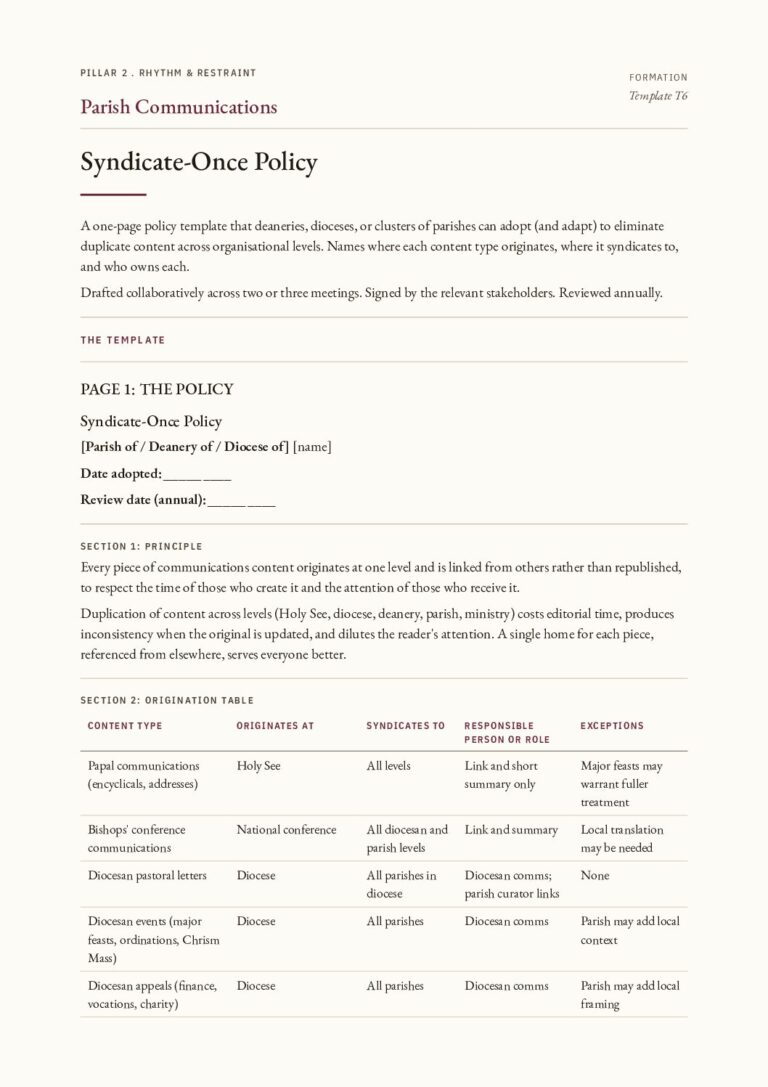
From the Holy See and the USCCB, things come down that matter to the whole Church: papal encyclicals, synodal outcomes, major feasts, universal liturgical changes. The parish doesn’t need to republish these; it needs to signpost them, with attribution, so the reader who wants to go further knows where to look.
From the diocese, things come down that matter to everyone in that diocese: the bishop’s pastoral letters, safe environment policies, major events, appeals, sacramental schedules that affect all parishes. A parish bulletin that tries to reproduce all of this becomes an appendix. The parish bulletin should summarize and link, not republish.
From the deanery, where one exists, things move between neighbouring parishes that share a priest or a cluster: joint penance services, deanery youth events, combined charity initiatives. This content matters to the parish but is not generated by it.
From the parish itself, the bulk of the content originates: Mass times, the sacramental calendar, the parish pastoral council (PPC) updates, the finance reports, the newsletter, the pastoral notes. This is the primary content of parish life.
From ministries within the parish, content rises: the SVP update, the youth retreat report, the bereavement group invitation, the music ministry’s call for new members. This is where Pillar 1’s Communications Champions work lives in practice. The ministries originate. The parish curates and publishes.
The principle that saves parishes from drowning in duplication is syndicate-once. Any given piece of content should live in exactly one place, and everywhere else should link to it. The parish bulletin doesn’t reproduce the bishop’s letter; it links to it. The deanery website doesn’t copy the parish’s event; it links to the parish page. The ministry’s blog post is written once and surfaced in multiple places through syndication or cross-posting, not by being retyped into three different systems.
This is not a technical problem. It is a discipline problem. Software can support it, but software cannot impose it. The parish that has agreed, editorially, that each piece of content has one home, will communicate more clearly with a free WordPress site than a parish that hasn’t will communicate with a fifty-thousand-pound CMS.
Restraint: when not to post
This is the shortest section in the essay, and the one most parishes will find hardest to accept.
Sometimes the right communication is silence.
Not because there is nothing to say. Because the moment calls for the exhale, not the inhale. Because the reader has already been given everything she needs this week, and another item would be noise. Because the Church is resting and the parish should rest with her.
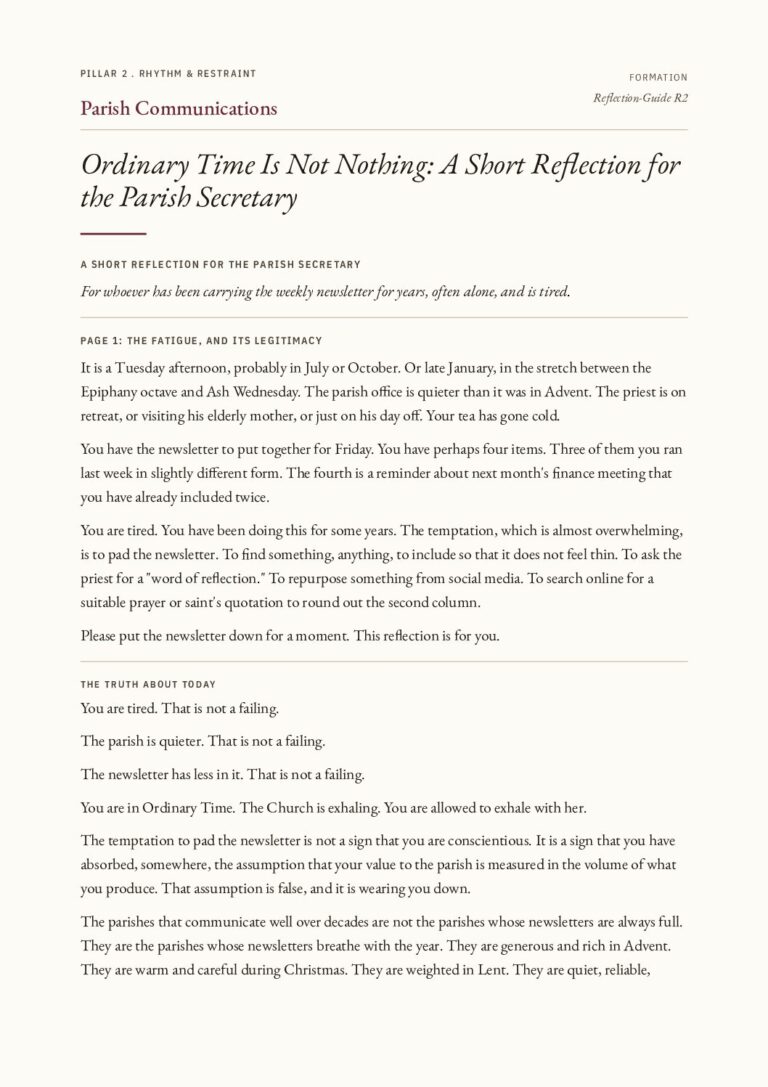
A parish secretary who feels obliged to produce content every week at a constant volume is a parish secretary who has been put in an impossible position. Her own year has seasons. Her parish’s year has seasons. Her readers’ attention has seasons. Insisting on constant output is not serving any of them; it is performing communications rather than doing them.
Restraint is an act of pastoral charity. It says to the reader: your attention is precious to us, and we will not demand it when the moment does not call for it. It says to the parish secretary: you do not have to manufacture content to justify your role. You have to steward the parish’s communications well, which includes knowing when to say nothing.
Restraint is not silence in emergencies. When something matters, the parish communicates, promptly and clearly. But in the long stretch of Ordinary Time, in the quieter weeks of the year, in the seasons when the Church is exhaling, the parish’s communications are allowed to exhale too.
And here is the pastoral piece, said plainly. A parish that has learned to exhale does not panic when the people drift away with the breath. It trusts the rhythm. It knows that Advent is coming, that Lent is coming, that Easter is coming, and that the next deep inhalation will call the people back. It prepares for that inhalation rather than trying to manufacture it in the wrong season. It communicates well when the Church is breathing deeply, and quietly when she is resting.
The parishes that thrive over decades are the parishes that have learned this. They communicate less, on average, than parishes that burn out trying to maintain constant volume. But the less they communicate is of higher quality, arrives at the right moment, and is trusted by readers who have learned to listen for it.
Horizontal differentiation: the five kinds of content
Inside a parish, content falls into at least five kinds, each with its own rhythm and its own breath. A parish that treats them as a single undifferentiated stream loses the rhythm; a parish that gives each one its own rhythm gains clarity.
Spiritual content: homilies, reflections, the rhythm of the liturgical year itself, saints’ days, Scripture commentary. This is the deepest register, and it belongs most heavily to the inhalations.
Pastoral content: bereavement, baptism preparation, marriage preparation, RCIA, anointing of the sick, prayer requests. This is tender content, usually individual rather than general, and often best handled through personal contact rather than broadcast.
Operational content: Mass times, confession times, hall bookings, parking, building notices. The parish cannot function without this, and its readers need it reliably, but it does not need inspirational treatment. Clarity is the pastoral virtue here.
Community content: SVP, social committee, youth, music, outreach, parish trips. This is where most Communications Champions live in the sense we discussed in Pillar 1. It rises from the ministries and is curated by the parish.
Financial content: second collections, appeals, annual accounts, major capital projects. A parish that communicates honestly about money is a parish that has understood that stewardship is pastoral work.
Each of these five kinds has its own cadence. Operational content is weekly. Financial content is monthly or quarterly, with annual set-pieces. Spiritual content rises with the seasons. Community content rises when ministries have something to share. Pastoral content moves at the pace of human lives, which is not a cadence you can schedule.
The practical move: stop thinking about the parish bulletin as a single undifferentiated list. Think about it as five named sections, each with its own editor, its own rhythm, and its own breath. Some weeks some sections will be quiet, and that is correct. Some weeks some sections will be dense, and that is correct too.
How this plays out elsewhere, briefly
As with Pillar 1, this pattern plays out differently in different parts of the global Church, and the principle travels better than the specific casting.
In many Latin American parishes, horizontal differentiation is already present in the form of comunidades eclesiales de base. Each small Christian community has its own rhythm, its own leadership, its own content. The challenge at parish level is coordinating across dozens of these without flattening them.
In much of sub-Saharan Africa, vertical flow is everything. A parish with multiple outstations served by a visiting priest must pass content between levels efficiently or the outstations drift. The rhythm of breath still holds; the channels are WhatsApp and catechist-led gatherings rather than printed bulletins.
In North American parishes with professionalised communications staff, the risk is hyperventilation. A paid Director of Communications with a program to fill often over-produces, particularly in Ordinary Time. The discipline of restraint is harder to hold when the comms budget is being justified quarterly.
In English parishes, the common failure is flat volume across all seasons. Part-time parish secretaries trying to meet a weekly deadline rarely have the bandwidth to plan by liturgical season, and the year becomes an endless series of similar weeks.
The liturgical year, though, is universal. It is the one thing a parish in Manila, a parish in Montreal, a parish in Monrovia, and a parish in Milton Keynes all share. Which means the principle of communications that breathe with the liturgical year is available to every Catholic parish on earth, regardless of resources.
What to do this week
Three things. Genuinely only three.
One. Map the year on one page. Print the liturgical calendar, or draw one by hand. Mark Advent, Christmas, Ordinary Time after Christmas, Lent, Holy Week, Easter, Eastertide, Pentecost, Ordinary Time, Christ the King. Note where you are right now. This is not a filing exercise; it is an act of attention. Pin it above the desk of whoever curates your parish’s communications.
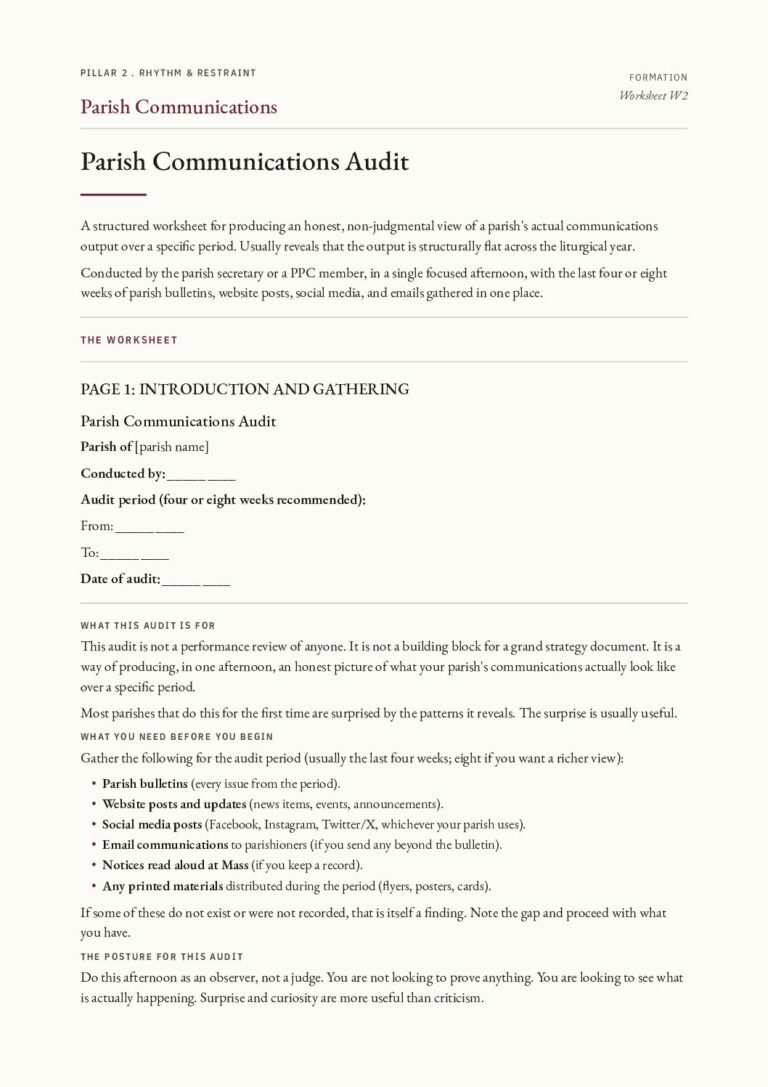
Two. Audit last month. Take the last four weeks of parish bulletins, website posts, and announcements. Count the items. Note which of the five content kinds each one belongs to. Note the liturgical week each one fell in. Then ask, honestly: were we inhaling or exhaling during those weeks, and did our communications know?
Three. Pick one thing to stop communicating. Just one. Something that has become habit rather than need. Something that goes in the bulletin every week because it always has, not because it still serves readers. Remove it. See who notices. Most of the time, nobody will, and you will have recovered a small space for something that matters more.
That is all. No software. No system change. You have begun to breathe with the Church, and the rest of the work flows from there.
The theology underneath, said once and plainly
Breath is not a metaphor the Church invented for communications strategy. Breath is older than that. Deeper than that.
In Hebrew, ruach means both breath and Spirit. The Spirit of God hovers over the waters at the beginning of Genesis. God breathes into the clay and the man becomes a living soul. The prophet Ezekiel stands in the valley of dry bones and calls on the breath, and the breath comes, and the bones live. In Greek, pneuma carries the same double sense: breath and Spirit. When the risen Christ appears to the apostles in the upper room on Easter evening, he breathes on them and says Receive the Holy Spirit. At Pentecost, the Spirit comes as a rushing mighty wind, which is to say, as breath on a scale the Church has never seen.
The Church’s liturgical year is not a clever metaphor pasted onto the calendar. It is the Church’s participation in the rhythm of the Spirit, lived out in time, over the course of twelve months, year after year, century after century. The breath is real. It is how the Church has always lived.
A parish that learns to communicate with this breath is not practicing good content strategy. It is participating, in a small and local way, in the Church’s own rhythm, at the service of her mission. The parish secretary who plans her year by liturgical season is engaged in something older and deeper than administration. She is breathing with the Church.
This is the theology underneath. It is also the pastoral reality. The parishes that get this right, even accidentally, are the parishes where people stay. Not because the communications are slick. Because the rhythm feels right. The reader opens the parish bulletin in the second week of Advent and senses, without being able to name it, that the parish is inhaling with her. That the parish is present at the deep breaths and quiet at the exhales. That she is being loved with the rhythm of the year rather than shouted at with constant noise.
That is what we are building. Tools, eventually, to make this easier. But the tools are downstream of the breath.
Closing
The parish secretary who has been producing fourteen items a week, every week, for six years, now has permission to exhale. She can plan her year by liturgical season. She can let Ordinary Time be ordinary. She can trust that the next Advent is coming.
The priest who has been approving bulletins on Saturday night now has language for why the second week of Advent is not a time for fourteen items. The breath is deeper. The content should be, too.
The volunteer who wants to add a fifteenth item in the middle of Ordinary Time can be gently told that the parish is exhaling, and that her good news will land more clearly at the next inhalation, and that waiting is a gift, not a rejection.
The parish is breathing. It always has been. Our work is to notice, and to breathe with her.
Salve, Regina, Mater misericordiae. Salve.
Sean Brannon is the founder of True Light Digital, a Christian communications agency with a particular focus on Catholic parishes, deaneries, and dioceses. If your parish is working through these questions, we’d love to hear from you: sean@truelight.digital.
This essay is part of our Pillar 2 series on Rhythm & Restraint. The accompanying Liturgical comms calendar template and Parish communications audit worksheet are available as free downloads.