A scene you’ll recognize
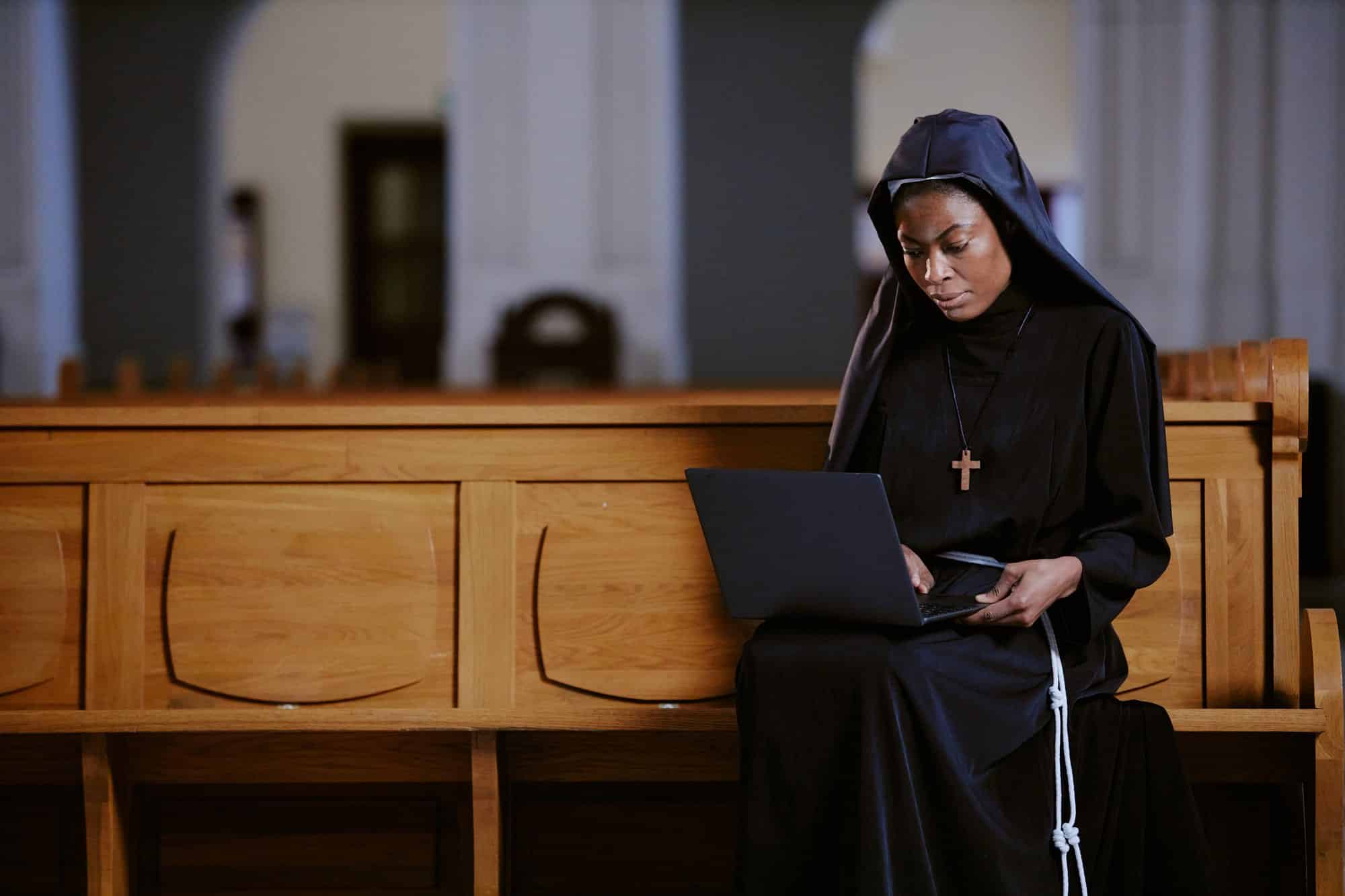
Somewhere in England this Wednesday morning, a woman is sitting at a kitchen table she’s been using as an office for six years. She has thirty minutes before the school run. In front of her is a Word document titled Newsletter_Draft_v4_FINAL_USE_THIS_ONE.docx, a printout of Mass times she’s about to get wrong in at least one place, an email from a parishioner asking whether the SVP collection is this Sunday or next, and a half-drunk cup of tea.
She has not been asked to do any of this. She volunteered, once, about four years ago, after Father mentioned at the back of church that it would be nice if someone could “just look at the website.” She has a full-time job. She has children. She does this because nobody else was doing it, because she loves her parish, and because she is the kind of person who sees something that needs doing and quietly does it.
If your parish website is where this goes wrong, we build ones the office can actually run. Catholic parish websites
She is also, although nobody has ever used this phrase to her, a Communications Champion.
And when she retires from the role next year, which she will, because she is exhausted, because her own mother is now ill, and because she has carried this for too long, the parish will lose six years of institutional knowledge in a single afternoon. Passwords. Relationships with suppliers. An informal editorial voice that has quietly shaped how the parish sounds to the world. A connection to half a dozen ministry leaders who trusted her.
The parish website will not go down. It will just slowly, invisibly, stop being alive.
This essay is about why that keeps happening, and why the way most people think about fixing it is wrong.
The mistake nearly everyone makes
When a parish finally decides to “do something about communications,” the reflex is to look for a single person to put in charge. A volunteer to adopt the website. A parish secretary whose remit quietly expands. A nephew who does “computer things.” Somebody, anybody, who can be pointed at the problem.
This is the mistake.
It isn’t that the people nominated are bad at the work. They are often remarkable: attentive, generous, faithful, under-thanked. The mistake is structural. A parish is not a business with a marketing department. It is a community of people carrying out the mission of Christ together, and the communication of that mission is not a task to be delegated to one person. It is something that happens through the whole community, or it doesn’t really happen at all.
The person sitting at the kitchen table on Wednesday morning is doing real and important work. But the parish has asked her to do something that no single human being can sustainably do, which is be the communications life of a whole community. She is holding up, alone, a function that is meant to be shared.
So when she retires, or burns out, or moves house, the system collapses. Not because she was weak. Because the design was wrong.
What a Communications Champion actually is
Here is the reframe this whole essay rests on, and it’s a simple one.
A Communications Champion is not a job. It’s a function. And that function belongs to anyone in the parish who has good news to share about what God is doing through the work they’re part of.
Read that again slowly, because nearly everything else follows from it.
The volunteer who has been running the food pantry for twelve years, feeding forty families a month, is a Communications Champion for that ministry. Not because she’s the best writer in the parish, but because the good news she has to share is hers to share. Nobody else was there. Nobody else saw the faces. Nobody else can tell it with the weight it deserves.
The youth minister who ran the confirmation retreat last weekend and watched eleven teenagers encounter something real is a Communications Champion for youth ministry. The news of what happened in that church hall is hers to share first.
The choir director, two weeks before Advent, who wants to invite new singers into the community: Communications Champion.
The bereavement group lead who wants grieving parishioners to know that there is a place for them, quietly, on a Thursday evening, with tea and other people who understand: Communications Champion.
The parish secretary editing and curating it all, protecting the parish’s voice, saying “not this week, next week,” gently rewording a submission so it matches the parish’s tone: also a Communications Champion, in a very specific editorial role we’ll come to.
And the volunteer who comes in on Wednesday mornings for thirty minutes to format the newsletter. Yes. Her too.
This is not a clever content framing. The Catholic Church has always taught that every baptized person shares in the mission of Christ, and that this share is not delegated to the laity by the clergy but belongs to them directly by virtue of baptism. Vatican II made this explicit, particularly in Apostolicam Actuositatem, the Decree on the Apostolate of the Laity. The youth minister doesn’t need a special permission to talk about her ministry to her own parish. She has, like every baptized member of the parish, a real share in its mission, exercised in coordination with her parish priest who carries the responsibility for the parish as a whole.
Most parishes are trying to run communications on a model that doesn’t reflect what the Church actually believes about the laity. The fix isn’t to invent something new. It’s to notice what is already true.
Three flavours of champion
Once you see Communications Champion as a function rather than a person, something useful happens. You start to notice that the function shows up in at least three distinct flavours, and the people who are good at one are often not the people who should be doing the others.
Originators are the people doing the ministry. They are the source of the good news. The SVP lead, the youth minister, the charity coordinator, the RCIA catechist, the food pantry volunteer, the parish finance chair writing a one-paragraph update on what the bazaar raised for the parish roof. Without originators, there is nothing to communicate. The parish is silent not because the website is broken but because no one has said anything worth saying.
Originators don’t need to be brilliant writers. They need to be willing to send two or three paragraphs and a photograph to somebody trusted, once in a while, when something real has happened.
Curators are the editorial layer. They protect coherence, tone, timing, and truth. They decide what goes where, what gets bumped to next week, what needs a gentle rewording, what probably shouldn’t be published at all. This is where the parish secretary almost always sits, and where, for reasons we’ll come to, she has often been quietly doing three jobs and only been thanked for one.
Curators are the conscience of the parish’s public voice, working under the parish priest who carries final responsibility for what goes out in the parish’s name. They are also the function most at risk of being accidentally made into a bottleneck if the originator layer is thin.
Producers are the people who actually post, format, schedule, upload, and press publish. Sometimes the curator and the producer are the same person. Often they shouldn’t be. Producing is a teachable technical function. Curating is a judgment role that takes years to grow into. If you can separate them, even lightly, the curator’s life gets a great deal easier.
Most parishes, when they first look at this model, realize they already have plenty of originators (they just haven’t named them), a reasonably good curator (usually the parish secretary, usually overstretched), and no producer at all (the curator is doing both jobs). The fix is almost never to find a single brilliant new hire. It’s to name the originators who already exist, protect the curator, and find or train a producer so the curator can go back to curating.
The English parish context, honestly named
I want to name that I’m writing this from England, because the furniture of a parish here is not the furniture of a parish everywhere, and pretending otherwise produces writing that sounds true but isn’t useful.
In England, the typical parish has a priest, often one of several parishes he serves, sometimes covering three to seven churches across a deanery, often tired in ways he won’t say out loud.
A parish secretary. Frequently part-time, sometimes technically a volunteer, sometimes paid a modest stipend, often doing far more than her job description suggests.
A Parish Pastoral Council, consultative, varying wildly in how active it is from parish to parish.
A Finance Committee, which by canon law every parish must have, and which usually functions.
A safe environment officer, which, post the last twenty-five years of what the Church has had to reckon with, is a serious and non-negotiable role.
A scattering of ministries: SVP, youth, music, catechists, bereavement, social committee, outreach, charity fundraising, sometimes RCIA, sometimes a men’s group or a mothers’ group or a prayer group, almost always a few people who have been quietly running things for longer than anyone can remember.
In this landscape, the parish secretary has very often been cast as the Communications Champion by default. Not because she was the best fit but because she was already there. She answers the phone, she knows the suppliers, she has the password to the website that the last volunteer set up in 2011 on a hosting account nobody can find the login for. So communications has quietly been bolted onto her role.
And here’s what happens: she becomes, by accident, all three flavours at once. Originator (because she’s the only one typing), curator (because she has the editorial eye and the relationships), and producer (because she’s the one at the keyboard). No one person can sustainably do that, and most parishes are built on the goodwill of women who have been trying to do it anyway for years.
The English reframe is this: the parish secretary is almost always a superb curator, and she is almost never the person who should be originating everything. The goal is not to take communications away from her. The goal is to put a dozen originators around her, and ideally a producer alongside her, so she can do the editorial work she is good at without having to manufacture the content out of thin air.
This is a structural shift, not a technological one. No WordPress plugin fixes it. No migration to a new platform fixes it. You fix it by naming people, forming them, and giving them permission.
The good news is that in a typical English parish, the people already exist. They’re in the pews on Sunday. They’re running the ministries already. They just haven’t been asked.
How this looks elsewhere, briefly
I should say, because one of the gifts of writing for the internet is that people from everywhere read, that this structure plays out differently in different parts of the global Church. The three-flavour model (originator, curator, producer) travels better than the specific English casting.
In many Latin American parishes, the originator layer is already deeply distributed through comunidades eclesiales de base, small Christian communities that carry a meaningful share of parish life. The challenge is often curation and coordination across dozens of these groups, not finding originators.
In much of sub-Saharan Africa, parishes frequently have multiple outstations served by a priest who visits on a rotation. Catechists run weekly liturgies of the Word in his absence. The originator layer is vast. The communications infrastructure is often WhatsApp and word-of-mouth long before it is a website. The three flavours are present but the tools are different.
In North American parishes, particularly larger ones, there is sometimes a paid Director of Communications who is essentially a professional curator-plus-producer. The risk in that model is the opposite of the English one: the originator layer can atrophy because people assume “the comms team will handle it,” and the parish’s voice becomes institutionally smooth but pastorally thin.
The model holds. The casting changes. Which is what you’d expect from a Church that is genuinely catholic, genuinely universal, rather than the projection of any one region’s habits.
Forming and supporting champions
Here’s the practical bit. If you’re a priest, or a PPC chair, or a parish secretary reading this thinking “yes, but how do I actually do any of this on a Tuesday evening with the resources I have?”, this section is for you.
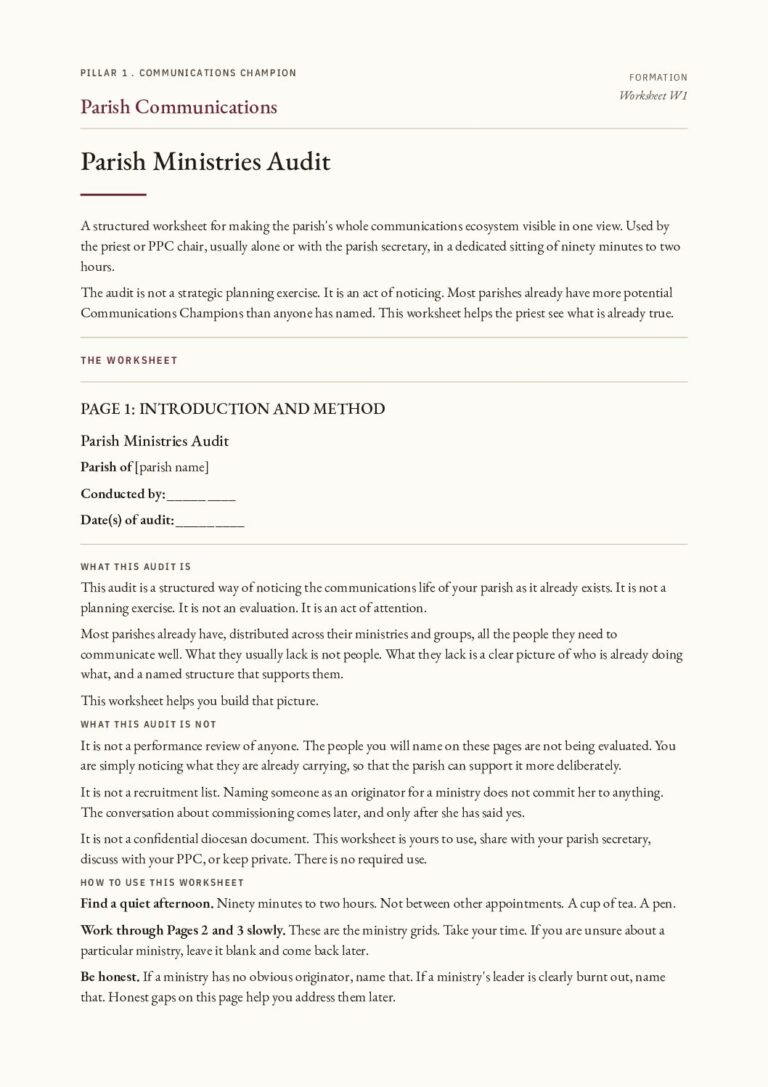
Start with what already exists. Walk through your parish’s ministries and name, for each one, a single person who is already effectively the one who would know if something newsworthy happened. The SVP lead. The youth minister. The catechist. The music director. You don’t need to create these people. You need to notice them.
Have the conversation. Sit down with each of them over tea, not in a meeting, and say something roughly like: “I think the work you’re doing deserves to be seen, and I’d like to ask if you’d be willing, two or three times a year when something worth sharing happens, to write it up. Not a blog post. A few paragraphs in your own words, a photo if you have one, and send it to the parish secretary. She’ll tidy it, decide where it goes and when, and put it out. But the words need to come from you, because nobody else was there.”
You will be astonished how often the answer is “I didn’t realize you wanted to hear about that.”
Protect the curator. Make it explicit, verbally and in writing, that the parish secretary (or whoever holds the curator function) has the authority to edit, bump, reword, or decline submissions. Not as censorship. As editorial stewardship, working under the parish priest who carries final responsibility for what goes out in the parish’s name. Without this clarity, she has to re-negotiate her role every single week with well-meaning people who don’t understand why their bit didn’t go in the bulletin.
Find or train a producer. This is often where True Light Digital gets called in, but it doesn’t have to be external. A tech-curious parishioner, a retired communications professional, a sixth-former looking for a CV project: any of them can be taught to press publish if the curator has already done the editorial work. Separating production from curation is the single most powerful structural change most parishes can make.
Don’t build a committee. I mean this kindly. The instinct in parish life is to form a committee for everything, and committees are where willing people go to have their energy quietly drained. The originators don’t need to meet each other regularly. They need a clear, simple route to get things to the curator, and a reliable sense that their contribution mattered. That’s all.
Protecting the champions you have
Every champion, in every flavour, is at risk of three things: burnout, scope creep, and being taken for granted. Protecting them from these is not a luxury. It is the difference between a parish that still has functioning communications in five years and one that doesn’t.
On burnout: the single most common cause of parish communications collapse is one person carrying too much for too long without anyone noticing. The antidote is both structural and personal. Structurally, distribute the originator layer so no single person is the bottleneck. Personally, pay attention to the people doing the work, and act on what you notice. A parish secretary who feels seen will carry a great deal. A parish secretary who feels taken for granted will, eventually and rightly, stop.
On scope creep: the phrase “can you just…” is the enemy of every communications champion in every parish on earth. Can you just update the hall booking form. Can you just remind everyone about the collection. Can you just post the photos from First Holy Communion. Every individual ask is reasonable. The sum of all the asks is unsustainable. Champions need someone, usually the priest or the PPC chair, who is willing to say, on their behalf, “that’s a lovely idea, let’s add it to the list and she’ll get to it when she can.” Without that air cover, the champion becomes a request-processing machine and the editorial judgment dies.
On being taken for granted: this is where most parishes get the response wrong. The instinct is to fix it with public recognition, a line in the newsletter, a thank-you from the pulpit. For some people that lands well and matters. For a lot of the most reliable parish workers, it doesn’t. They’ve been doing the work precisely because nobody was watching, and a sudden spotlight feels like a small betrayal of what the work was.
The right move is to ask them, and to believe what they say. Some people genuinely appreciate being named publicly. Others want a handwritten note from the priest at Christmas and nothing else. Others want to be left alone to keep doing the work, and the only thanks that means anything to them is a quiet word, in private, that names specifically what they’ve been carrying. The pastoral skill is knowing which is which, and the way you find out is by paying attention to the person.
What every champion needs, regardless of temperament, is for someone with standing in the parish to actually know what they’re doing. The priest should know. The PPC chair should know. There should be at least one person, somewhere, who can say to them with specificity, “I know what you’ve been doing this year, and thank you.” For a lot of people, particularly the help-from-behind ones, that matters far more than anything that happens in public.
On succession: start planning it the day someone takes on the role. This sounds cold. It isn’t. It is an act of love. Every champion will, eventually, step down through illness, age, moving house, a job change, exhaustion, or simply because the season of that particular service has ended. A parish that has documented what the champion does, who she works with, and what the passwords are is a parish that can receive her gift gracefully and let her go gracefully. A parish that hasn’t done this is a parish that, when she leaves, silently punishes her for the fact of leaving by making her feel that everything will now fall apart.
Succession planning is how you honor the champion you have now by not putting her in the position of being irreplaceable.
Why this matters
I’ve tried throughout this essay to keep the deeper reasoning in the bones of the argument rather than on the surface. But it’s worth saying plainly what’s underneath it.
The Catholic Church teaches that by baptism every Christian is incorporated into Christ and shares in the mission of the Church. This isn’t decorative language. It means the work of the Church is not reserved to the clergy, is not a special task for professionals, and is not something laypeople need to be licensed into. The lay apostolate is real, and it’s grounded in baptism itself. Vatican II spent a lot of ink making this explicit, particularly in Apostolicam Actuositatem, but the reality it describes is older than that document.
What I’m proposing in this essay is one application of that teaching to the specific problem of parish communications. The Communications Champion framework, the three flavours, the casting of the parish secretary as curator: these are mine, not the Church’s. I think they’re a sensible way to organize parish life around something the Church has always actually believed about the laity, but I want to be honest that the framework is a working proposal, not a doctrine.
The point that does come from the tradition, and that I think most parishes have quietly drifted away from, is this: the Body of Christ has many parts, and each part is necessary. A parish that concentrates all communications in one overworked person is, whether it realizes it or not, acting as if only one part of the Body had anything to say. A parish that distributes the function across the people already doing the ministry is acting as if the whole Body were alive. The first is exhausting and fragile. The second is closer to what the Church actually is.
We are building tools, eventually, to make the second easier. But the tools are downstream of the structure, and the structure is downstream of how a parish understands itself. The parish that gets that right can do remarkable things with a free WordPress site. The parish that gets it wrong will spend fifty thousand pounds on a system and still not know what to say with it.
What to do this week
If you’ve read this far, you probably want to do something. Here are three things, genuinely only three, that you can do in the next seven days that will change the trajectory of your parish’s communications more than any software purchase will.
One. Name your originators. Walk through your parish’s ministries on a piece of paper. For each one (SVP, youth, music, catechists, bereavement, social, outreach, finance, pastoral council, whatever you have), write down the name of the one person who would know if something worth sharing happened. You are not creating a new role. You are noticing what is already true.
Two. Name your curator. In most English parishes, this is the parish secretary, and she has been doing this job for years without anyone naming it as her job. Name it. Thank her for it. Give her the authority, out loud, to edit, rework, and bump submissions. If she is not the right person, if she has too much else on, name someone else. But make sure somebody holds the editorial function. Not everybody, and not nobody.
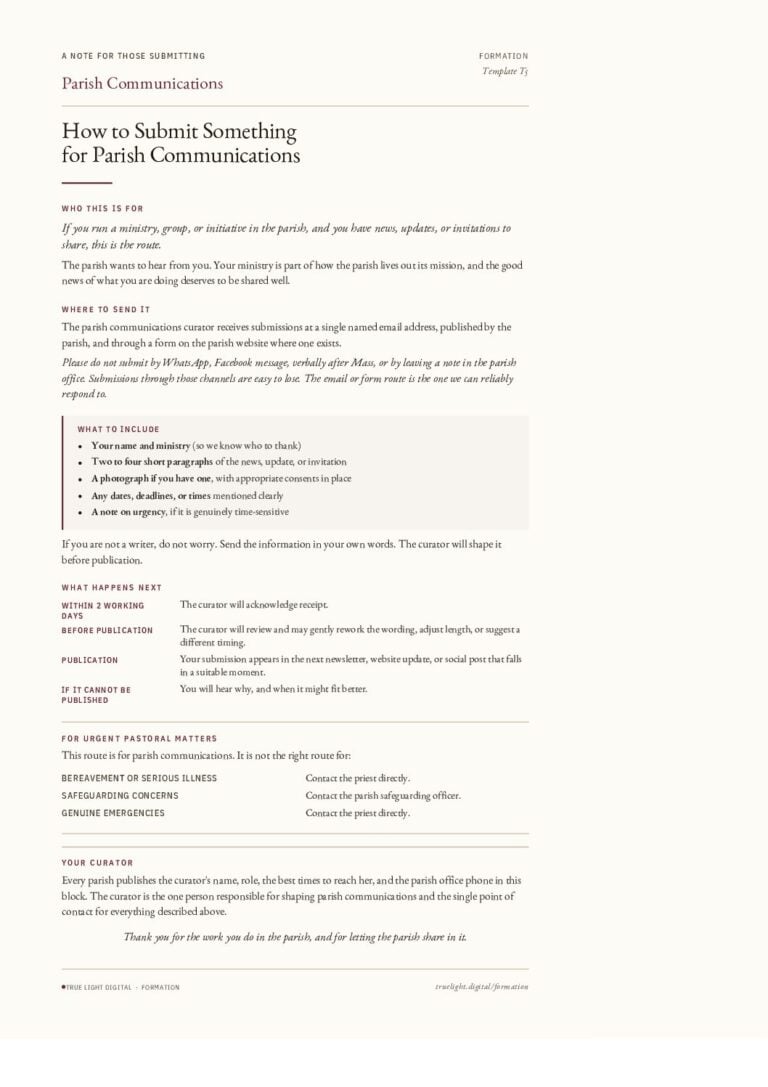
Three. Agree one submission route. Not three. Not “email me or text me or catch me after Mass.” One. A single inbox, a single form, a single expectation. Tell your originators about it. Make it the easiest possible thing for them to feed in their two paragraphs and a photo. Make it the easiest possible thing for the curator to receive.
That is all. You have not bought any software. You have not built any website. You have not migrated anything. You have identified the human function that any future software, website, or migration will either serve or fail to serve.
This is the work. The rest is plumbing.
Where this essay is going next
This is the first of a series, and it’s the foundation of everything we’re doing at True Light Digital. The communications champions are the human layer, and without them nothing else matters. But they are also, precisely because they are human, not enough on their own. They need structures around them: editorial frameworks, submission routes, syndication between diocesan, deanery, and parish levels, safeguards around what the parish can and cannot publish, and yes, eventually, software that gets out of their way and lets them do their work.
Those are the subjects of the next pillars. For now, the starting point is the starting point: the people, named and supported, doing the work they have always been called to do.
May God bless the woman at the kitchen table on Wednesday morning, and all like her, and may we build the things that make her work a little less lonely and a little more shared.
Sean Brannon is the founder of True Light Digital, a Christian communications agency with a particular focus on Catholic parishes, deaneries, and dioceses. If your parish is working through these questions, we’d love to hear from you: sean@truelight.digital.
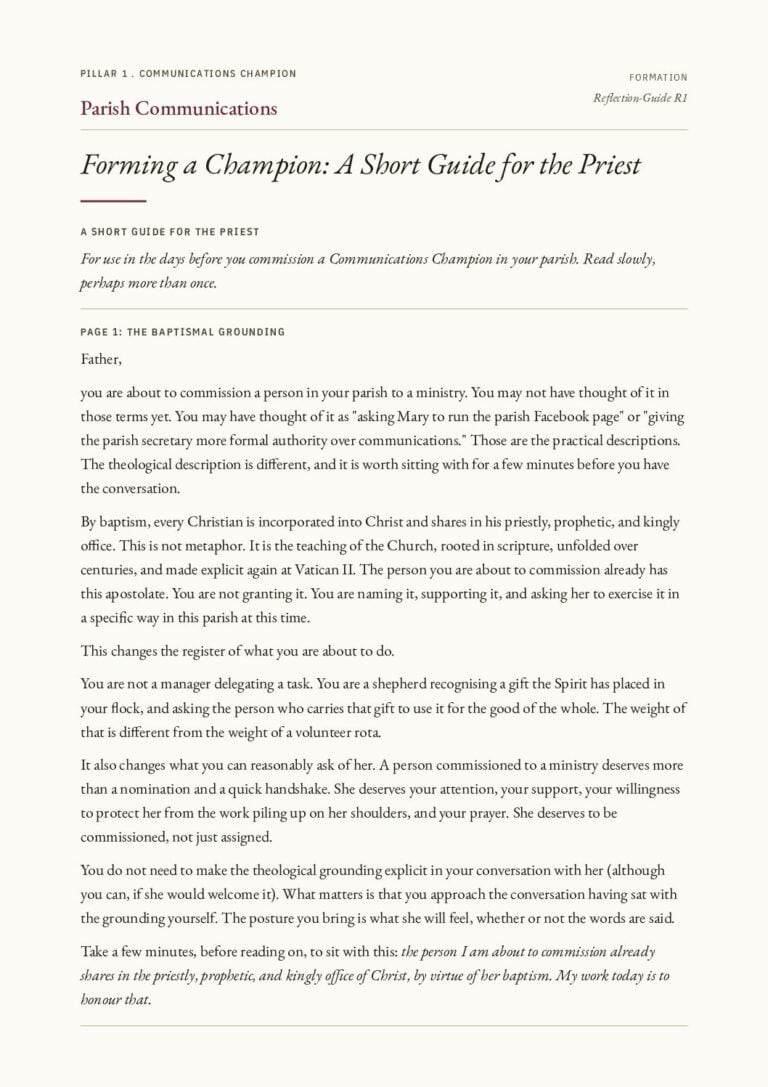
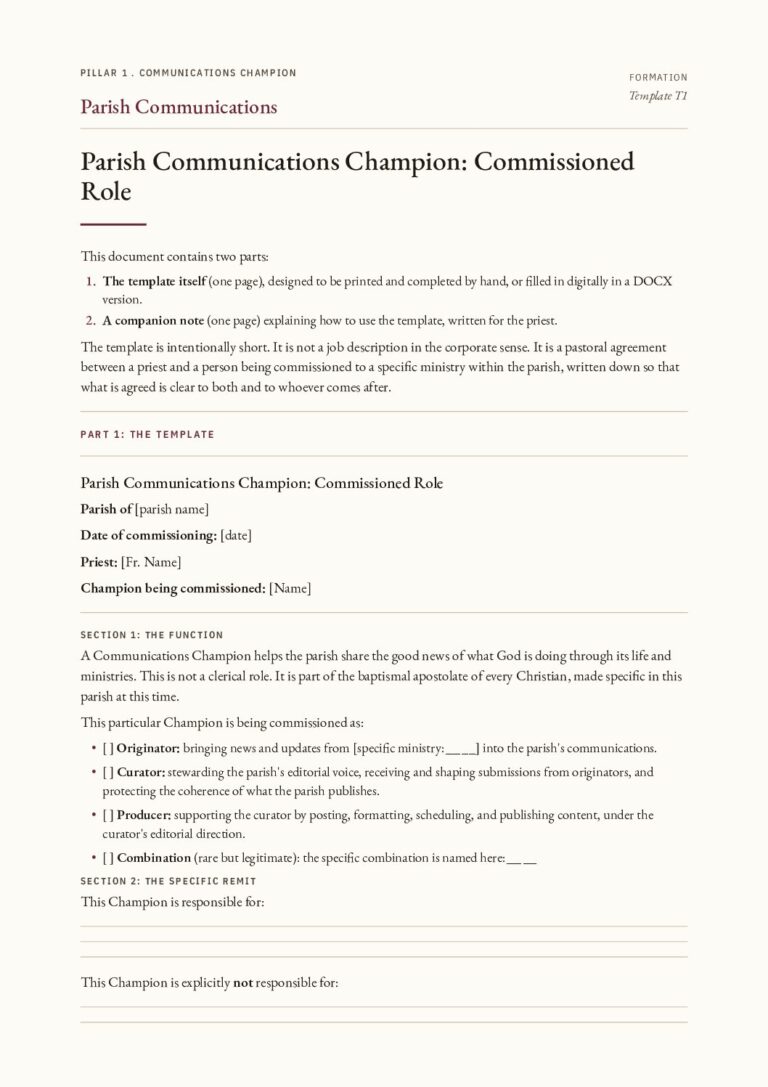
This essay is part of our Pillar 1 series on The Communications Champion. The accompanying Parish Communications Champion role description template and Submission route one-pager are available as free downloads.