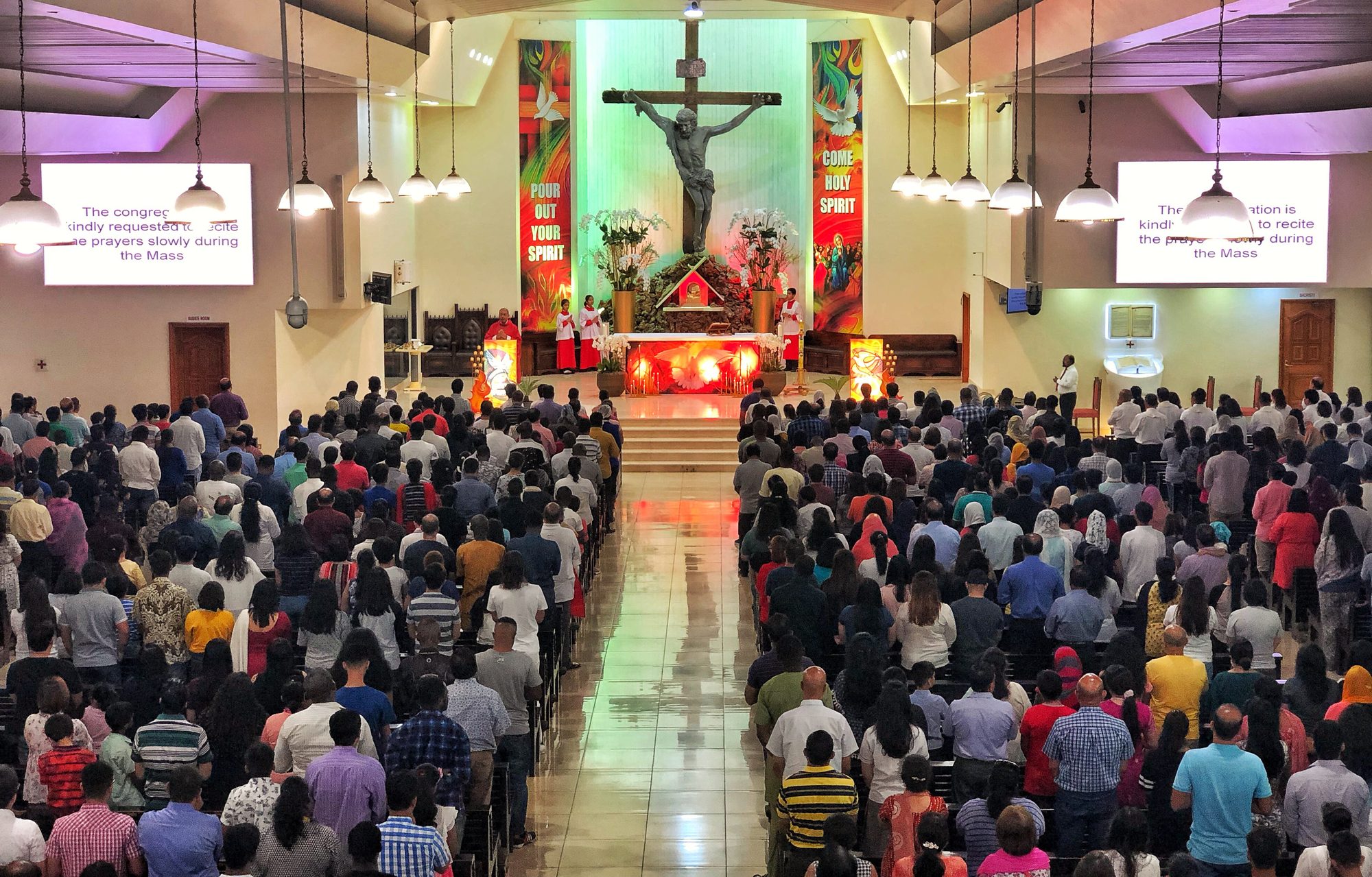
The discipline of speaking on behalf of the Body, and why a parish’s most important communications skill is the pause before speech.
The pause
A parish secretary receives a submission on a Wednesday afternoon. It is a short piece from a well-meaning parishioner, offering prayers and support for a family in the parish who have just suffered a bereavement. The parishioner names the family. She quotes a detail of the death that she heard at the back of church after Mass. She writes warmly, generously, from what is obviously real love for her community. She sends it in hoping it will appear in this Friday’s newsletter.
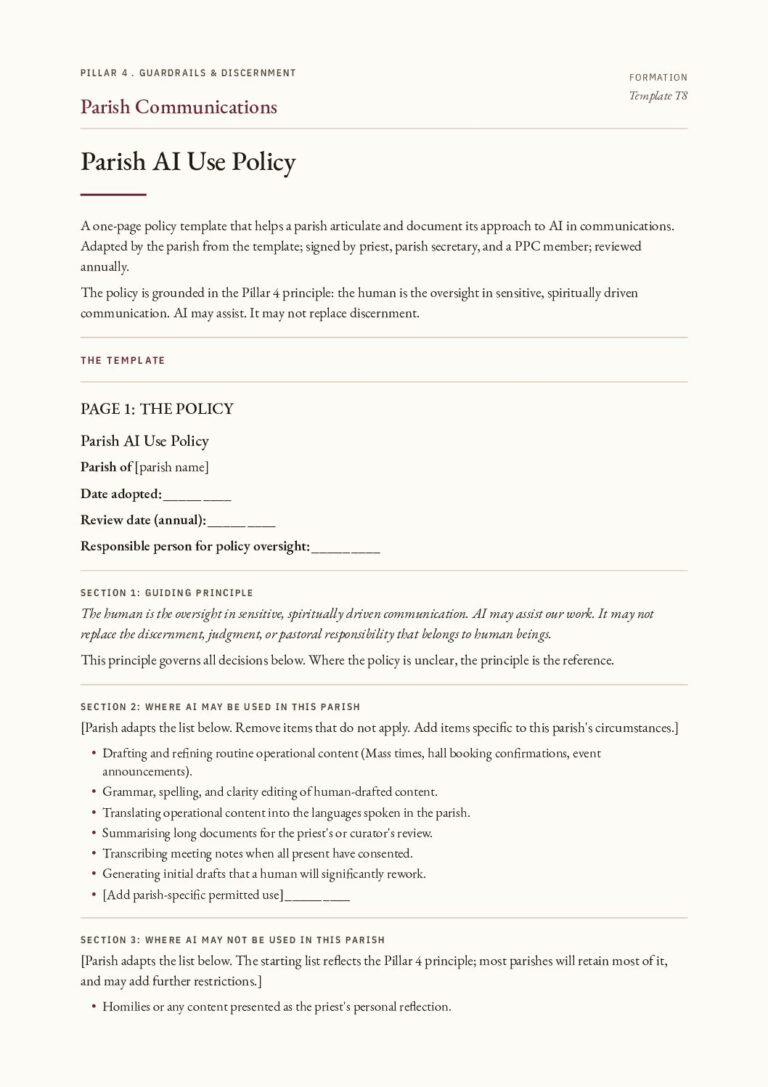
There's a free policy template for this in the library. Parish AI use policy
The parish secretary reads it. She pauses.
The pause is the whole subject of this essay.
She does not publish it. She does not reply immediately. She sits with it. Perhaps she rereads it, slower this time. Perhaps she thinks about the widow, about whether the widow has told her own children yet what the parishioner is about to broadcast to five hundred people. Perhaps she thinks about the detail of the death that the parishioner has included, which she herself had not known, and which the family may or may not have chosen to share publicly. Perhaps she thinks about the parishioner who wrote the piece, whose kindness is real, and about how to honor that kindness while protecting the family from being loved too loudly, too fast, in public.
None of this is bureaucracy. None of this is in a policy document she is consulting. This is discernment, in its older and proper sense, happening in real time, in a parish office on a Wednesday afternoon, in a woman who may never have used the word for what she is doing.
What she does next is the work. She picks up the phone. She calls the family first. Not the priest, not the agency, not the safe environment officer, not yet. The family. She asks if they have seen the submission, or whether they would like to. She asks what they would want the parish to say, if anything, and when. She offers, gently, to hold the piece or to rework it or to let it go entirely, whichever they prefer. The family is relieved. They ask her to hold it until after the funeral, and to soften a particular detail that the widow had not known her mother-in-law had told the parishioner. The parish secretary thanks the parishioner for her kindness, tells her honestly that the family has asked for a different timing, and quietly makes sure a version of the piece, refined and consented to, appears the following week.
Nothing goes wrong. Nothing makes the news. Nothing ends up in a safe environment report. No lawyer is called. The parish has communicated well, which is to say, it has communicated with the right hesitance, from the right posture, toward the right ends. And almost nobody, outside the family and the secretary, knows that any of this happened.
This is the fruit of the discipline this pillar is about. Most of what good parish communications looks like is things that did not happen, because somebody paused.
Speech on behalf of the Body
Before we go further, we need to name what makes parish communication different from other kinds of speech, because the posture we are describing only makes sense if you see the thing clearly.
Personal speech is one thing. You speak for yourself. Your words carry your weight, nobody else’s. If you say something foolish, you pay for it, and only you.
Commercial speech is another. A company speaks to sell, and the conventions of commercial speech assume this. Nobody expects a brand to be honest in the way a friend is honest; nobody expects an ad to sit with a bereavement for three days before responding. Commercial speech has its own ethics, lighter than personal ethics in some ways, heavier in others.
Parish speech is neither of these.
When a parish communicates, it is speaking on behalf of the Body of Christ as that Body is locally present in this particular place. This is not a marketing claim. It is a theological fact, and whether the parish means to invoke it or not, its readers feel it. A parish newsletter is not the same kind of document as a community group’s email list, even if they look similar on the screen. An announcement from the parish priest carries the weight of a thousand years of priestly speech, whether he intended it or not. A post on the parish Facebook page is read by some of the people who read it as if the parish itself is speaking, because to them, it is.
This changes the ethical weight of every act of parish communication. Not catastrophically. Not in a way that should make the parish secretary afraid to press publish. But in a way that should make her, and the priest, and whoever else is speaking on the parish’s behalf, pause before they do.
Speech on behalf of the Body deserves care. That care is what this essay calls hesitance.
Hesitance, properly understood
Hesitance is not fear. It is not second-guessing. It is not the paralysis of someone too worried about getting something wrong to move at all.
Hesitance is the practiced slowness of people who know that words have weight and that the Body they speak for deserves more than speed.
The older English word for this is trepidation, from the Latin trepidare, to tremble. Not the modern trepidation that means anxiety. The older sense: the trembling of someone approaching something sacred. The instinctive slowing of the steps near the altar. The lowered voice in a hospital room. The pause before saying a name in prayer.
A parish secretary who reads a submission and pauses is trembling, in this older sense. She is approaching speech on behalf of the Body, and she knows that the approach deserves care. She is not afraid. She is reverent, in a small and unshowy way, and the reverence expresses itself as hesitance.
Hesitance produces better communication than speed does. It produces better editorial judgment, better pastoral care, better safe environment decisions, better data protection, better use of AI, better handling of copyright, better relationships with the people being written about. Almost everything that distinguishes parish communications done well from parish communications done badly lives in the quality of the hesitance.
It is also, practically speaking, free. It does not require software. It does not require a bigger budget. It does not require more staff. It requires the discipline of building a pause into the publishing workflow, and the willingness to use that pause to think, ask, and sometimes decline.
Most of this essay is about what the hesitance should contain, and where it matters most, and what the fruit of it looks like in specific domains. But it all rests on the pause.
Discernment: the practice the pause serves
Hesitance, on its own, is a posture. What happens inside the hesitance is discernment, and discernment is a specific Catholic skill, older than modern communications by a very long way.
In the Catholic tradition, discernment is not the same thing as making sensible choices. It is a spiritual practice of distinguishing genuine goods from apparent goods, recognizing the movements of the Spirit in a situation, weighing competing obligations, and reaching a decision that honors the whole picture rather than the most obvious part of it.
The Ignatian tradition, shaped by Saint Ignatius of Loyola in the sixteenth century, has developed discernment into something close to a craft. Ignatius taught that many of the choices we face are not between good and evil, which are usually easy to see, but between two real goods that cannot both be fully served. In those situations, the work is not to find the right answer; the work is to weigh the goods honestly, to notice which choice produces consolation and which produces desolation in the person discerning, to sit with the weight long enough to let the truth emerge, and then to act.
Parish communications is full of moments like this. The bereaved family’s privacy and the parishioner’s real pastoral need to express support. The safe environment officer’s protocols and the priest’s pastoral relationship with a particular family. The need to communicate an appeal for the roof fund and the need to protect people from yet another financial ask in a month when three other asks have already been made. The desire to share the joy of a confirmation and the safe environment principle that images of minors require explicit consent. None of these are right-versus-wrong problems. They are good-versus-good problems, and they are what most parish communications decisions actually are.
Discernment is the skill of holding two goods in tension, sitting with the tension without rushing to resolve it, and reaching a decision that honors both as far as they can be honored. The parish secretary in the opening scene is doing exactly this. She is not choosing between good and bad; she is weighing the parishioner’s real kindness against the family’s real need for privacy, and she is landing on an outcome that honors both. The fact that she does this without drama, without committees, without anyone ever naming it as discernment, is a tribute to her formation, not a sign that discernment is trivial.
Most parishes do not talk about discernment when they talk about communications. They talk about content calendars and social media strategy. The absence of the older vocabulary costs them. When a communications decision is treated as a marketing problem rather than a discernment problem, the wrong kind of thinking gets applied, and the wrong kind of thinking produces the small harms that accumulate over years into parishes where trust in the official word has quietly evaporated.
The rest of this essay walks through the major domains where discernment matters most, and what guardrails, rightly understood, do for each of them.
Guardrails as the fruit of discernment
Before the domains, one more piece of the frame.
Guardrails are what you build when discernment has been done. They are the practical, reusable form of a judgment that somebody, somewhere, thought through slowly so that it does not need to be thought through from scratch every time. A safe environment policy is a crystallised form of discernment about how to protect children, developed over decades of hard learning. A data protection policy is a crystallised form of discernment about how to respect the personhood of those whose information a parish holds. An editorial vetting checklist is a crystallised form of discernment about what to publish and what to hold back.
Guardrails and discernment need each other. Guardrails without discernment become bureaucratic rules that nobody internalises, and which produce paradoxically dangerous behavior when edge cases emerge. Discernment without guardrails cannot scale beyond one wise person, and loses everything when that person leaves. The parish that has both, and that treats them as servants of one another, is the parish that can handle the hard cases without breaking.
With that in place, the domains.
Safe Environment: the discipline made law
Safe Environment is the domain where the Church has been forced to build hesitance into law, because we failed, catastrophically, over decades, to exercise it without being required to. That failure is part of the reason any of this has to be written.
I will not rehearse here what the Church has had to reckon with. Anyone reading this essay who is involved in parish work already knows, and anyone who does not know can find the public record in an afternoon. What matters for this pillar is that safe environment policies are not arbitrary rules imposed from outside. They are the form that hesitance has been forced to take by the weight of what happens when hesitance is not practiced. Every safe environment protocol is a monument to a failure of discernment somewhere in the Church’s past. Honoring the protocols is, among other things, an act of honoring the people who were harmed by their absence.
For parish communications specifically, safe environment means several concrete things, and the principles travel across jurisdictions even where the specific rules vary.
Images of children and vulnerable adults. The default is no. Consent is required, in writing, from the parents or guardians in the case of children, and from the person themselves in the case of vulnerable adults. General consent forms filed at the start of the year are not enough for specific images in specific contexts. The safe environment officer’s guidance, in your diocese, is the specific operational rule. But the disposition underneath is: we do not publish images of those who cannot fully consent to their publication, unless care has been taken and consent has been given with full understanding.
Named individuals in sensitive contexts. A child’s name attached to a First Holy Communion photo is one thing. A child’s name attached to a request for prayers because of illness or family crisis is another. The latter requires far more thought, and often the right answer is to communicate the prayer request without naming the child. The same logic applies to vulnerable adults, to families in crisis, to the recently bereaved. Pastoral care sometimes requires naming. Pastoral care also sometimes requires the opposite.
Historical information. A parish’s website, newsletter, and social media accumulate content over years. What was appropriate to publish in 2015 may not be appropriate to leave published in 2026. A safe-environment-aware communications practice includes periodic review of what has accumulated, and the willingness to remove things that were fine at the time but should no longer be searchable.
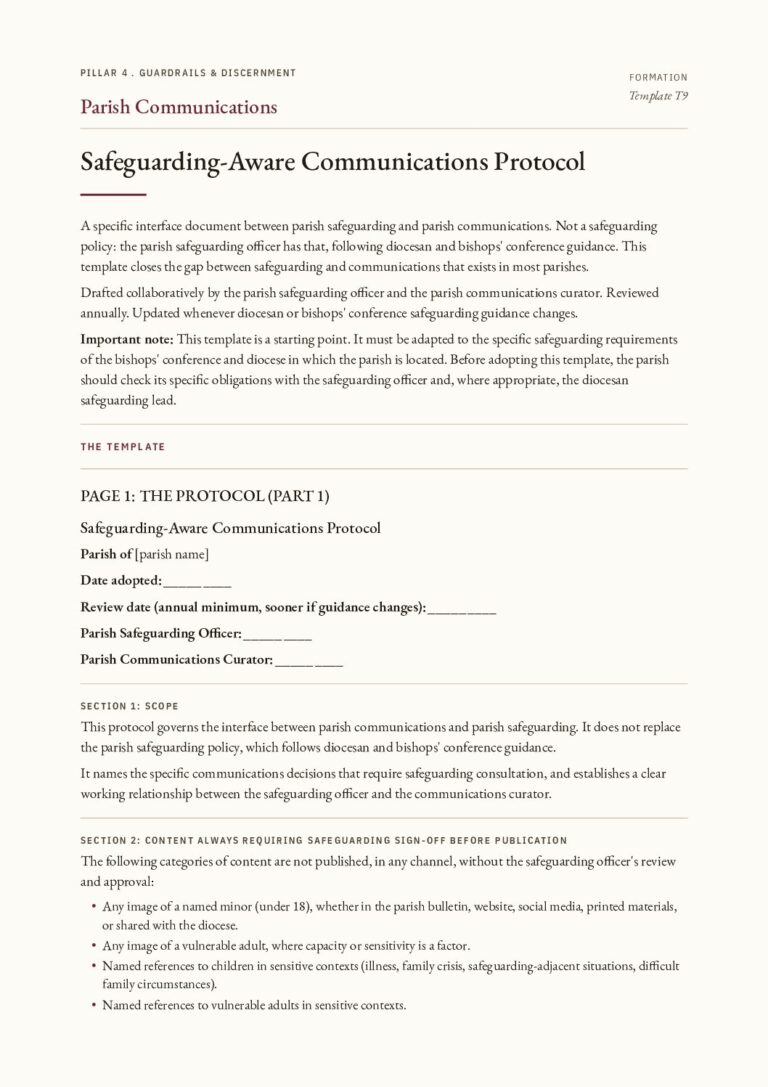
Integration with the safe environment officer. The parish safe environment officer is not a nuisance to be managed around. She is a colleague of the communications work, and the right pattern is for communications decisions involving children, vulnerable adults, or sensitive family situations to be made with her in the loop from the start, not brought to her after the fact. The parish whose communications worker and safe environment officer have a working relationship is the parish that avoids the crises that destroy trust.
The safe environment reporting obligation. This is outside communications but must be named. If anyone involved in parish communications becomes aware, in the course of their work, of information that suggests a safe environment concern, the obligation is to report through the proper channels immediately. No exceptions. No weighing of goods. This is the one area where discernment does not apply, because the Church has learned, painfully, what happens when people try to discern their way around mandatory reporting.
Beyond these specifics, the deeper point. Safe Environment is not one topic among many in parish communications. Safe Environment is the best-developed instance of a disposition that should inform everything the parish publishes about or toward real people. The trembling, reverent care that safe environment policy requires around children is the same trembling, reverent care that should be extended, in appropriate forms, to everyone the parish speaks about.
Data protection: respect for persons as a legal instrument
Data protection law in the United Kingdom, the European Union, parts of the United States, Canada, Australia, and increasingly elsewhere is, in one sense, a legal framework with specific requirements that parishes must follow. Specifics vary by jurisdiction; the operational details belong in your diocesan policy and local data protection guidance, not in a cornerstone essay.
But the deeper point, which every parish needs to internalise regardless of jurisdiction, is this. Data protection law is, at its best, a secular approximation of a theological principle: that persons are not objects, that their information is not the parish’s property, and that respect for them requires careful handling of what is known about them. The law is approximating something the Church has always taught. A parish that treats data protection as a compliance nuisance has missed the theological point, and is probably also not very good at compliance.
In practice, for a parish, this means several things.
Personal data is broader than people realize. Names, email addresses, postal addresses, phone numbers. But also: photographs, sacramental records, prayer request submissions, bereavement notifications, mailing list membership, event registrations, donation history. Anything that identifies a person, or could be combined with other information to identify them, is personal data. Parishes sit on an enormous amount of this, usually in fragmented systems, often without anyone having thought carefully about any of it.
Consent is not a one-time box. It is an ongoing relationship. A person who consented to be on the parish mailing list in 2018 has the right to leave at any time, and the parish has the obligation to make leaving easy. A person who consented to have their photo used in parish communications at a particular event has not consented to have that photo used indefinitely for any purpose. Consent is granular, revocable, and requires respect.
Retention is a discernment question. How long does the parish keep what. Sacramental registers are kept permanently, by canon law. Prayer request submissions, perhaps, for as long as they are being prayed for and no longer. Financial data, for whatever the relevant legal period requires. Old mailing list subscriptions that have been inactive for three years, probably not. The principle: keep what is needed, no longer.
Access is a discernment question. Who in the parish has access to what data, and why. The parish secretary may legitimately need access to most of it. The new volunteer on the youth team probably does not need access to the full membership database. Access follows need, not convenience.
Prayer requests are a specific pastoral matter. Many parishes take prayer request submissions, which often contain sensitive information about illness, family situations, and personal distress. These are not ordinary data. They are offered in confidence, in a posture of vulnerability, and the parish owes them specific care. Prayer request information should not be shared beyond those who are actually praying. It should not be left visible on a shared system where unrelated volunteers might see it. It should not be posted on a public parish website without explicit consent. The instinct should always be toward confidentiality, and consent for anything beyond that should be specific.
The deeper principle, under all of these specifics, is the one the secular law is approximating. Respect for persons as images of God means that what the parish knows about them is held carefully, on their terms, in a posture of service rather than ownership.
AI and the question of voice
This is the domain where discernment is most alive, because the tools are changing faster than the Church’s policies can be written, and because the theological questions are genuinely new in their current form even though the underlying principles are ancient.
Here is the operative principle, and the one I want every parish to hold onto as new tools continue to arrive.
The human is the oversight in sensitive, spiritually driven communication.
AI can assist. AI can draft. AI can accelerate. AI can summarize. AI can translate. AI can transcribe. None of these are problems in themselves, any more than a word processor is a problem, or a photocopier, or a phone. What matters is that the discernment, the judgment, the pastoral weight, and the final decision belong to a human who has thought, prayed, and taken responsibility.
A parish secretary who uses AI to help her draft a bereavement notice, after she has spoken to the family and thought about what they need, is using a tool. A catechist who dictates the substance of a First Communion handout and uses AI to refine the prose is using a tool. A translator who uses AI to render a parish newsletter into the three languages her parish’s families speak is using a tool. None of these are problematic, and pretending they are would set the Church at odds with the practical reality of how people now work.
Homilies are a different category. Pope Leo XIV, speaking to the priests of Rome in February 2026, asked priests to “use our brains more and not artificial intelligence to prepare homilies.” Formation takes that directive seriously. Preparation of homilies is priestly work in a particular sense: it is the fruit of prayer, of time spent with the readings, of the priest’s pastoral knowledge of his own people. AI is not, in this season of the Church’s discernment, a tool to be brought into that pipeline.
The problem is different. The problem is AI used to replace human voice where human voice is pastorally required.
A homily generated by AI at eleven o’clock on a Saturday night, without the priest having thought about the readings, without him having sat with what his people need to hear, is a small fraud on the congregation that comes on Sunday expecting him to have wrestled with the Word for them. A condolence message generated from a template to a bereaved family, without a human having thought about that specific family and what they are carrying, is an insult dressed up as care. A parish “reflection” generated in bulk and pushed out weekly as spiritual content, without a human having discerned what the parish actually needs to hear in this particular season, is a hollowing-out of the very thing parish communications are supposed to be.
The line is not technical. The line is about where the discernment lives. If a human has genuinely discerned, and AI helps her express what she has discerned, the work is human work, assisted by a tool. If a human has skipped the discernment and let AI substitute for it, the work is fraudulent in a specific and serious way: it offers the appearance of pastoral attention where no pastoral attention has actually occurred.
Practical principles for parishes, which will need refining as the tools evolve.
Use AI for work that does not require pastoral presence. Drafting standard notices. Cleaning up grammar. Translating operational content. Summarizing long documents for a busy priest. Transcribing meeting notes. Suggesting reworked phrasings for a communications piece where the writer is stuck.
Do not use AI for work that requires pastoral presence. Homilies. Reflections the priest signs. Responses to bereaved families. Pastoral letters to the parish. Personal correspondence from clergy to individuals. Content presented as the discerned wisdom of a particular human when no particular human has discerned it.
Disclose when it matters. A parish does not need to footnote every use of a spellchecker. It does, arguably, need to be honest if AI is producing the substance of what people believe is human reflection. The principle of honesty argues for disclosure whenever the reader would reasonably feel deceived to learn the truth. Where the line falls will depend on context, but the question to ask is: would the person reading this feel betrayed if they knew how it was produced? If yes, disclose, or do not publish.
Protect sensitive data. AI tools often process information on external servers. Pastoral data, safe-environment-relevant data, confessional-adjacent content, bereavement information, should not be entered into public AI tools without careful consideration of where that data goes and who can see it. The parish’s discretion with personal information does not pause because a new tool is convenient.
The parish needs a written policy. Short. Maybe one page. What AI is used for, what it is not used for, who decides edge cases, how disclosure works. Many parishes do not yet have this. Almost all parishes will need it by the end of the decade. True Light Digital has a template available, and every parish should adapt one to its own context.
Under all of this, the principle holds: the human is the oversight. AI is a tool that can accelerate the human’s work, but it cannot replace the human’s discernment, and the Church’s care for souls requires that the discernment remain human-held.
Copyright, liturgical texts, and the work of others
A shorter section, but a practical one.
Parishes routinely publish material whose rights they do not hold. Hymn lyrics. Images from Google searches. Liturgical texts without the proper ICEL or bishops’ conference permissions. Photographs of artwork from museum websites. AI-generated images of Christ or Mary or specific saints, which raise their own questions. Readings of scripture from translations that have licensing requirements.
The legal situation varies by jurisdiction and is genuinely complex. But the pastoral principle is simple: the parish’s communications work uses the gifts of others, and honoring those others is part of the posture this essay has been arguing for.
The minimum operational requirements for most parishes.
Music. A current license for whatever liturgical music reproduction the parish does: OneLicense, CCLI, ELSM, or the equivalent in your jurisdiction. This covers projection, printing in worship aids, and increasingly streaming. The diocese usually has guidance, and parishes often share licenses at deanery or diocesan level.
Liturgical texts. The official editions of liturgical texts are usually held by the local bishops’ conference, and reproduction requires permission for some uses and is freely allowed for others. Short quotations in newsletters and bulletins are usually fine. Full texts on websites usually require permission. The principle: check before you publish anything more than a short quote.
Scripture. Translations have rights. The Revised Standard Version, the New Revised Standard Version, the Jerusalem Bible, the Christian Community Bible, and others all have specific reproduction rules. Most parishes can quote scripture freely within reasonable limits, but longer passages on websites or in printed materials may require permission.
Images of people. Anything involving recognizable individuals, especially minors, goes back to the safe environment and data protection sections above. Anything involving photographs taken by others requires the photographer’s permission.
Images of art. Museum websites often have specific terms. Wikipedia images are usually free to use under Creative Commons but may have attribution requirements. AI-generated images are a new category with no settled rules.
AI-generated religious imagery. A developing question that the Church will need to address more formally. The specific problem: AI-generated images of Christ, the Virgin, particular saints, or the Eucharist raise questions about appropriate representation that the Church has thought about for centuries through the theology of sacred images. An AI-generated image of the Sacred Heart, produced without human discernment about its fidelity to tradition, is not obviously the same kind of artifact as a commissioned sacred image. Parishes should tread carefully here, and the default should be toward traditional imagery or human-created work until the Church gives clearer guidance.
The underlying principle is the same as the others: the parish’s communications work honors the persons and institutions whose gifts it uses. Honor is expressed through attribution, through permission, through proper licensing, and through the small costs of doing it right rather than the large costs of doing it cheaply.
Editorial vetting: the curator’s daily discernment
We met the curator role in Pillar 1. In this pillar, the focus is on the specific judgment the curator exercises on a Wednesday afternoon, over a submission, with a cup of tea and the weight of everything the previous sections have described.
The curator’s discernment is not a committee process. It is one person, usually the parish secretary or someone holding an equivalent function, reading a submission and making a call. The quality of the call is what determines the quality of the parish’s communications, more than any other single factor.
Practical principles.
The pause is the practice. Build time into the workflow. Submissions should not be published the same day they are received, except in operational emergencies. The pause lets the discernment happen. Parishes that require same-day publication on everything are parishes that have structurally eliminated the space for judgment.
Rework more than you refuse. Most submissions are not wrong; they are just not quite right. The submitter has good intent and a real contribution to make. The curator’s first instinct should be to rework, not reject. A gentle rewording, a softened line, a reordered paragraph, often produces exactly what the submitter wanted, with the editorial care the parish needed. The submitter rarely objects; they usually feel their piece was improved.
When you refuse, honor the submitter. Sometimes a piece cannot be published. The tone is wrong. The content is inappropriate. The timing is off. The family implicated has not been consulted. When the curator declines to publish, she owes the submitter a specific, respectful explanation. Not a form letter. Not a “policy says.” A direct, pastoral conversation, in person or by phone where possible. The submitter may not agree, but she will feel seen, and she will keep submitting in future.
Ask before publishing about people. Anything written about a named person, or a family, or a group, should be seen by them before it appears. This is not always convenient. It is almost always the right practice. The family named in the bereavement piece. The volunteer being thanked for twenty years of service, who might prefer not to be thanked in public. The parish youth group being described as “struggling with attendance,” which is true and probably ought to be discussed but perhaps not in the bulletin without warning them.
Escalate thoughtfully. The curator does not have to carry every decision alone. Some decisions should go to the priest. Some should involve the safe environment officer. Some should be raised with the parish pastoral council (PPC). Knowing when to escalate is itself a discernment, and the parish that supports its curator in escalating without treating it as a failure is a parish whose curator will make better calls.
Keep a note, in difficult cases. When a decision is made to hold, rework, refuse, or escalate something significant, a brief written note helps. Not a bureaucracy. A sentence or two. What was submitted, what was decided, why. This protects the curator if questions arise later, and it builds institutional memory for her successor.
Good editorial vetting is usually invisible. Nothing goes wrong. The newsletter arrives. The website looks fine. The parishioners read, or do not read, without noticing what they are not seeing. The value of the curator’s work is measured mostly in the absence of harm.
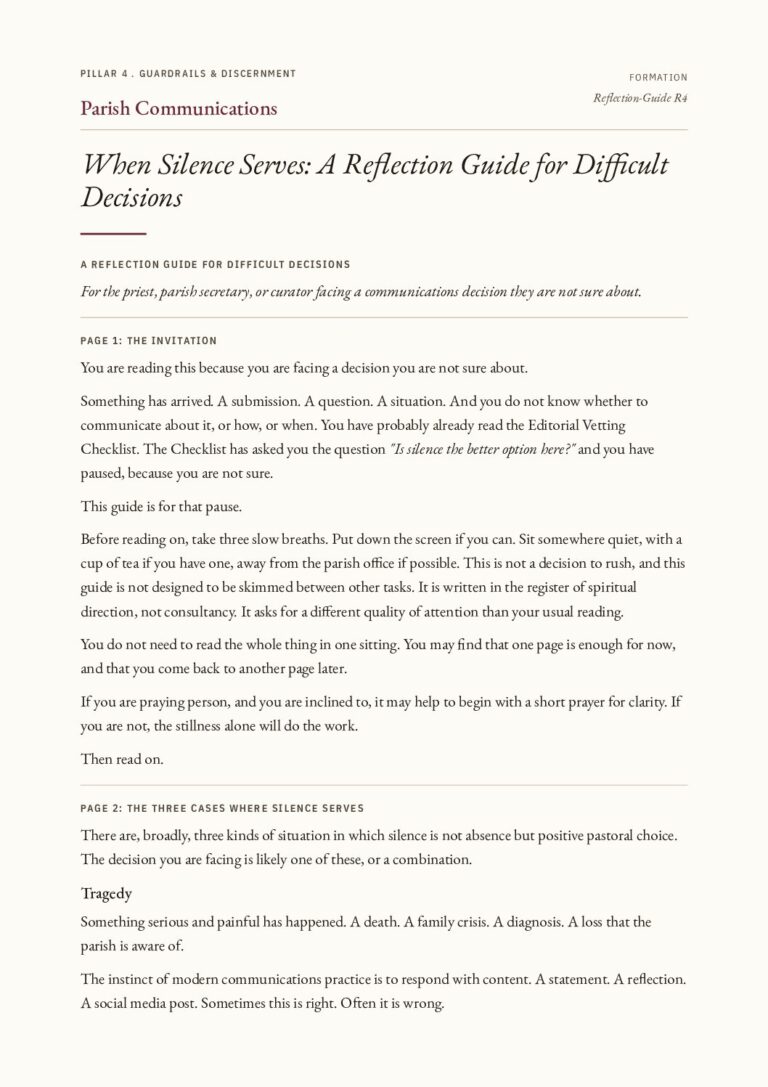
When silence serves the mission
There is a specific discipline in knowing when not to communicate at all, and it deserves its own section because it runs against the grain of almost every impulse in modern communications practice.
Silence is sometimes the right answer. Not silence as avoidance. Silence as a positive act of pastoral charity.
The most obvious case is tragedy. When something serious and painful happens in the parish, the instinct of some communications practitioners is to turn it into content. A statement. A reflection. A social media post. Sometimes this is right. Often it is wrong, and the right response is to remain silent in public while the pastoral work happens in private. The family whose child has died does not need the parish’s Instagram post about grief. They need a priest at the house. They need the parish secretary to hold the funeral arrangements carefully. They need specific, human presence. The public communication, if it ever comes, comes slowly, with the family’s consent, and only if it serves them rather than serves the parish’s need to be seen responding.
The less obvious case is controversy. When something contentious arises in the parish, the instinct is often to communicate a position, to clarify, to get ahead of the story. Sometimes this is right. Often it escalates what would have died on its own. The anonymous complaint, the disgruntled former volunteer’s social media post, the parishioner who has taken issue with a decision of the priest, are often best handled pastorally and privately rather than rebutted publicly. Public rebuttal gives the controversy weight it does not deserve, and drags the parish into a register it should not be speaking in.
The quiet case is fatigue. Sometimes the parish is tired. The readers are tired. The liturgical season is exhaling, as we discussed in Pillar 2. The right communications move is less, not more. A week without a newsletter in the middle of Ordinary Time is not a failure; it is sometimes a gift to everyone involved.
Silence as a positive practice requires confidence, because it looks, to outside observers, like inaction. It requires the parish secretary to say, when asked, “we decided not to communicate about that, and that was the right decision.” It requires the priest to support her in that decision. It requires a parish culture where not-communicating is recognized as a legitimate choice, not a failure of nerve.
The theological ground for this is old. The Church has always known that some things are sacred because they are not spoken. The seal of confession, the most absolute of these, is the boundary beyond which speech cannot go, no matter the cost, because what is said in confession belongs to God alone. Not every parish communication is a confession, but the principle extends: some things are protected by not being communicated, and the parish that understands this protects its people.
When communications becomes the mission
One last warning, because it matters and because the drift is easy.
Parish communications exists to serve the mission. The mission is the Gospel, the sacraments, the pastoral care of real people. Communications is a tool the Church uses, one among many. It is a legitimate tool, and a useful one, and in the right hands it extends the mission into places it otherwise could not reach.
It is also, like all tools, prone to expanding until it replaces the thing it was meant to serve.
The signs of drift are quiet. The parish measures its success by website traffic rather than by the sick visited. The communications team grows while the catechists shrink. The parish priest spends more time approving posts than hearing confessions. The newsletter becomes more important than the funeral. The social media presence gets more energy than the adoration chapel. The parish starts performing community rather than living it, and nobody quite notices when the line was crossed.
This is not a hypothetical. It has happened to parishes that spent heavily on digital transformation and then wondered, five years later, why they felt hollower. The communications ate the mission, quietly, over time, by consuming attention that should have gone elsewhere.
The guard against this is discernment exercised at the institutional level, not just at the piece level. The parish priest, the PPC, the trustees where they exist, are responsible for asking, periodically: is our communications work still serving the mission? Or has it started to become the mission? If the honest answer is that the tools have begun to swallow the thing they were meant to serve, the work is to shrink the tools, not to feed them further.
True Light Digital is a communications agency, and we say this plainly because it is true: the parish that needs less communications, done better, is almost always better off than the parish that needs more communications, done more visibly. Our job, when we serve a parish well, is often to build less and to build less visibly than the parish initially thought it wanted. A digital presence that serves the mission is a digital presence that can be forgotten about for weeks at a time because the rest of the parish’s life is going well.
The theology underneath, said once and plainly
The disposition this essay has described is not a modern communications technique. It is an ancient Christian practice, older than the internet, older than the printing press, older even than the writing of most of the New Testament.
The Mystical Body of Christ, the doctrine that the Church is not merely an institution but the living Body of which Christ is the Head, is the theological ground for all of it. When a parish speaks on behalf of this Body, it is speaking as one part of Christ’s body speaks to others, and the weight of that deserves reverence. The parish’s communications are not brand management. They are a form of participation in Christ’s own voice to his people, however locally, however imperfectly.
The Eighth Commandment, often translated as “Thou shalt not bear false witness,” is commonly read as a prohibition on lying. It is deeper than that. The Catechism, in its treatment of the Eighth Commandment, discusses the duties of truthful communication, the right of every person to their good reputation, the limits on speaking of others’ faults, and the obligation of respect for the truth about persons. This is, in essence, the ethical foundation of everything we have discussed. Safe Environment, data protection, editorial vetting, the discipline of silence: all of them are forms of the Eighth Commandment applied to the specific conditions of modern communications.
Prudence, the first of the four cardinal virtues, is the practical wisdom that allows a person to discern the right action in a specific situation. It is not caution. It is not timidity. It is the skill of knowing, in this case, what is actually called for, and acting accordingly. The parish secretary who pauses before publishing is exercising prudence, whether or not she has ever used the word.
The seal of confession is the deepest marker of the Church’s respect for speech’s power. What is said in confession belongs to God, and nothing, no state power, no pastoral urgency, no clever argument, can break that seal. The existence of this absolute limit teaches the Church something about speech more generally: that some things protect people by not being said, and that the Church has always known it.
The tradition of custodia, the guarding of the eyes, the tongue, the heart, is a spiritual practice older than most of what we have discussed. Custodia linguae, guardianship of the tongue, is specifically the discipline of speech. The parish communications worker is engaged in a modern form of an ancient practice: guarding the speech of the Church, from within the Church, in service of the Church’s mission to souls.
None of this is new. All of it is waiting to be rediscovered, named, and applied by parishes whose communications have lost the older vocabulary without noticing.
What to do this week
Three practical moves.
One. Build a pause into your publishing workflow. If your parish currently publishes submissions the same day they are received, change it. Move to next-day minimum, three-day standard, seven-day for anything involving named individuals. The pause is the whole discipline. Without it, discernment cannot happen.
Two. Have the conversation with your safe environment officer. If your parish’s communications worker and safe environment officer do not already have a working relationship, begin one this week. A coffee, a short meeting, an agreed protocol for how communications decisions involving children or vulnerable adults will flow. You do not need a policy document. You need a relationship.
Three. Write down one thing your parish will not communicate. One thing. Something that has been published before, or is sometimes published, that should not be. Perhaps a category of image. Perhaps a kind of personal detail. Perhaps a naming practice. One specific, named restriction, written down, held by the curator and the priest. That single act of restraint, made explicit, begins the culture of discernment the rest of the work will grow from.
Closing
The parish secretary who paused on a Wednesday afternoon, who picked up the phone to the family before she picked up the publishing tool, who reworked the parishioner’s submission with care and published it a week later, is not being difficult. She is not being slow. She is not imposing bureaucratic friction on the parish’s communications.
She is practicing a spiritual discipline that the Church has known about for two thousand years. The discipline of pausing before speech. The discipline of hesitance in the face of sacred things. The discipline of discernment, exercised quietly, without drama, on behalf of the Body she is speaking for.
Most of her work will never be seen. The pieces she caught before they caused harm. The families she protected by holding content back. The submissions she reworked so the submitter felt honored and the subject was served. The AI-generated draft she chose not to use because the situation called for her own voice. The silence she kept when communication would have been easier but silence was right.
This is the deepest work in parish communications. It is also the least visible. It is rarely rewarded, rarely named, rarely thanked. And it is the work that distinguishes a parish whose communications serve the mission from a parish whose communications have quietly started to consume it.
True Light Digital exists, in large part, to support this work. Not to replace it. To give it the tools, the templates, the policies, and the frameworks that let the human discernment happen reliably, week after week, in parishes whose communications workers are carrying more than they can be expected to carry alone.
The human is the oversight. The pause is the practice. The discernment is the work. The guardrails are the fruit.
And the parish, breathing with the Church, served by tools that know their proper place, held by people whose hesitance is a form of love, is the point of all of it.
Sean Brannon is the founder of True Light Digital, a Christian communications agency with a particular focus on Catholic parishes, deaneries, and dioceses. If your parish is working through these questions, we’d love to hear from you: sean@truelight.digital.
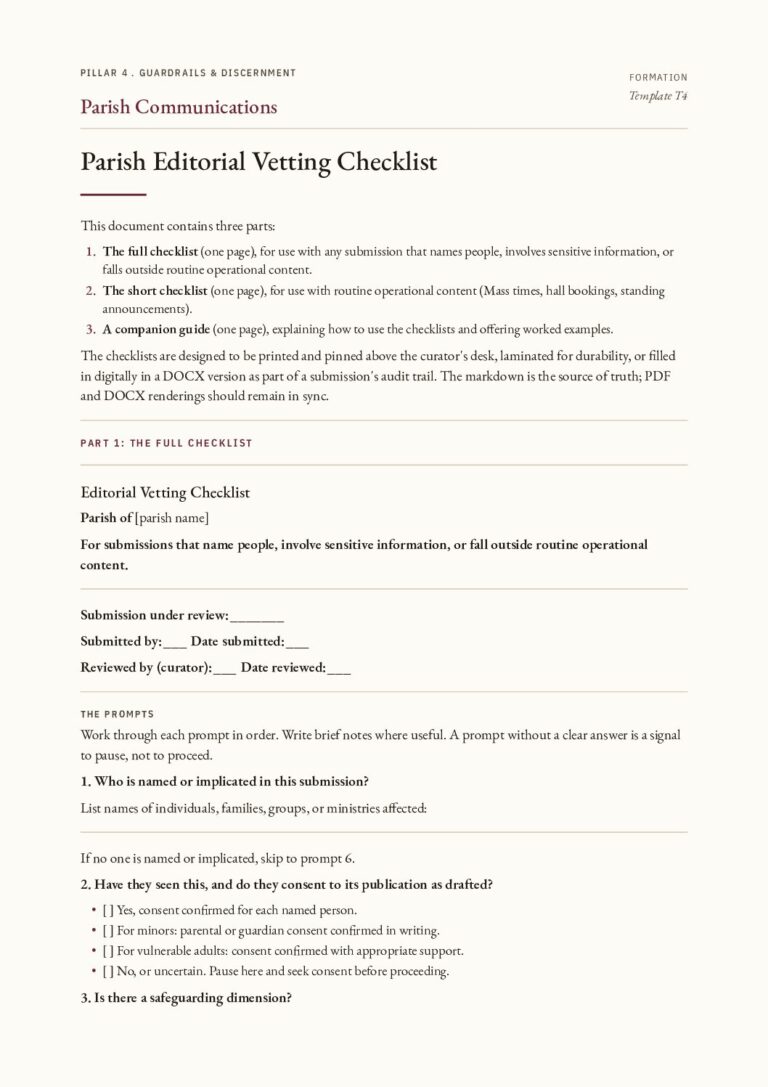
This essay is part of our Pillar 4 series on Guardrails & Discernment. The accompanying Parish editorial vetting checklist, Parish AI use policy template, Safe environment communications protocol template, and “When silence serves” reflection guide are available as free downloads.