How parishes actually change, and how to help without breaking them.
The $5,000 website
A parish spends $5,000 on a new website. A local agency is chosen, the right one, with real WordPress expertise and good intentions. A volunteer is nominated to run it, a capable woman who used to work in marketing before her children were born. Training is booked. A launch date is agreed. At the parish pastoral council (PPC) meeting, Father says some warm things about the exciting new direction for the parish. Everyone claps.
If your parish website is where this goes wrong, we build ones the office can actually run. Catholic parish websites
Six months later, the website has three posts on it. Two of them are from the launch week. The third is the Easter Mass schedule, which is now out of date. The volunteer has moved to another parish because her husband changed jobs. The parish secretary has her Friday mornings back, which she was quietly glad about, and has not said so aloud. Father, when asked, says he thinks it is going well. Nobody can find the password. The $5,000 is gone.
This story is everywhere. I have watched it happen. You have watched it happen. Every parish secretary reading this essay is nodding, because she has watched it happen, too, possibly more than once.
The temptation, when faced with this pattern, is to blame something specific. The agency was wrong. The volunteer was wrong. The training was inadequate. The priest didn’t really back it. The parish secretary was passive-aggressive. If only we had picked a different CMS. If only we had hired someone more senior. If only the volunteer hadn’t moved.
None of these is the real answer. The real answer is that the parish never actually changed. And the parish never actually changed because nobody had ever sat down and thought honestly about what it takes for a parish to change.
This pillar is about that. About the particular, strange, slow, beautiful way that real change happens in a parish, and about how to accompany it without breaking the people you are trying to help.
Why parish change is not corporate change
There is a whole industry of change management literature aimed at organizations. Most of it is useful in corporate contexts. Most of it is poison in parish contexts, and the harder you apply it, the more damage you do.
A parish is not a company. Five things make this true, and each of them matters.
The primary unit is relationship, not process. In a company, a manager can change a process and expect compliance. Employees may not like it, but they will do it, because their paycheque depends on it. In a parish, nobody’s paycheque depends on compliance. The parish secretary might be paid a modest stipend, but the volunteer running the SVP isn’t. The catechist isn’t. The finance chair isn’t. The choir director isn’t. Change in a parish happens through trust or it doesn’t happen at all, and trust does not run on quarterly timelines.
Most of the people doing the work are volunteers. Volunteers who feel judged stop volunteering. Volunteers who feel replaced stop volunteering. Volunteers who feel given more work without being asked stop volunteering. And when a volunteer stops, the parish loses more than productivity. It loses a relationship, a pastoral thread, an institutional memory. The cost of getting parish change wrong is measured in lost parishioners, not lost revenue.
The parish has been here longer than you have. Whatever you want to change has a history. The website nobody likes was built with love by someone five years ago. The Friday newsletter exists because somebody, probably dead now, thought it mattered. The clunky Excel spreadsheet has been maintained for a decade by a woman who has carried the memory of three parish priests. If your first move is to propose replacing any of this without first asking why it exists, you have already lost the room, whether or not the people in the room have the vocabulary to say so.
The stakes are pastoral, not commercial. When a corporate project goes sideways, a business loses money. When a parish project goes sideways, a bereaved family cannot find the number for the funeral coordinator, a recently widowed man gives up on the confusing website and feels more alone, a parish volunteer who was carrying a gift quietly withdraws. These are real harms to real people’s spiritual lives. A change that damages pastoral care to improve operational efficiency has not understood what a parish is for.
The spiritual life of the parish continues throughout. The change is not the main event. The Mass is the main event. The sacraments are the main event. The care of the sick and the dying is the main event. Any change project that asks the parish to prioritize the change over the mission has misunderstood the parish’s own order of loves. The digital transformation is not more important than Sunday, and pretending otherwise is a quiet form of idolatry.
These five facts are not complications to be managed around. They are the actual conditions under which parish change happens. Working with them is the work. Fighting them is how you get the $5,000 website that nobody uses.
A word about American church marketing
I want to be honest about something, because it shapes a lot of the bad advice floating around the Catholic digital space.
A significant amount of what gets pitched to parishes as “digital transformation” or “parish engagement” or “communications strategy” is imported, more or less directly, from American evangelical megachurch marketing playbooks. These playbooks exist because they work, in a specific context, for a specific kind of church that was built on consumer-choice theology and a congregation that shops between churches the way Americans shop between brands.
Catholic parishes are not that. They are territorial by structure, sacramental by nature, and built around a liturgical year that was already old when America was discovered. The playbook does not fit. And when you try to force it on, you get the things that make people flinch. The branding refresh. The engagement metrics. The “growth funnel.” The urgency-manufactured email sequences. The “your donors want to hear from you every week.” The aesthetic of conference Christianity, projected onto a parish whose real aesthetic is the Stations of the Cross and a tea urn in the church hall.
I am not saying the Americans have nothing to teach us. They have built genuinely impressive digital operations, and we should learn from the craft. But the posture is wrong for a Catholic parish. The posture of that playbook is conversion-funnel marketing, and a Catholic parish’s work is the care of souls already entrusted to it. These are not the same task. They do not call for the same tools. They do not call for the same pace. They do not call for the same language.
Parish change done well is closer in spirit to spiritual direction than to marketing campaigns. It moves at the pace of the people, it honors what is already there, and it trusts that the Holy Spirit is doing more work than any of us can see. A change management approach that does not have room for any of that will fail, whatever it costs, however well designed it is.
This is the ground Pillar 3 is written from. Not against the Americans. Against the importation of the wrong register into a parish that was already breathing at a different rhythm.
The posture: invitation and patience
Here is the reframe this pillar rests on.
You do not get buy-in from a parish. You extend an invitation to the parish to consider a change, and you wait. You do not drive adoption. You accompany people into new ways of working at whatever pace they can carry. You do not transform anything. You propose, you listen, you adjust, and you let time do the actual work that time, in a parish, has always done.
Invitation carries a few things that “buy-in” does not.
Invitation is offered, not imposed. The parish can decline it, and your relationship with the parish is not damaged by that decline. You come back in six months and try again if the change still seems right, or you let it go and propose something different, or you conclude that what you wanted to change was actually fine and you were wrong.
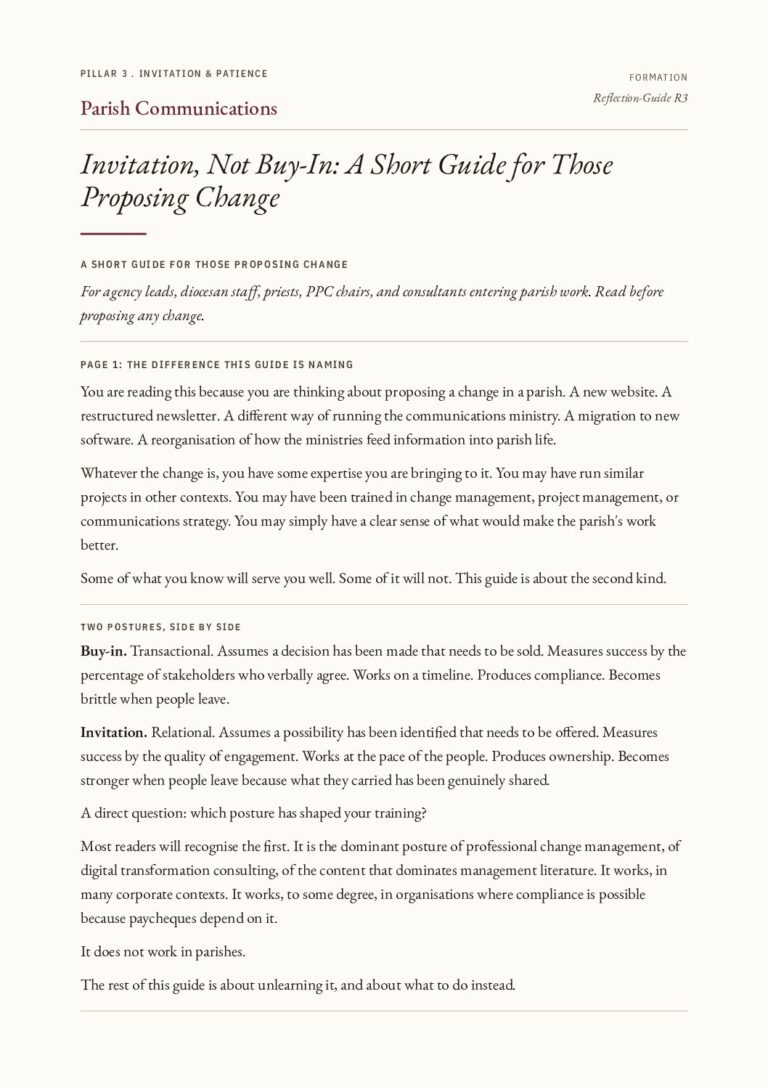
Invitation assumes the other person has agency. The volunteer who has run the parish newsletter for fifteen years is not an obstacle to be managed. She is a person with her own view, her own history, and her own relationship to the work. An invitation asks her opinion. It does not tell her the decision has been made.
Invitation is patient. You do not schedule an invitation for the end of the month with a deadline for a response. You extend it, let it rest, wait for the person to come back to you. This is how people say yes to things that matter. Not because they were pressured, but because they sat with the idea long enough to recognize whether it was right.
Patience carries its own freight. Patience is not passivity. It is not the absence of urgency; it is the willingness to let the right urgency emerge from the people who have to live with the change, rather than manufactured by the person proposing it. Patience is what distinguishes pastoral change from marketing campaigns. Patience is what honors the fact that the Holy Spirit does not usually work to a project plan.
A change conducted in this posture looks different from a change conducted as a transformation. It is slower. It involves more conversations. It costs more in time and less in money, which turns out to be the opposite of what most agencies want to sell. And it works, when the faster version does not.
Honoring what already works
This is the single most important move in parish change, and it is the one most often skipped.
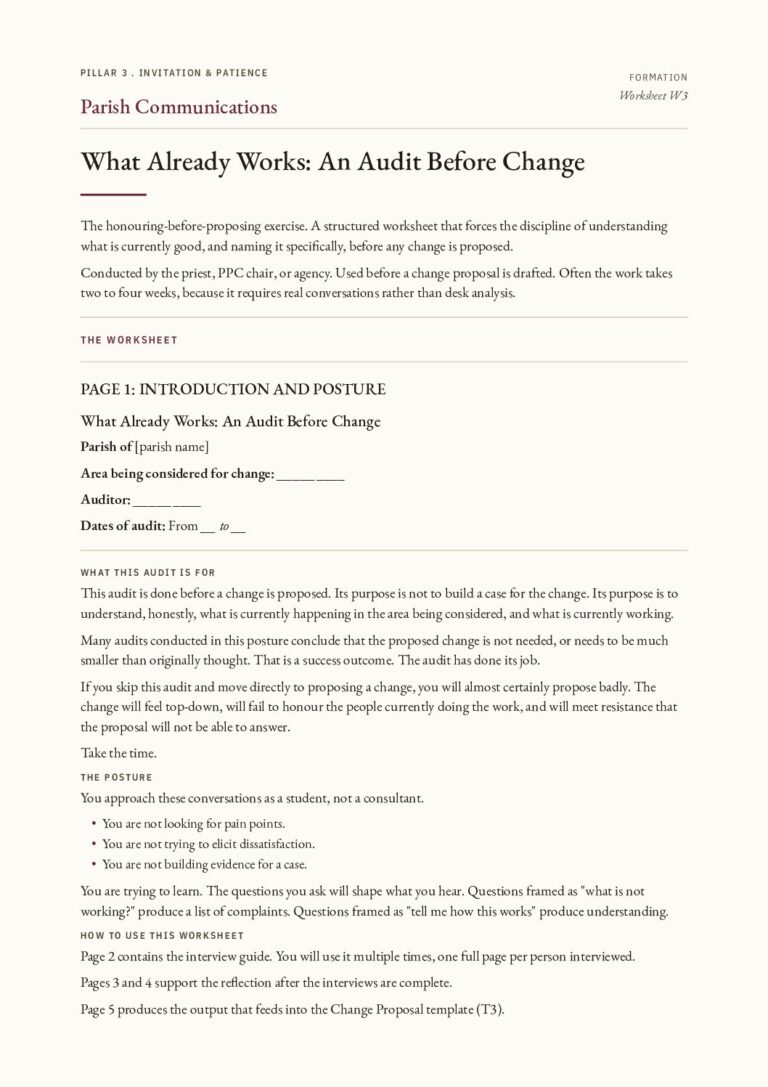
Before you propose replacing anything, you understand and name what is already working. Not performatively. Not as a rhetorical device before you roll out the new system. Actually. The fifteen-year volunteer knows things about the parish that you will never learn from a stakeholder interview. The clunky Excel spreadsheet is solving a problem you have not yet identified. The website nobody likes is still, at this moment, the front door of the parish for several families who found it during a hard week in their lives.
The honoring has to come first. If your first move is not honoring, your second move will not be listened to, even if it is technically correct.
What honoring looks like, in practice.
You ask before you propose. Before suggesting a new system, you sit down with the person currently carrying the work and you ask her what it is like. Not “what are the pain points,” which is consultant vocabulary and immediately puts people on guard. Something more like: “Tell me how this works. What do you find yourself doing every week? What do you wish more people understood about it?” You listen. You take notes, or you just listen carefully and remember. The first conversation is not where you sell anything; it is where you learn.
You name the good. Once you have listened, you say back to the person what you have heard, and you name, specifically, what is good about what she has been doing. This is not flattery. It is an honest observation: this spreadsheet has kept track of three priests’ worth of parish data and still works; that is not a small thing. This newsletter has arrived on Friday mornings for twelve years, through Covid, through two priests, through your own cancer scare, and parishioners look for it. That is not a small thing. When you name the good specifically, the person knows you have seen what she has carried, and a door opens.
You carry what is good into whatever comes next. If you are going to replace the spreadsheet, the new system carries forward the things the spreadsheet was doing well. The volunteer who was running it has a named role in the new system. The institutional memory is preserved, not treated as obsolete. The change becomes an extension of what was already there, not a repudiation of it.
This is not diplomacy. It is truth-telling. The people who have been carrying the work have, in fact, been carrying something valuable, and a parish change process that does not begin with that honoring is a process that has lost the pastoral thread before it has begun.
The long conversation
Real parish change happens through a long conversation, not a project plan. The project plan is a useful internal document for the agency. It should almost never drive the pace of the actual change.
The long conversation has several threads, each moving at its own speed.
There is the priest’s thread. Father has other things to do. His engagement with any change will be in small increments, often at odd hours, usually wedged between a hospital visit and a funeral. You do not ask for his hour-long workshop time. You ask for ten minutes after morning Mass on a Tuesday. You send him short messages. You write things he can read in five minutes. You respect that his main work is not digital transformation; it is the care of souls. If you require him to be a project champion in the corporate sense, you will lose him, because the role does not fit the shape of his life.
There is the parish secretary’s thread. She has been quietly running large parts of this already. Her view is the most practically valuable view in the parish, and she is the person most at risk of being ignored in a change process because she is so rarely in the room when decisions get made. Your job is to put her in the room, explicitly and repeatedly, and to weight her view heavily. She knows what will actually work on a Wednesday morning. The agency does not.
There is the long-serving volunteer’s thread. She may be resistant, and her resistance is usually right about something, even if she cannot always name what. A volunteer who has been doing something for fifteen years has noticed patterns you have not. Her resistance is data. Work with it. Ask what she is worried about, specifically. Address the specific worry. Do not try to overcome her resistance through persuasion; try to understand it, because it is almost always telling you something true about the parish you have not yet seen.
There is the PPC’s thread. Move slowly here. A PPC is a consultative body, and asking it to rubber-stamp a decision that has already been made is both bad practice and bad governance. Bring questions before you bring proposals. Let the PPC shape the direction, not just approve it. A change that the PPC has genuinely shaped is a change the parish has genuinely shaped, and the difference is substantial.
There is the parishioners’ thread, which is the slowest of all. Most parishioners will not know a change is happening until the website looks different or the newsletter arrives in a new format. Their experience of the change is entirely downstream of the decisions the other threads have made. Your obligation to them is to make sure the changes you are rolling out do not break the pastoral services they rely on. The elderly woman who has been finding the funeral Mass times on the website for eleven years needs to be able to find them next week, too. If your change breaks that, you have done her a pastoral harm.
All of these threads run in parallel, at different speeds, with different textures. The long conversation is the patient weaving of them into something that eventually, over months, becomes an agreed change that the parish has actually made, rather than one that has been done to it.
The rule of three seasons
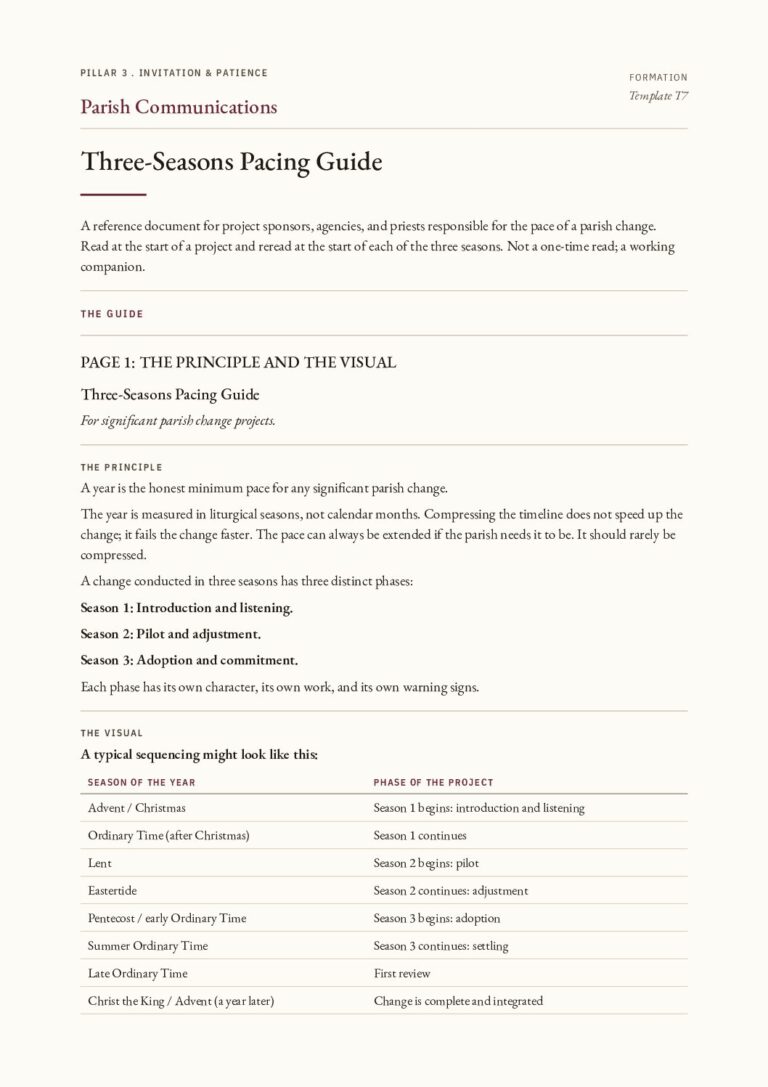
I want to propose a specific pacing principle: that significant change in a parish should span at least three liturgical seasons.
Not three months. Three seasons.
Why seasons and not months? Because seasons are how parishes actually experience time, as Pillar 2 explored at length. The natural unit of parish rhythm is liturgical, not calendar. A change that touches parish life has to accommodate the rhythm of parish life, which means it has to breathe with at least three distinct seasons of the year to be properly tested and settled.
The rough shape.
Season one: introduction and listening. You propose the change. You have the early conversations. You honor what already works. You do not build anything yet. You are listening, adjusting, and letting the idea settle in the parish’s imagination. Do not skip this. Almost every failed parish change project has skipped this. If you introduce a change in Advent, you are still in season one at Christmas, probably most of the way through.
Season two: pilot and adjustment. You build something small. A prototype, a trial, a limited pilot. You give it to a small group, probably the most sympathetic originators from the Pillar 1 model. You learn what is right and what is wrong. You make changes. You keep talking. The pilot is not the launch; it is the listening made visible. A change introduced in Advent is probably piloted somewhere in Lent or Eastertide.
Season three: adoption and commitment. If season two has gone well, you roll the change out to the parish properly. Training, documentation, commissioning of the people who will carry it. This is where most projects think they are starting, and it is actually where a good project is about two-thirds of the way through. If the introduction was at Advent, the full adoption is probably around the following Advent, which is close to a year later.
A year. This is not slow. This is the pace at which parish change actually sticks. Projects that try to compress this into eight weeks are not moving faster; they are failing faster. They just do not know it yet, because the failure takes another six months to become visible.
Agencies and IT departments often resist this because their funding models assume quicker work. Parishes sometimes resist it because a change proposed in March feels urgent, and they want it done by June. In both cases, the honest answer is that the parish’s own rhythms will not be hurried without cost. You can compress the timeline. You cannot compress the time it takes for people to change their relationship with how they do things. That time is what it is.
When to pause or stop
Not every change should happen. Some changes should start and then be paused. Some changes should be abandoned halfway through because the parish has told you, in a dozen small ways, that it is not ready. Part of invitation and patience is the willingness to hear no, including the no that is expressed through inaction rather than words.
The signs that a change should be paused.
The key people have gone quiet. The priest is not responding to your messages. The parish secretary has stopped raising the project in her weekly emails. The long-serving volunteer has become polite but distant. These are not scheduling accidents. They are communication.
The pilot is not being used. You built the prototype, you gave it to the sympathetic group, and six weeks later nothing is happening on it. This is not a usability problem. This is the parish declining the invitation in the gentlest way available to it.
The pastoral load has risen. Something else has happened in the parish. A funeral of someone significant. A safe environment matter. A financial crisis. The parish’s attention is correctly elsewhere. Continuing to push the change forward in that environment is a failure of reading the room.
The original reason for the change has faded. Sometimes, halfway through a project, everybody realizes the problem it was solving was not really the problem. The honest move is to stop, name that, and not be embarrassed about it. A change that is completed despite having lost its reason is a worse outcome than a change that is abandoned with honesty.
Pausing is not failure. In a parish, pausing is often wisdom. The project that should have taken a year and was rushed into four months often needs two years to recover from. The project that paused at month five, was given six months to breathe, and then resumed in its own time often completes well. The difference between the two is whether the person driving the change was willing to slow down when the parish asked them to.
The theology underneath, said once and plainly
The Church has always been patient with herself.
Councils take decades to happen and decades more to be received. Saints are canonised slowly, sometimes centuries after they died. Doctrines develop over hundreds of years, sometimes thousands, and the Church does not panic about the pace. A parish that changes over three seasons is moving, by the Church’s own standards, quite briskly.
The reason for the Church’s patience is theological. The Holy Spirit does not move at project-management speeds. The Spirit works at the pace of persons, at the pace of conversion, at the pace of the slow growth of holiness in ordinary lives. A parish change project conducted with invitation and patience is a project conducted with some humility about who is actually doing the work. It is the Holy Spirit’s parish, not the agency’s, not the priest’s, not the consultant’s. Our job is to offer what we have, to invite, to listen, and to trust that the Spirit will move people at the pace they can be moved.
This is not an argument for never acting. Urgency exists. Some changes genuinely do need to happen soon. A safe environment gap, a broken website that is misleading bereaved families, a system that has become actively unsafe. In those cases, urgency is legitimate, and the rule of three seasons bends to the pastoral reality. But the urgency most change projects claim is manufactured, not real. It comes from budget cycles, or agency timelines, or somebody’s conviction that this change really ought to happen now. The question to ask, when urgency is claimed, is whose urgency it is. If it is not the parish’s urgency, it is not real urgency. It is borrowed from somewhere else, and it will fail against the parish’s actual pace.
A parish that changes slowly, invitationally, patiently, with honoring of what came before, is a parish that is participating in the way the Holy Spirit has always worked in the Church. Our job is to match that pace, not to fight it.
What to do this week
Three practical moves, as in the previous pillars.
One. Identify the tacit knowledge holders. Whatever change you are considering in your parish, there is at least one person, usually a woman who has been quietly doing the work for years, whose tacit knowledge you need before you propose anything. Write down her name. Book a conversation with her. Not a stakeholder interview. A cup of tea. Ask her to tell you how the current thing works, what she likes about it, what she worries would be lost if it changed. Listen more than you talk. You are not selling anything yet. You are learning.
Two. Write down what already works. On a piece of paper, list three specific things the current system, process, website, or workflow does well. Not generically. Specifically. “The current newsletter always arrives on Friday by 10am because Mary sets it up on Thursday evening.” “The current website is mobile-responsive on the Mass times page because Paul insisted on that two years ago.” “The current process for booking the hall works because Barbara keeps the paper diary in the sacristy cupboard and checks it herself.” If you cannot name three specific things that work, you have not listened enough yet. Go back to step one.
Three. Set the minimum pace. Ask yourself honestly: what is the slowest this change is allowed to go? Not the fastest. The slowest. If the answer is “we need this done by the end of the quarter,” then you are operating on someone else’s timeline, not the parish’s, and you should name that before you proceed. If the answer is “it will take however long it takes, and we will be ready to pause if needed,” then you have a chance of doing real change rather than performing transformation.
That is all. No software. No system. You have begun to understand what changing a parish actually requires, which is honoring, listening, and time.
Closing
The fifteen-year volunteer is not an obstacle to your project. She is the parish.
The parish secretary who did not say what she thought in the first meeting is not passive-aggressive. She has watched three previous “transformations” come and go, and she is protecting her energy.
The priest who said warm things at the PPC and then went quiet is not disengaged. He is tired. He has been tired for some time. His silence is not about you. It is about the weight he is already carrying.
The parishioner who does not care about any of this and will never read the website is not the problem. She is the point. She is what the parish is for. Whatever changes you make had better, on the other side, serve her bereavement when her husband dies, and her confirmation preparation when her granddaughter enrols, and the quiet comfort of knowing that her parish has not become a start-up since she last went to Sunday Mass.
Parishes change slowly, by invitation, with patience, and by honoring the people who were already there. They can be helped. They cannot be hurried. The agency, the priest, the consultant, the volunteer, the diocese, all of us are accompanying a change that is really being done by the Holy Spirit, at the Spirit’s pace, through the people who will still be there long after we have moved on.
Our job is to invite. And to wait.
Sean Brannon is the founder of True Light Digital, a Christian communications agency with a particular focus on Catholic parishes, deaneries, and dioceses. If your parish is working through these questions, we’d love to hear from you: sean@truelight.digital.
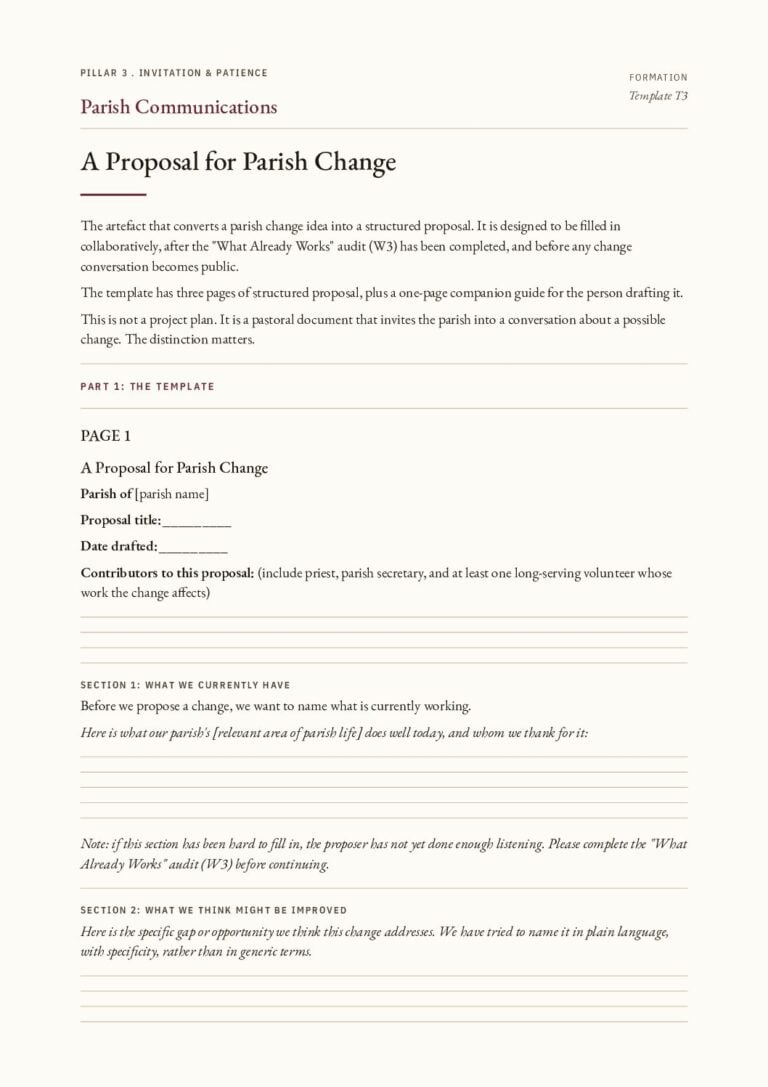
This essay is part of our Pillar 3 series on Invitation & Patience. The accompanying Change proposal template, “What already works” audit worksheet, and Three-seasons pacing guide are available as free downloads.